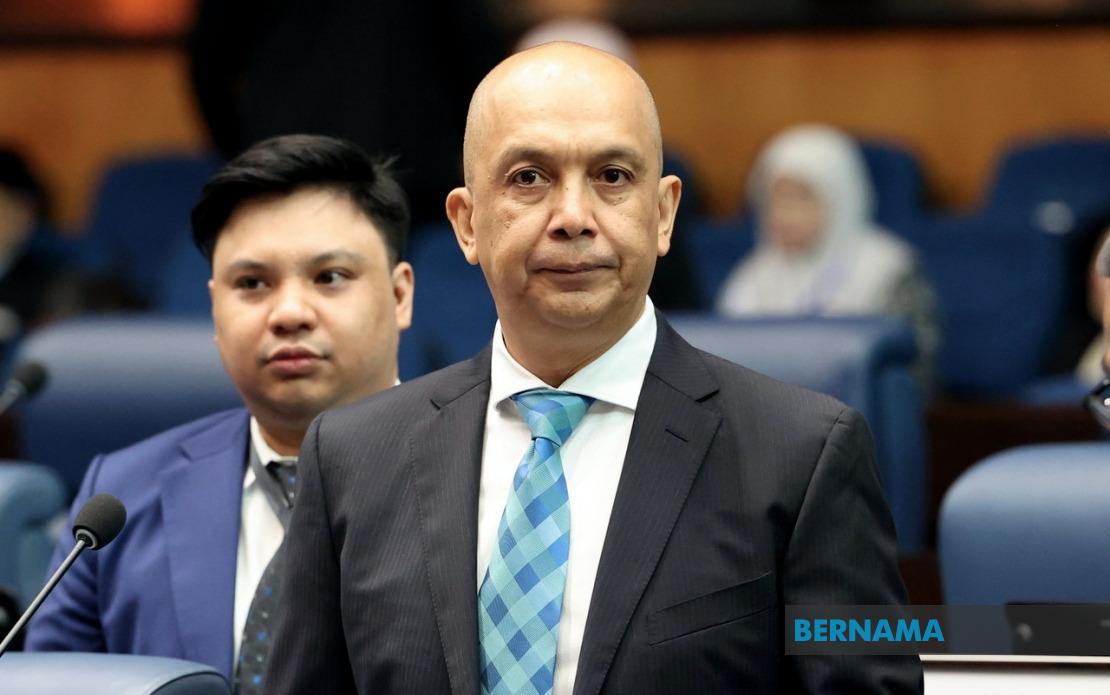
The Sabah state government received RM600 million from the Federal Government's RM1.5 billion interim Special Grant in mid-June and is now pressing for the outstanding RM900 million to be released within the current calendar year. The payment represents a partial settlement following Prime Minister Datuk Seri Anwar Ibrahim's announcement of an increased interim allocation during celebrations of Kaamatan Festival in late May, marking a significant step in addressing the state's long-standing fiscal disputes with Kuala Lumpur.
Sabah Assistant Finance Minister II Datuk Mohd Ishak Ayub made clear that the state government's acceptance of the RM600 million interim disbursement does not constitute agreement on the final quantum that Sabah is entitled to receive under constitutional provisions. The official characterised the current payment as a provisional measure, explicitly stating that it carries no prejudicial effect on the state's statutory rights. This careful legal positioning reflects ongoing tensions between Sabah and the federal authorities over revenue-sharing arrangements that have persisted for decades.
The core of Sabah's contention rests on Articles 112C and 112D of the Federal Constitution, which stipulate the state's entitlement to a 40 per cent share of certain federal revenues. State officials have repeatedly emphasised that this constitutional formula must be implemented in full, not merely honoured in part or through ad hoc grants. The interim special grant mechanism, while welcome, does not resolve the fundamental question of what constitutes a proper constitutional settlement. Sabah's position suggests that federal authorities have offered the payment as a gesture of good faith, but the state leadership views it as an interim measure rather than final resolution.
Parliamentary questions posed by representatives from multiple parties underscore the cross-party nature of this issue within Sabah's legislature. Datuk Seri Wilfred Madius Tangau of UPKO-Tamparuli, Datuk Seri Mohd Shafie Apdal of Warisan, and Alias Sani, also of Warisan, all raised matters pertaining to the special grant and the broader 40 per cent revenue entitlement. The breadth of parliamentary interest indicates that this is not merely a government-versus-opposition concern but rather a matter of shared Sabah interest that transcends conventional political divisions.
The sequence of federal-state correspondence spanning June 9, 19, and 26 demonstrates an intensive negotiation process between Kuala Lumpur and Kota Kinabalu during the weeks following the Prime Minister's May 30 announcement. These exchanges suggest that the RM1.5 billion interim figure itself was subject to discussion and refinement, with the eventual RM600 million initial tranche potentially representing a compromise position. The timing and phasing of the disbursement—with the first half arriving in June and the second half sought by year-end—suggests an attempt to structure the payment in a manner that accommodates both federal budgetary constraints and state fiscal pressures.
For Malaysian readers beyond Sabah, this episode illuminates the complex constitutional architecture of Malaysia's federal system. Unlike purely unitary states, the Malaysian federation grants constituent states specific revenue rights derived directly from constitutional text rather than merely from federal largesse. Sabah's insistence on the 40 per cent formula reflects a constitutional entitlement rather than a request for charity, a distinction that carries profound implications for centre-state relations across the federation. Similar disputes have simmered in other states, particularly Sarawak, making Sabah's resolution potentially a bellwether for broader federal-state financial arrangements.
In a related parliamentary development, Sabah Assistant Minister of Women, Health and People's Wellbeing Datuk Rina Jainal addressed welfare assistance levels, indicating that the state government would sustain assistance payments within the RM200 to RM350 monthly range. The minister acknowledged that any further increases would depend on improvements in Sabah's overall financial position, implicitly linking welfare provision to the state's capacity to generate or receive additional revenue. This connection between the special grant negotiations and social welfare programs underscores how financial settlements with the federal centre directly affect the state's ability to deliver essential services to vulnerable populations.
The welfare eligibility criteria have been expanded in tandem with adjustments to poverty line income definitions. The household income threshold for assistance eligibility has been raised from RM1,198 in 2025 to RM1,236 in the current year, marginally broadening the population potentially eligible for state welfare support. This technical adjustment, while modest in magnitude, reflects efforts by the Sabah government to ensure that welfare programs remain relevant to actual living costs and household economics in the state, which typically exceed national averages in many categories.
For federal welfare assistance programs, any increases in payment rates depend on allocations determined during the federal budget cycle and announced by the Prime Minister during parliamentary presentations. This division of responsibility—with federal welfare programs subject to federal budget parameters and state programs constrained by state fiscal capacity—creates a two-tier welfare system where beneficiaries in states with stronger revenue bases may receive higher assistance. The situation in Sabah thus illustrates how resolution of constitutional revenue disputes has ripple effects throughout the social welfare ecosystem.
The outstanding RM900 million requested for disbursement before year-end would bring the interim special grant allocation to its full RM1.5 billion. Whether this represents a meaningful step toward resolution of the deeper 40 per cent formula dispute or merely a temporary arrangement remains unclear. Sabah officials have signalled that they do not regard this interim grant as satisfying their constitutional rights, suggesting that negotiations over the full entitlement may persist beyond 2024. This trajectory could shape federal-state relations significantly, particularly if other states begin to articulate similar revenue claims based on constitutional provisions.
The resolution of Sabah's financial dispute with the federal government carries implications extending beyond the state itself. How Malaysia's federal centre responds to state demands grounded in constitutional text will help define the practical limits of federalism in Southeast Asia's most complex multiethnic federal democracy. The emphasis on the 40 per cent formula and the constitutional framework suggests that Sabah officials are building a legal and political foundation for sustained pressure, whether through parliamentary mechanisms, intergovernmental negotiations, or potentially through judicial processes. The RM900 million sought for 2024 thus represents not merely a budget line item but a test case for how constitutional federalism functions in contemporary Malaysia.

