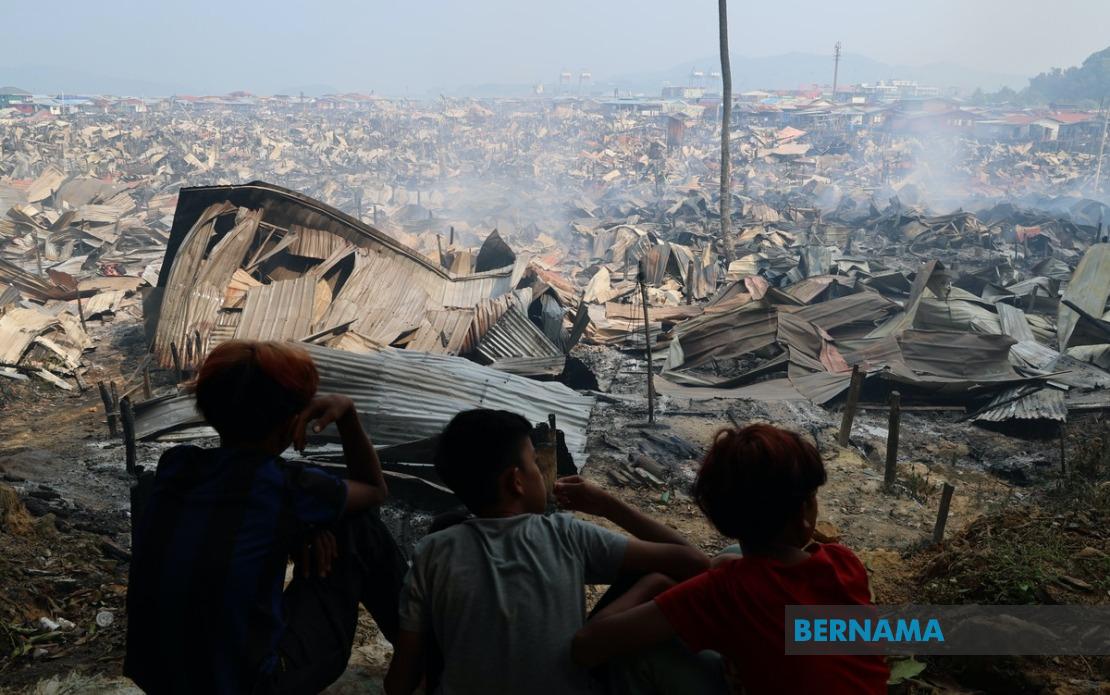
The Sabah state government has announced a comprehensive aid package totalling RM3,000 for each Malaysian-headed household devastated by a massive fire that engulfed Kampung Lok Buta in Numbak, Kota Kinabalu, early yesterday morning. Chief Minister Datuk Seri Hajiji Noor made the announcement during a visit to survivors sheltered at the Likas Multipurpose Hall temporary relief centre, where he pledged the three-part financial assistance drawn equally from the state government, the federal government, and Yayasan Kebajikan Sabah, each contributing RM1,000 per household.
The magnitude of the disaster became clearer as officials confirmed that more than 200 residences were reduced to ash in the pre-dawn blaze, which erupted at approximately 1.40 am and spread with alarming speed through the densely populated settlement. The human toll extended beyond material loss, as three children perished in the flames: four-year-old Nana Abdullah, her six-year-old brother Mohd Asrul, and their eight-year-old cousin Nurfarahdilah Mohd Tajihah. These deaths underscored the particular vulnerability of informal settlements where rapid fire spread, limited escape routes, and inadequate warning systems can prove catastrophic within moments.
Beyond the immediate cash assistance, Hajiji emphasized that the state government would mobilize institutional resources to help families reconstruct their lives. The State Secretary's Office has been tasked with coordinating reconstruction efforts in partnership with Majlis Amanah Rakyat (MARA), the federal development agency, suggesting a collaborative approach between state and federal authorities. This institutional engagement signals that the response extends beyond emergency relief into medium-term recovery planning, a critical distinction in disaster management where initial aid must transition into sustainable rebuilding frameworks.
The question of where residents will rebuild their homes remains undetermined, reflecting the complexity of post-disaster rehabilitation in urban and semi-urban areas. Hajiji noted that the suitability of the original site in Kampung Lok Buta would be assessed alongside potential alternative locations, indicating that authorities are considering whether the burnt settlement can be safely redeveloped or whether displaced families should be relocated elsewhere. This decision carries profound implications for community cohesion, as forced relocation can fragment social networks and disrupt livelihoods, whereas rebuilding on the original site may replicate the conditions that made the area vulnerable to the initial disaster.
Recognizing Malaysia's diverse population composition, the government extended humanitarian consideration to non-Malaysian heads of household affected by the fire, allocating RM1,000 to each such family from state coffers. This approach reflects the practical reality that informal settlements in Malaysian cities often house undocumented migrants and long-term foreign residents who contribute to local economies despite their immigration status. The inclusion of non-citizens in the relief scheme, though at a reduced rate, acknowledges both their vulnerability and their integral place within the affected community.
Immediate survival needs remain central to the relief operation, with the government committing to supply essential provisions including food and household items to displaced families. The establishment of the temporary relief centre at Likas Multipurpose Hall provides shelter and coordination hub, though such facilities are typically designed for short-term occupation rather than extended displacement. The transition from emergency sheltering to permanent or semi-permanent housing solutions will likely determine how quickly families can stabilize their circumstances and resume productive activities.
The Kampung Lok Buta fire exemplifies recurring challenges in Malaysian urban settlements, particularly in Sabah where rapid urbanization has outpaced infrastructure development and building safety enforcement. Informal housing areas, characterized by makeshift structures, narrow alleyways, and limited access for emergency vehicles, create conditions where fires spread rapidly and evacuation becomes perilous. The loss of three young children in a single incident highlights how inadequate urban planning and weak building regulations disproportionately endanger the most vulnerable populations, especially in communities where formal fire safety mechanisms are absent.
From a broader policy perspective, the disaster raises questions about fire prevention and disaster preparedness in Sabah's urban fringe areas. Kampung Lok Buta represents one of many informal settlements across Malaysian cities where residents lack access to adequate fire suppression infrastructure, early warning systems, or formal building standards. The reconstruction process offers an opportunity for authorities to implement improved safety measures, though such interventions require careful balancing between preventing future disasters and avoiding displacement-driven gentrification that could further marginalize residents.
The coordination between state and federal agencies in the relief response signals recognition that disaster management requires multi-level governance. The involvement of Yayasan Kebajikan Sabah, a state charitable foundation, alongside government allocations demonstrates how public and quasi-public institutions can pool resources during emergencies. However, the sustainability of such assistance beyond the initial phase remains uncertain, particularly for families whose income-generating assets were destroyed and who may face prolonged economic disruption.
For Sabah specifically, this disaster occurs amid broader conversations about urban development, housing policy, and safety standards in a state undergoing rapid economic transformation. The fire's timing and scale suggest that informal settlement dynamics require urgent attention from policymakers focused on preventing future catastrophes. Whether the reconstruction process will fundamentally address underlying vulnerability or merely rebuild settlements to their previous standards will largely determine whether such disasters can be prevented in future.
The RM3,000 per household assistance package represents a meaningful but potentially insufficient response to families who have lost homes, possessions, and in some cases, family members. The package's adequacy will depend on local housing costs, employment opportunities, and the timeline for reconstruction. Early intervention with immediate cash assistance can prevent survival crises and secondary displacements, but medium-term support structures will be equally critical as families navigate the complex process of rebuilding homes and restoring livelihoods in a community fundamentally altered by disaster.

