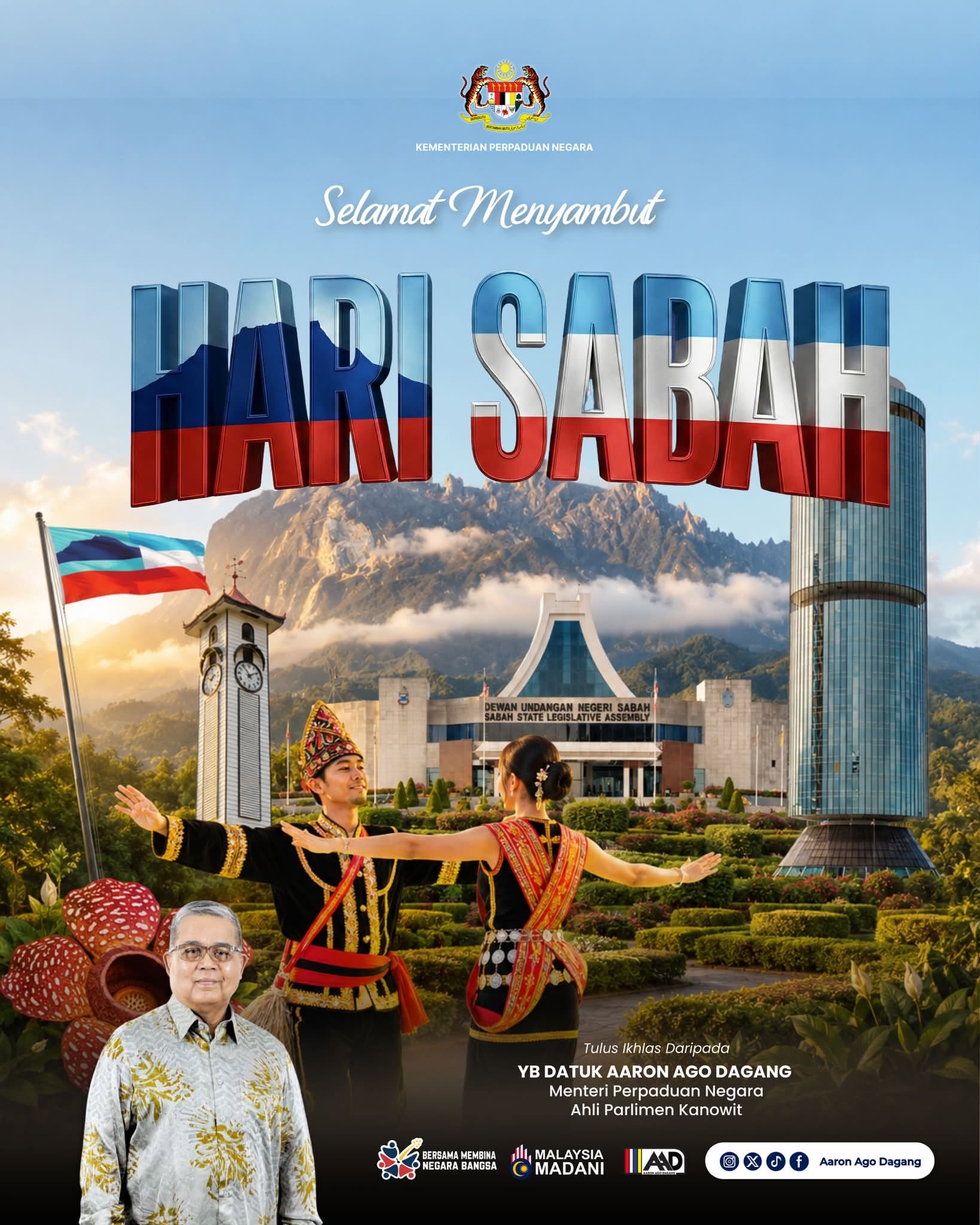
National Unity Minister Datuk Aaron Ago Dagang has underscored how Sabah's extraordinary ethnic and cultural composition stands as one of the state's defining assets, reinforcing Malaysia's identity as a genuinely multicultural nation. Speaking during Sabah Day commemorations on August 31, the minister highlighted the intricate mosaic of communities that have collectively forged the Bornean state's character over centuries, demonstrating that diversity need not fragment societies when grounded in mutual respect and understanding.
Sabah's demographic landscape encompasses 35 distinct ethnic groups and 217 sub-groups, each maintaining its own linguistic traditions, customary practices, distinctive clothing, musical heritage and spiritual customs. Among the major communities are the Kadazan, Dusun, Bajau, Murut, Rungus, Bisaya, Lotud and Lundayeh peoples, whose accumulated contributions have created the pluralistic society that characterises modern Sabah. Rather than treating these differences as impediments to cohesion, the minister's remarks frame cultural plurality as a constructive force that strengthens the social fabric when communities engage with genuine appreciation for one another's traditions.
The philosophical underpinning of the minister's message challenges a widespread assumption that diversity inherently creates tension. Sabah's historical experience demonstrates the opposite proposition: that harmony flourishes when populations deliberately cultivate understanding across ethnic and linguistic boundaries. This perspective carries particular relevance for Malaysia as a whole, where managing communal relationships across multiple ethnic groups remains central to political stability and social progress. The Sabahan experience, which has evolved through periods of external colonial administration, Japanese occupation and ultimately self-determination, offers a practical illustration of how diverse populations can forge genuine common purpose.
August 31 holds profound historical significance within Sabah's trajectory toward political autonomy. The date marks the state's achievement of self-governance in 1963, culminating a transition that began during the era when the region was administered by the British North Borneo Company and continued through subsequent periods of foreign control. This achievement of sovereignty represented not merely a constitutional transfer of authority but symbolised the capacity of Sabah's diverse population to articulate a collective political identity and pursue shared aspirations for self-determination.
The establishment of the Federation of Malaysia on September 16, 1963, represented a pivotal moment when Sabah joined with the peninsula and other Borneo territories to create the modern Malaysian federation. This decision reflected the conviction among Sabah's leadership that regional interests would be better served through participation in a larger national framework. The voluntary nature of Sabah's accession to the federation underscores an important historical principle: that the state's relationship with Malaysia rests upon negotiated consensus rather than imposition, a foundation that continues to shape contemporary discussions regarding federalism and regional governance.
The minister's exhortation to remember historical figures and earlier generations serves an important commemorative function, directing public attention toward the contributions of individuals and movements that enabled Sabah's political evolution. These ancestral efforts—whether undertaken by traditional rulers, colonial administrators who eventually championed independence, nationalist leaders who articulated visions of self-rule, or ordinary citizens who sustained cultural practices through periods of external governance—created the conditions within which contemporary Sabah operates. Acknowledging this historical debt establishes moral continuity between past sacrifices and present privileges.
Datuk Aaron's remarks also contain implicit urgency regarding the present generation's responsibilities. He articulated a vision wherein Sabah's younger cohorts must simultaneously advance the state across multiple contemporary domains—education, economic development, technological innovation and general infrastructure—while preserving the historical memory, cultural practices and political identity that distinguish Sabah within the Malaysian context. This dual imperative reflects the tension that many regional societies face when pursuing modernisation: the need to embrace contemporary development methodologies without allowing traditional knowledge systems and cultural expressions to atrophy through neglect.
The designation of August 31 as Sabah Day by the state government in 2024 formalises what was previously an informal commemoration, elevating it to official status within the state's ceremonial calendar. This administrative decision reflects broader recognition that Sabah's political and cultural particularity deserves institutionalised observance, allowing citizens and observers to engage in regular reflection upon the state's historical trajectory and contemporary position within Malaysia. State-level day designations serve important functions in sustaining regional consciousness and reinforcing subnational identities within federal systems.
For Malaysian federalism more broadly, Sabah's experience illuminates how constituent states can maintain distinctive identities and pursue region-specific development priorities while remaining integrated within a larger national framework. The minister's emphasis on diversity as strength rather than division provides a philosophical counterweight to essentialist arguments that suggest multicultural arrangements inevitably generate conflict. Instead, Sabah's actual historical experience demonstrates that deliberate institutional arrangements, inclusive governance approaches and genuine celebration of cultural difference can produce stable, harmonious societies.
The implications of the minister's message extend beyond ceremonial commemoration. In an era when ethno-nationalist movements elsewhere in Asia have emphasised majoritarian cultural dominance, Sabah's example of coexisting ethnic and religious communities maintaining their distinct identities while participating in shared governance offers a constructive alternative model. This becomes particularly significant given Malaysia's own ongoing negotiations regarding national identity, religious accommodation and communal representation, subjects that repeatedly feature in domestic political discourse and constitutional interpretation.
Looking forward, the challenge for Sabah involves translating rhetorical commitments to diversity and harmony into concrete institutional practices and resource allocation decisions that genuinely benefit all constituent communities. This requires ensuring that economic development opportunities, educational advancement, infrastructure investment and cultural preservation initiatives reach populations throughout the state rather than concentrating in specific regions or benefiting particular groups disproportionately. The sustainability of multicultural arrangements depends upon demonstrable material benefits for all participants, not merely symbolic affirmation of cultural value.

