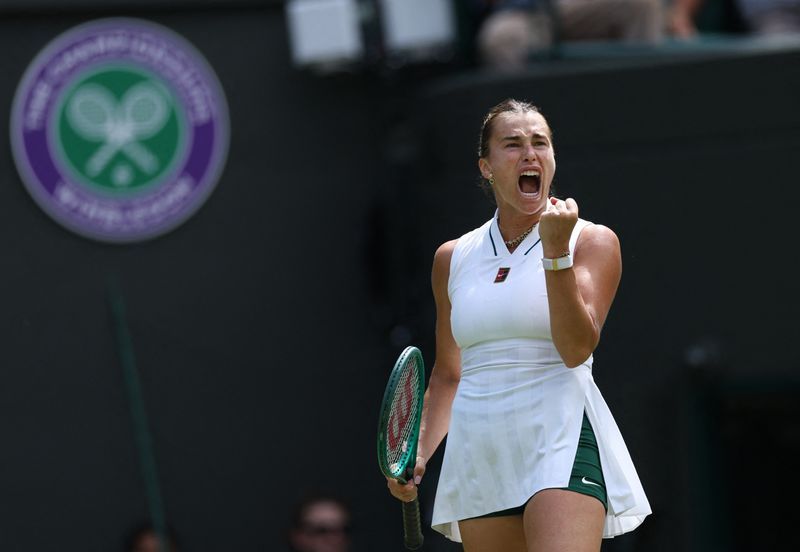
Aryna Sabalenka's complex relationship with grass-court tennis came sharply into focus during her second-round encounter with American McCartney Kessler at Wimbledon on Wednesday, as the Belarusian's competitive instincts eventually proved decisive in a 6-1 7-6(9) victory at the All England Club. The world number one's contrasting fortunes across the two sets told the story of a player oscillating between comfort and anxiety on the notoriously unpredictable London surface.
The opening set provided little drama or suspense, with Sabalenka commanding the baseline exchanges and dictating points with the same heavy-hitting tennis that has made her a dominant force on hard courts. Her dominance was so complete that Kessler, who remarkably arrived at this stage without surrendering a single game in her opening match, found herself unable to gain any purchase in the set. The Belarusian's superior power and consistency proved overwhelming, and the one-sided scoreline of 6-1 offered early encouragement that she would dispatch her opponent with minimal fuss.
Yet the second set transformed the narrative entirely. Kessler, having weathered the initial onslaught, began to find her rhythm and rhythm on the grass. The American's aggressive approach gathered momentum, and by the midway point of the set, she had thrust herself into an unexpectedly commanding position. When Kessler surged to a 5-2 advantage, she appeared genuinely poised to force a deciding set against the sport's highest-ranked player. The Belarusian's frustration became increasingly apparent, with repeated angry strikes to her thigh serving as a visible outlet for her mounting irritation at her own play and Kessler's rising confidence.
The critical juncture arrived at 5-3 when Kessler carved out two set points, a luxury that seemed to promise an extended examination of Sabalenka's grass-court temperament. The American pressed further, even forcing a tiebreak through sheer determination and aggression, where she manufactured two additional opportunities to close out the set. Each of these moments represented a genuine threat to Sabalenka's tournament ambitions, as a third set would have fundamentally altered the psychological complexion of the contest. The quality of Kessler's tennis during this phase demonstrated why she had negotiated her first-round obstacle so comprehensively.
Sabalenka's response to this adversity revealed the veteran quality and court awareness that separates top-tier competitors from their challengers. Rather than succumbing to pressure or abandoning her game plan, the world number one drew upon her superior shot-making arsenal and match-craft. Her ability to produce heavier and more penetrating groundstrokes at crucial moments proved the decisive factor, and she systematically nullified Kessler's momentum. After converting her third match point, Sabalenka secured victory in one hour and 39 minutes, preserving her ambitions to claim a maiden Grand Slam title on a surface other than hard courts.
Sabalenka's struggle on grass, relative to her dominance elsewhere, reflects a broader pattern in her career. While hard courts have proven a near-perfect fit for her aggressive baseline approach, grass presents an entirely different strategic puzzle. The reduced reaction time, heightened unpredictability, and tactical fluidity demanded on turf courts challenge even the most powerful hitters. Her previous Wimbledon campaigns have consistently illustrated this tension, with occasional flashes of brilliance offset by frustrating inconsistency. Wednesday's contest represented precisely this duality, and her ability to ultimately prevail suggests growing comfort with the surface's demands.
The victory carries meaningful implications for her broader tournament trajectory. Sabalenka will advance to face Jelena Ostapenko of Latvia in the third round, an opponent who, as a former Grand Slam champion, presents another formidable examination of her grass-court credentials. Ostapenko's own comfort on this surface, combined with her aggressive instincts, could replicate aspects of the Kessler challenge. However, Sabalenka's successful negotiation of Wednesday's test provides genuine encouragement that she possesses the mental resilience to navigate increasingly difficult opponents.
For Malaysian and Southeast Asian tennis followers, Sabalenka's performance underscores the importance of adaptability at the sport's highest levels. While she remains primarily associated with hard-court dominance, her ongoing development as a multi-surface competitor demonstrates the tournament demands placed on contemporary professional athletes. Her pursuit of a Grand Slam title beyond hard courts aligns with the career trajectory of the sport's greatest champions, many of whom have mastered the technical and psychological adjustments necessary across different playing environments.
Sabalenka's acknowledgement of the difficulty she faced and her relief at progressing reflected genuine gratitude for survival rather than satisfaction with performance. "She really tested me today and I am super happy to pass the test," the relieved champion said post-match. Her characterisation of the contest as a "test" she was relieved to "pass" rather than dominate underlines the genuine competitive threat Kessler posed. "She played incredible and played super aggressive and it was really tough to handle the second set and I am glad to have powered through," she added, offering candid assessment of her own wavering performance during the critical phases of the second set.
The broader context of this match reflects evolving women's tennis dynamics, where depth of talent increasingly means that even the world's elite must navigate genuine peril from relatively unknown competitors. Kessler, despite her relative obscurity at this career stage, demonstrated the tactical sophistication and emotional control necessary to threaten the establishment's highest-ranked figure. Her near-upset bid suggests that Wimbledon's grass courts, more than other surfaces, genuinely compress the gap between elite champions and aspiring challengers, creating the conditions for dramatic upsets and memorable performances.

