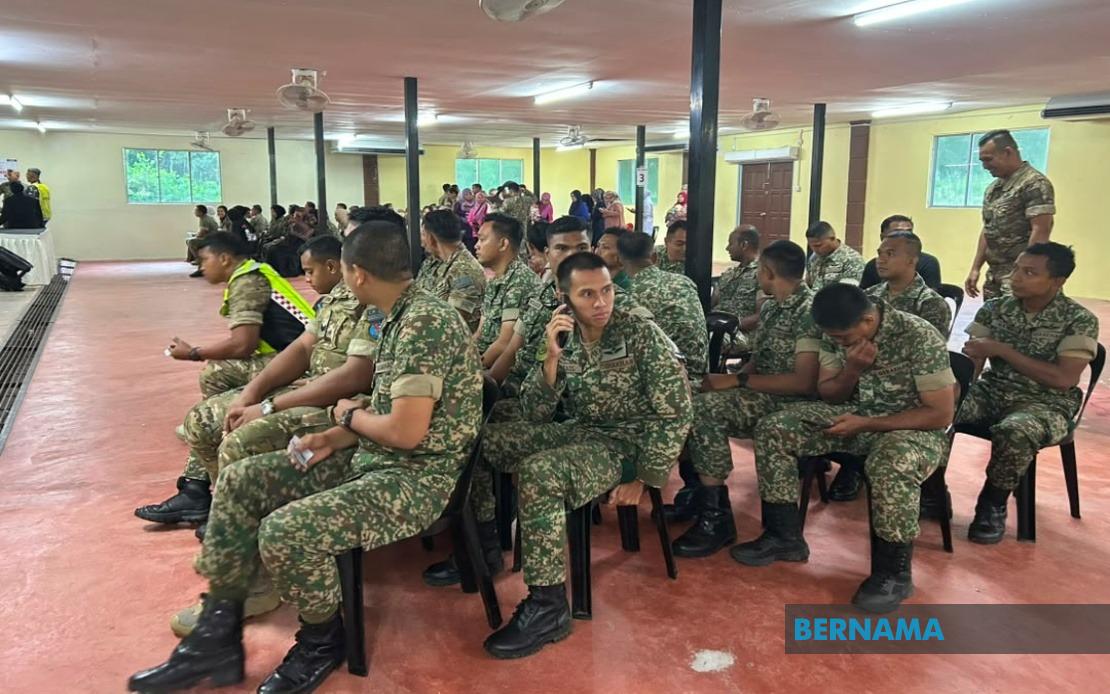
As polling preparations intensify for the 16th Johor State Election, two senior federal ministers have issued appeals to military and police personnel taking part in the early voting process, urging them to recognise their civic responsibilities and approach the ballot with the seriousness that democratic participation demands. Home Minister Datuk Seri Saifuddin Nasution Ismail and Defence Minister Datuk Seri Mohamed Khaled Nordin made their separate calls through social media platforms on the day early voting commenced, underlining the significance of the electoral exercise among security sector employees.
The early voting cohort represents a substantial bloc of the electorate, comprising 24,751 individuals drawn primarily from Malaysia's defence and internal security apparatus. Among these are 12,041 members of the Malaysian Armed Forces along with their spouses, complemented by 12,710 police personnel and their family members. This segment of voters typically participates in advance polling arrangements to ensure their continued availability for operational duties during the main polling day, reflecting the operational nature of security sector work.
Saifuddin Nasution, who holds the additional position of Pakatan Harapan secretary-general, framed the early voting opportunity as a fundamental exercise of democratic entitlement. In his message to voters, he emphasised that participation should be conducted "with full responsibility and in the spirit of democracy," language that signals the ruling coalition's emphasis on institutional integrity as campaigns enter their closing phases. His dual messaging—addressing both the procedural aspects of voting and the broader campaign conduct of the PH machinery—suggests concern about maintaining standards throughout the electoral process.
Mohammad Khaled's intervention carried a subtly different emphasis, focusing on the forward-looking development agenda rather than procedural matters. The Defence Minister connected the act of voting to Johor's continued trajectory, suggesting that early voters bear responsibility not merely for fulfilling a legal obligation but for determining the trajectory of state governance. This framing attempts to elevate the significance of the exercise beyond the mechanics of ballot-casting to encompass the substantive policy choices confronting the electorate.
Meanwhile, state leadership offered its own perspective on the electoral proceedings. Menteri Besar Datuk Onn Hafiz Ghazi, representing the Barisan Nasional coalition in Johor, issued a parallel appeal to early voters that emphasised continuity and stability. His call for voters to place trust in BN candidates specifically referenced three policy pillars—stability, development, and public welfare—that constitute the incumbent coalition's electoral messaging framework. The distinction between BN's emphasis on continuation and PH's broader appeal to democratic principles reflects their respective positioning in what has become a closely contested electoral contest.
The logistical dimensions of early voting underscore the complexity of managing electoral processes across a large state. Sixty-four designated voting centres opened their doors at 8 am to accommodate the distributed security personnel, with staggered closing times between noon and 6 pm depending on local voter concentrations and administrative capacity. This operational structure acknowledges the practical challenges of concentrating large numbers of voters within constrained timeframes while maintaining voting integrity and queue management.
From a broader Southeast Asian perspective, Malaysia's management of elections involving security sector employees reflects a mature democratic approach that recognises the legitimate needs of personnel unable to vote on standard polling days while maintaining the fundamental principle of one person, one vote cast in formal circumstances. This contrasts with electoral systems where such populations face restrictions or face de facto barriers to participation. The Malaysian approach thus represents an institutional accommodation of practical necessity without compromising democratic authenticity.
The 16th Johor State Election encompasses the full slate of state assembly constituencies, with both major coalitions fielding candidates across all 56 seats. The competition has mobilised 172 candidates representing diverse political formations, with polling scheduled for Saturday. The early voting window thus provides the first substantive indication of voter mobilisation and turnout patterns, offering preliminary signals about the intensity of engagement across different demographic segments.
The appeals issued by these senior figures carry implicit messages about the standards the national leadership expects to prevail throughout the electoral contest. By publicly invoking concepts of responsibility, democracy, and good conduct, the ministers establish reference points against which subsequent campaign behaviour can be assessed. This performative dimension of political communication matters in Malaysian electoral contexts, where public pronouncements by senior figures often shape discourse about acceptable campaign norms.
For Malaysia's states more broadly, the Johor election carries significance as an indicator of coalition strength and voter preferences in a critical electoral terrain. The state's economic importance and demographic weight make its electoral outcomes consequential for national political calculations. The early voting process thus functions not merely as a procedural necessity but as a meaningful first chapter in what will likely prove a closely watched campaign that reflects evolving voter sentiment across the wider Malaysian political landscape.

