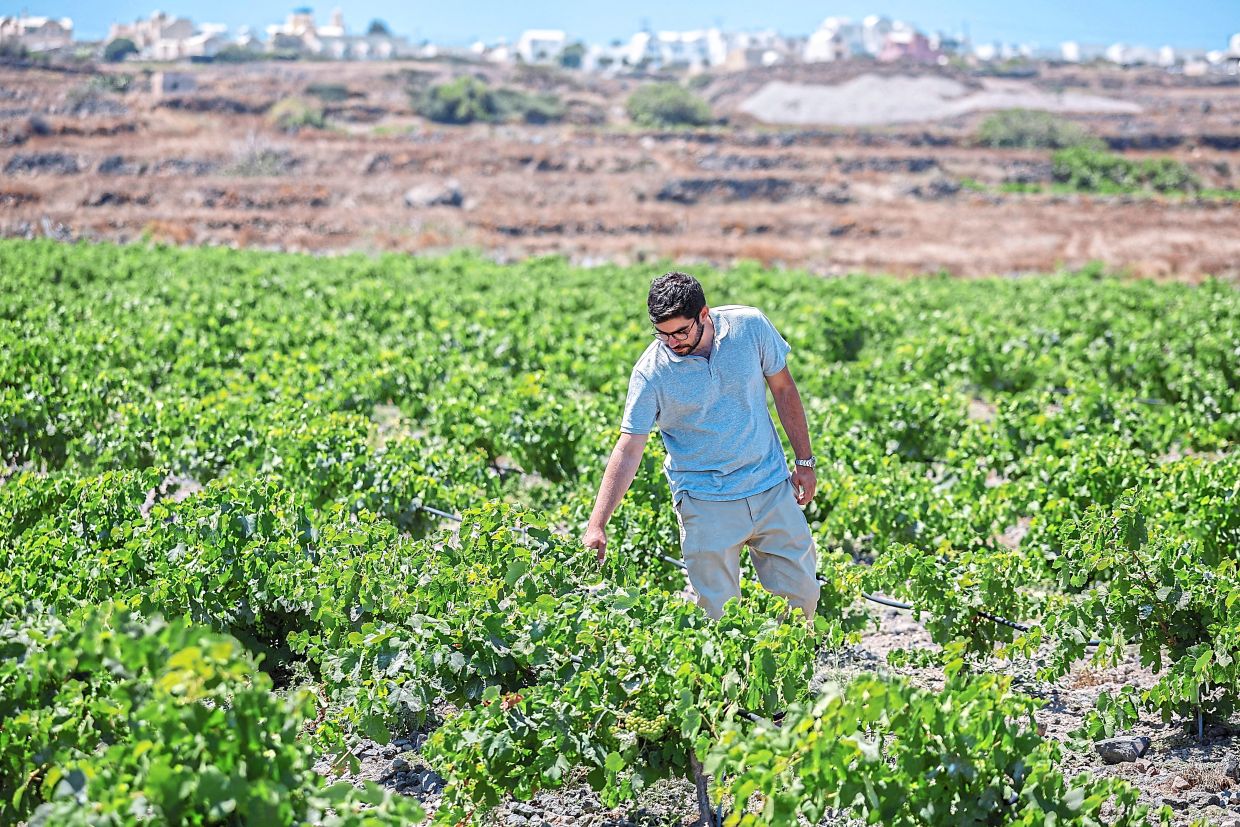
The Greek island of Santorini faces an existential challenge to its centuries-old wine tradition as climate-driven heat and drought intensify across the Mediterranean. Over the past three years, the island's legendary vineyards have endured record temperatures and critically low rainfall that have killed ancient vines, slashed production volumes, and driven grape prices sharply upward. The crisis extends beyond agriculture into broader competition for scarce water resources, as hotels and tourism infrastructure compete with farmers during peak summer months when both demand and temperatures surge simultaneously.
Yiannis Boutaris, a sixth-generation winemaker and operator of Domaine Sigalas, now part of the Kir-Yianni family of wineries, has witnessed the collapse of vineyards that survived for nearly a century. He points to a traditional basket-shaped vine, known locally as a "kouloura," that endured 90 years before succumbing to the relentless conditions between 2023 and 2025. The loss symbolises a broader transformation unfolding across Santorini's wine country, where the combination of depleted rainfall and soaring temperatures has fundamentally altered the agricultural landscape. Rather than abandoning the island's viticultural heritage, Boutaris has committed to adapting traditional practices to new environmental realities.
To address water scarcity directly, Boutaris is spearheading a pilot initiative with local authorities and university researchers that transforms treated wastewater from residential properties and tourist accommodations into irrigation supplies for vineyards. This approach mirrors water recycling practices successfully implemented in California, where sustainable agriculture requires innovation to maintain productivity in arid regions. The wastewater strategy offers significant advantages over alternative solutions: desalination plants consume enormous energy and require substantial capital investment, whereas treated wastewater utilises existing infrastructure and reduces overall water demand on limited island reserves. The project represents a pragmatic middle ground between surrendering to climate pressures and maintaining vineyard viability.
Beyond wastewater management, Boutaris is restructuring how vineyards are physically organised. The traditional Santorini method scattered vines across terrain to provide shade protection against intense summer sun. However, this dispersed arrangement complicates irrigation efforts and increases water waste through evaporation and inefficient distribution. Boutaris now experiments with row-based planting systems that align with modern irrigation technologies, enabling precise water application and reduced consumption. This geometric restructuring does not abandon Santorini's heritage so much as it modernises delivery mechanisms for a practice—vine cultivation—that remains fundamentally unchanged.
Atmospheric water harvesting represents another technological frontier being tested on the island. This innovative system captures moisture suspended in air using hydrogels, then applies solar-generated heat to extract the captured water for agricultural use. The technology embodies a complete decoupling from conventional groundwater or imported supplies, instead harvesting from an atmospheric resource that exists abundantly even in drought conditions. Solar-powered extraction aligns with the island's abundant sunshine, converting what would otherwise be a limiting factor into an energy source. Though still in pilot phases, atmospheric harvesting could eventually provide meaningful supplementary water for vineyards while minimising environmental impact.
Stefanos Koundouras, a viticulture professor at Aristotle University in Thessaloniki, emphasises that Santorini experienced catastrophic conditions during 2023 and 2024, with temperatures reaching their highest levels in six decades. These temperature extremes directly threaten the qualitative character that distinguishes Santorini wines in global markets. Beyond production volumes, climate stress alters the chemical composition of grapes, fundamentally changing flavour profiles and the wines' distinctive appellations. Koundouras warns that without significant adaptation, the wine sector across the entire Mediterranean region faces sustainability challenges as warming trends continue.
Grape pricing reflects these mounting pressures. On Santorini, where water remains scarce and conditions severe, producers report significantly elevated costs per kilogram compared to northern Greek regions where climate conditions remain more moderate. In northern areas, grapes sell for approximately €0.80 per kilogram, equivalent to roughly RM3.70, whereas Santorini prices have climbed substantially higher due to scarcity and intensified production costs. This price differential creates economic incentives for innovation but also threatens the viability of smaller producers unable to invest in new technologies.
Winemaker Yiannis Papaeconomou, whose vineyard is only six years old, is also participating in the wastewater recycling initiative. He simultaneously implements subsurface irrigation systems that deliver water directly to root zones rather than spraying from above, dramatically reducing evaporation losses during hot months. His vines are also restructured through revised trellising methods that optimise water distribution efficiency. These complementary techniques—wastewater sourcing, subsurface delivery, and structural redesign—represent a comprehensive adaptation strategy rather than piecemeal responses to isolated problems.
The broader context for Santorini's agricultural transformation reflects a continent-wide pattern. Across Greece, water stress increasingly pits competing interests against each other. During summer months, when tourism peaks and temperatures soar, farmers, hoteliers, and swimming pool operators all demand finite water supplies. This competition typically disadvantages agriculture, as tourism generates more immediate revenue and political capital. Islands and coastal regions face particularly acute challenges because desalination, though possible, requires substantial infrastructure investment and ongoing energy costs that smaller communities struggle to sustain.
For Southeast Asian observers, Santorini's experience offers instructive lessons about climate adaptation in agricultural regions dependent on specific crops and vulnerable to water stress. Malaysia and surrounding countries increasingly face similar pressures from changing rainfall patterns and rising temperatures, particularly in regions dependent on specialty crops. The Santorini case demonstrates that technological solutions—from wastewater recycling to atmospheric harvesting—exist but require significant coordination between government, researchers, and private producers. Equally important, successful adaptation requires reimagining relationships between tradition and innovation, rather than treating them as opposing forces.
The stakes for Santorini extend beyond economic considerations. The island's wine industry represents centuries of accumulated knowledge, cultural identity, and ecological adaptation to a specific terroir. If climate change renders traditional practices unviable, something irreplaceable disappears. Conversely, aggressive adaptation that abandons local knowledge risks losing the distinctive qualities that made Santorini wines globally recognised in the first place. Boutaris and Papaeconomou navigate this tension by embracing technology while maintaining commitment to heritage practices modified for contemporary conditions. Their approach suggests that climate adaptation need not mean cultural capitulation, provided communities invest creatively in innovation while remaining grounded in tradition.

