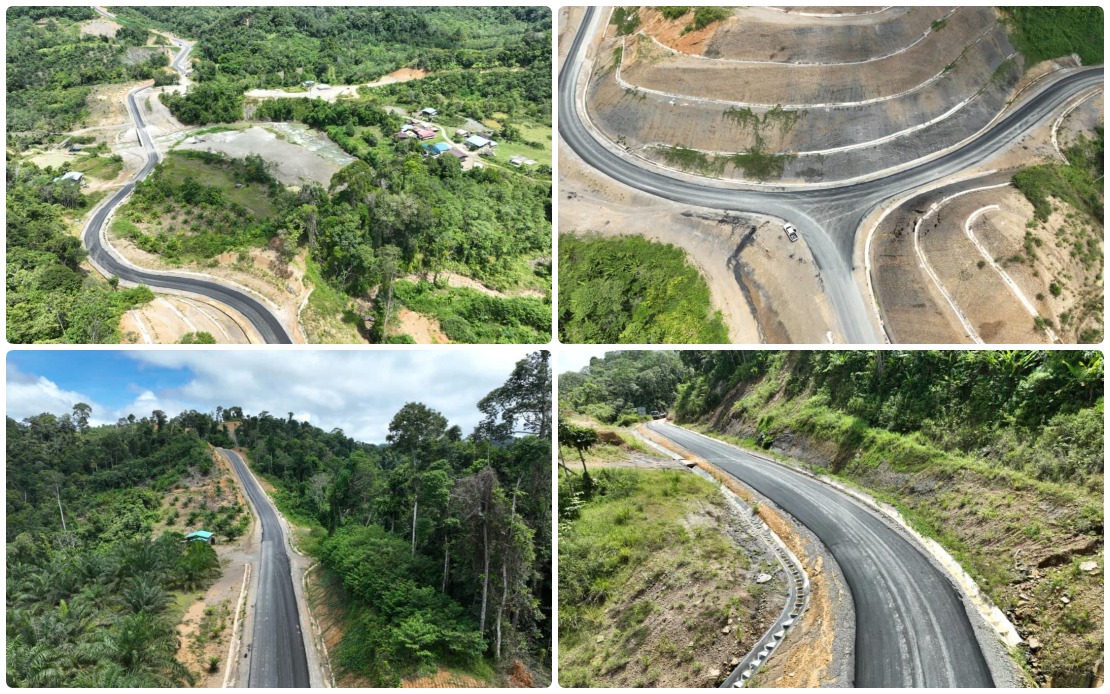
A major infrastructure milestone has been reached in Sabah's interior regions as the Jalan Sapulut-Salong-Pagalungan-Pensiangan road project achieves completion up to Pensiangan town. The breakthrough comes after years of development work aimed at transforming access to one of East Malaysia's most remote parliamentary constituencies. Datuk Seri Arthur Joseph Kurup, the Minister of Natural Resources and Environmental Sustainability and Member of Parliament for Pensiangan, has outlined how the completed section represents a transformative shift in connectivity and economic prospects for residents who have historically faced severe isolation.
The practical impact of the completed road segment is already visible in Pensiangan town. What was once a journey spanning more than six hours from Keningau has been compressed to just three hours, a reduction that fundamentally alters the feasibility of regular travel between the interior and lowland regions. Arthur's recent inspection and observations reveal a tangible shift in community patterns. Where boats once dominated the town's landscape, private vehicles now line the streets, signalling not merely improved infrastructure but a broader change in how residents can organise their daily lives and economic activities.
The improved road conditions carry implications that extend far beyond mere travel convenience. Healthcare and education professionals, including doctors, nurses and teachers, can now access Pensiangan with significantly reduced fatigue and time commitment. This accessibility improvement directly strengthens human capital delivery to remote communities, addressing a persistent challenge in interior Sabah where professional recruitment and retention have historically been constrained by geographical isolation. The enhanced safety profile during adverse weather is equally significant. Previously, unfavourable conditions could leave travellers stranded on roadside areas; the improved road surface and reduced journey duration now provide a buffer against such scenarios.
Economic revitalisation appears to be following infrastructure investment, with Arthur noting an observable trend of younger residents returning to villages to develop land and participate in local economic activities. This reverse migration pattern, often associated with improved connectivity in developing regions, suggests that transportation barriers were previously preventing productive utilisation of local resources and entrepreneurial initiatives. The removal of these barriers creates conditions for small-scale enterprise development, agricultural commerce and value-added processing that would otherwise remain inaccessible to interior communities.
The road project itself forms the centrepiece of a considerably broader development vision for Pensiangan parliamentary constituency. Arthur has framed the completed section as Phase Three of an integrated master plan designed to systematically transform Sabah's interior. Critically, Phase Four will extend the road network toward the Kalimantan border, creating potential for cross-border trade and tourism commerce that could position the region as a regional economic corridor rather than simply a remote backwater.
Comprehensive complementary infrastructure projects accompany the main road initiative, creating a multi-faceted development approach. The Sapulut coffee processing factory, currently under construction, represents efforts to add value to agricultural output rather than relying solely on raw commodity export. The completed Jalan Sinaron-Linayukan in Tongod and the ongoing Jalan Rancangan Belia Tiulon-Simbuan project extend road connectivity across the broader district. Jetty and boat facility upgrades at Pangkalan Salong acknowledge that water transport remains integral to the region's logistics network, particularly given the challenging terrain.
Commercial infrastructure development includes newly completed agricultural collection centres at Pagalungan Tamu and Salong Agrobazaar, facilities that could stabilise pricing and improve market access for smallholder farmers. These structures represent efforts to integrate interior agricultural production into broader supply chains. Concurrently, telecommunications upgrades throughout the district address digital connectivity gaps that increasingly constrain economic participation. Rural broadband access represents a critical but often overlooked infrastructure component, enabling access to digital markets, information services and distance education.
The planned immigration and customs complex at the Kalimantan border crossing, currently in the approval process, signals government recognition that sustainable development requires appropriate institutional frameworks for cross-border movement and commerce. Such facilities typically facilitate legitimate trade while strengthening border security and administrative capacity. The investment in border infrastructure suggests that regional policymakers view interior Sabah not as periphery requiring subsidy but as territory with genuine cross-border economic potential.
Educational infrastructure development through the newly completed Sixth Form Centre at Sekolah Menengah Kebangsaan Nabawan addresses a documented gap in secondary and tertiary education access for rural constituencies. Post-secondary education facilities in remote regions frequently reduce brain drain by providing advancement pathways that do not require relocation to urban centres. This facility may enhance retention of human capital within Sabah's interior.
The integrated development approach articulated by Arthur reflects a deliberate strategy to address multiple dimensions of underdevelopment simultaneously rather than pursuing isolated infrastructure projects. Roads alone, without accompanying market facilities, telecommunications, border infrastructure and educational facilities, typically generate limited sustainable impact. The apparent coordination across transport, commerce, communications and education sectors suggests more sophisticated development planning than has historically characterised rural Sabah policy.
For Malaysian readers broadly, this project illustrates the operational challenges of delivering infrastructure to vast, sparsely populated territories spanning difficult terrain. Sabah's geographic scale and population distribution create development economics fundamentally distinct from peninsular Malaysia's more densely settled regions. The multi-year timescale and integration of complementary infrastructure projects underscore the resource intensity required for meaningful rural development in Malaysian East Malaysia.
The completion milestone also reflects broader regional trends in Southeast Asia where improved interior connectivity has preceded significant economic transformation in comparable contexts. Thailand, Indonesia and the Philippines have pursued similar interior road development strategies with documented results in agricultural commercialisation and small-enterprise development. Sabah's interior roads project may anticipate comparable regional patterns, though sustainable outcomes will depend on market access, institutional support and policy stability across the development timeline.
The broader implication concerns whether infrastructure alone suffices for sustained rural development or whether complementary policy reforms—taxation, land tenure, agricultural extension services and credit access—must accompany physical infrastructure investment. Arthur's comprehensive development framework suggests recognition that infrastructure represents a necessary but potentially insufficient condition for interior economic transformation.

