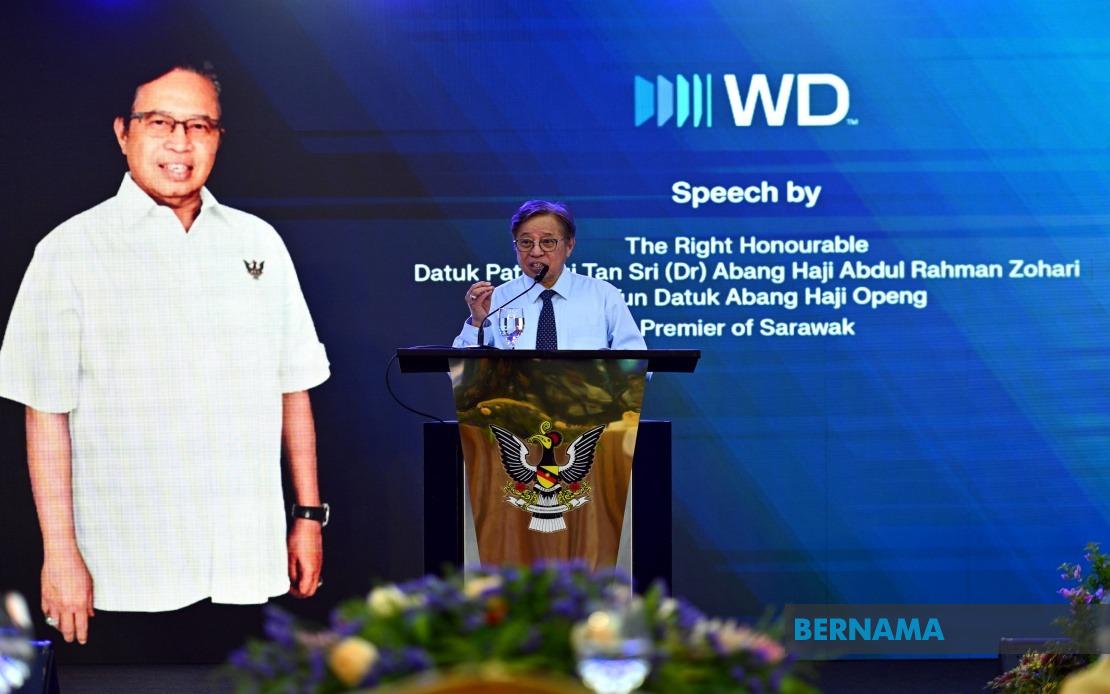
Sarawak's willingness to accept a higher special grant hinges entirely on whether Putrajaya can afford the additional outlay, Premier Tan Sri Abang Johari Tun Openg signalled this week, taking a pragmatic stance on negotiations that remain in their early phases. Speaking in Kuching after inaugurating a Western Digital programme, the Sarawak leader acknowledged that while any boost to the state's allocation would be welcomed, the government must not overextend itself financially to deliver such increases. His measured response reflects an understanding that federal revenue constraints, shaped by Malaysia's broader economic challenges and competing budgetary pressures, ultimately determine what Putrajaya can realistically offer the states.
The special grant mechanism enshrined in Article 112D of the Federal Constitution represents a longstanding fiscal arrangement between the federal centre and the state governments, with particular significance for Sarawak given its unique constitutional status under the Malaysia Agreement 1963. Abang Johari's comments came shortly after Prime Minister Datuk Seri Anwar Ibrahim indicated to Parliament that discussions on Sarawak's entitlements were actively proceeding in the spirit of honouring MA63 commitments. Yet the Premier's careful language suggests negotiations have not yet reached a stage where concrete figures or timelines are being discussed. Instead, the dialogue remains exploratory, with both parties apparently taking stock of what might be feasible within current fiscal parameters.
Abang Johari noted that no substantive technical discussions on the grant increase proposal have occurred to date, though the issue was broached in general conversation during a recent meeting with Anwar in Bintulu. This pattern is consistent with how major fiscal negotiations typically unfold in Malaysia's federal system, where preliminary soundings precede more detailed bargaining. The Premier's willingness to express understanding of the Federal Government's financial constraints, rather than making demands, positions Sarawak as a pragmatic negotiating partner—a posture that could prove advantageous as talks advance. Whether this conciliatory approach yields tangible results will depend partly on the trajectory of federal revenues and the competing claims from other states and federal programmes.
The timing of these discussions carries weight in Malaysia's broader political landscape. Sarawak has long argued that its contributions to national wealth, particularly through resource extraction and hydroelectric generation, merit recognition through enhanced fiscal transfers. The state's strategic importance to the federal coalition under Anwar's administration gives its concerns added leverage. At the same time, the Federal Government faces significant fiscal pressures from debt servicing, infrastructure commitments, and social spending obligations that limit headroom for new allocations. Abang Johari's statement can thus be read as a realistic acknowledgment of these competing pressures, even if it stops short of formally conceding any ground in the negotiation.
Beyond the immediate grant question, the Premier used the occasion to articulate a forward-looking vision for Sarawak's economic transformation, one increasingly centred on technology and data infrastructure rather than traditional resource extraction. His remarks about Sarawak's partnership with Western Digital, spanning approximately three decades, underscored the state's ambitions to position itself as a hub for advanced manufacturing and digital services. The emphasis on glass substrate-based data storage technology—a next-generation innovation enabling higher capacity storage for artificial intelligence and cloud computing applications—reflects Sarawak's strategic pivot toward sectors with greater value-added potential than commodity-dependent industries.
Abang Johari highlighted the state's natural endowments that make it attractive to technology investors: abundant renewable energy from hydroelectric resources and plentiful water supplies essential for cooling data centres. These advantages, he argued, have proven decisive in securing confidence from high-technology firms seeking sustainable and cost-effective locations for capital-intensive operations. The logic is compelling for Malaysian policymakers across the country. As global data creation accelerates and environmental considerations shape corporate investment decisions, states positioned with reliable green energy and infrastructure could capture disproportionate shares of emerging digital economy activity. Sarawak's early positioning in this transition may yield economic returns that dwarf those from conventional resource sectors.
Western Digital's continued expansion in Sarawak, advancing glass substrate technology, exemplifies how established multinational partnerships can evolve toward greater sophistication. The technology promises significantly enhanced data storage density, a capability increasingly critical as artificial intelligence systems and cloud infrastructure demand ever-larger processing and storage capacity. For Sarawak, hosting such advanced production facilities generates high-value manufacturing employment, technology transfer opportunities, and intellectual property development potential. The state's role in supplying cutting-edge components to global technology supply chains also reduces its economic vulnerability to commodity price fluctuations that have historically affected resource-dependent regions.
The intersecting narratives of fiscal negotiation and economic transformation reveal Sarawak's dual focus. On one hand, the state pursues fair treatment within Malaysia's federal fiscal framework, arguing for recognition of its historical contributions and continuing importance. On the other, it actively repositions its economy away from dependence on commodity exports toward participation in high-technology manufacturing and digital services. The success of the latter strategy could ultimately provide Sarawak with greater economic resilience and growth prospects than marginal increases to federal grants, though enhanced fiscal transfers could accelerate the pace of transition by funding enabling infrastructure and skills development.
For Malaysian observers and policymakers, Sarawak's approach offers instructive lessons about negotiating federal-state fiscal arrangements in an era of competing economic pressures and shifting comparative advantages. The state's combination of measured demands and constructive engagement with Putrajaya—paired with concrete efforts to diversify its economic base—may prove more effective than aggressive posturing in securing both near-term fiscal benefits and long-term prosperity. Whether the Federal Government can accommodate higher Article 112D allocations remains uncertain, dependent on revenue projections and political prioritization. What seems clear is that Sarawak's economic trajectory will increasingly be shaped by its technological capabilities and regional competitiveness, rather than by incremental changes to federal transfer mechanisms alone.

