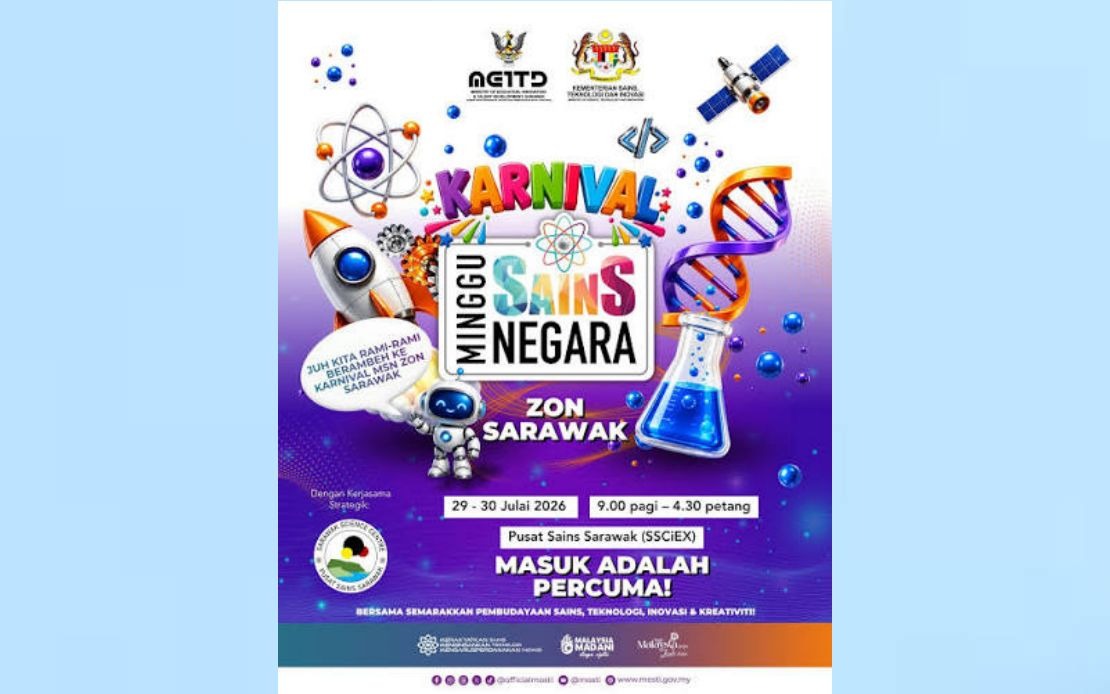
The Ministry of Science, Technology and Innovation formally unveiled the National Science Week Carnival 2026 for Sarawak at the Sarawak Science Centre in Kuching on Tuesday, signalling a significant push to make cutting-edge scientific engagement accessible beyond urban centres. The two-day event, inaugurated by Sarawak's Minister of Education, Innovation and Talent Development Datuk Seri Roland Sagah Wee Inn, represents an intentional departure from concentrating science promotion initiatives in major cities, instead prioritising interior and rural communities that have historically had limited exposure to hands-on STEM experiences.
MOSTI's secretary-general Datuk Dr Nagulendran Kangayatkarasu articulated the carnival's overarching philosophy during proceedings, describing it as a cornerstone endeavour within government strategy to cultivate enthusiasm for scientific inquiry and technological advancement among Malaysia's younger generation. This positioning reflects growing awareness among policymakers that technological literacy cannot remain the preserve of students in well-resourced urban schools if Malaysia aspires to compete globally in innovation-driven sectors. The initiative acknowledges a persistent capacity gap: students in Sarawak's hinterland regions often graduate with minimal exposure to laboratory work, coding fundamentals, or applied technology projects that have become routine in Klang Valley institutions.
A cornerstone component involves the STEM Catalysts Programme, which will conduct targeted outreach expeditions to schools in Meradong, Bintulu and Belaga districts—areas characterised by dispersed populations and limited access to specialised educational infrastructure. By bringing experiential learning activities directly to these communities, the programme sidesteps logistical barriers that typically prevent rural participation in centralised science events. This model proves particularly relevant for Sarawak, where geographical vastness and varied terrain have historically constrained educational equity, even as the state has developed economically.
Among the carnival's offerings is a notable emphasis on nuclear technology advocacy and public engagement. This component carries broader strategic implications for Southeast Asia's energy future. As regional nations increasingly evaluate nuclear power as part of decarbonisation strategies, building public understanding and confidence in nuclear safety becomes politically essential. Malaysia itself has previously shelved nuclear proposals amid public scepticism; positioning nuclear science education as part of mainstream STEM outreach represents an attempt to shift long-standing perceptions by framing the technology within youth-oriented, educational contexts rather than solely through contentious policy debates.
Integrated within the physical carnival is the sainsrakyat.my citizen science portal, a digital platform designed to dissolve traditional boundaries between professional researchers and community participants. The platform invites rural inhabitants, including those without formal scientific training, to contribute observational data that can inform legitimate research projects. This democratisation of scientific participation reflects global trends toward participatory science models, yet carries particular resonance in the Malaysian context where rural communities possess extensive environmental knowledge that remains underutilised in formal research frameworks. A farmer documenting crop disease patterns or a coastal resident recording fish population changes generates data of genuine scientific value whilst simultaneously developing scientific thinking habits.
The carnival initiative must be contextualised within Malaysia's broader human capital challenges. Despite ranking among upper-middle-income nations, Malaysia has struggled to convert economic growth into proportionate advances in scientific workforce development. Enrolment in STEM subjects at secondary and tertiary levels remains below optimal levels, with significant geographic disparities. Rural students often lack the foundational motivation and access that would push them toward science careers, meaning talent remains underdeveloped across vast regions. The Sarawak carnival attempts to address this pipeline problem at its source by creating formative encounters with science during school years.
For Sarawak specifically, the initiative carries economic implications. The state has positioned itself as a centre for downstream petroleum processing and is exploring renewable energy development. Building a science-literate workforce within the state reduces dependency on importing technical talent and creates pathways for local youth to participate in industrial development projects. Students exposed early to technology concepts through carnival activities and STEM programmes may subsequently pursue relevant qualifications, eventually contributing to local innovation ecosystems. This long-term workforce development angle often remains implicit in science outreach messaging but represents a genuine strategic consideration for state policymakers.
The carnival also reflects evolving understanding of how scientific culture develops. Exposing children to hands-on experiments, meeting practising scientists, and encountering real-world applications of physics and chemistry proves more effective in cultivating sustained interest than classroom-bound instruction alone. Carnivals create memorable, multi-sensory learning experiences that can crystallise childhood curiosity into adolescent commitment to scientific study. For rural students with limited prior exposure, such events may represent their single meaningful encounter with scientific practice during formative years, making the quality and accessibility of carnival experiences substantive rather than merely decorative.
The engagement strategy also acknowledges that scientific literacy serves broader citizenship goals beyond workforce preparation. Understanding basic scientific principles enhances citizens' capacity to evaluate health claims, assess environmental information, and make informed decisions about technological adoption. In an era of misinformation and rapid scientific change, public understanding of how knowledge is generated and validated becomes increasingly important. Science carnivals contribute modestly to this larger project of building evidence-based reasoning habits across populations.
Implementing such initiatives across Sarawak's diverse geography demands sustained logistical commitment and funding. Success depends not merely on launching carnival events but on maintaining institutional support, training sufficient facilitators, and creating feedback mechanisms that allow programmes to improve iteratively. Previous Malaysian science outreach efforts have sometimes struggled with sustainability challenges once initial funding cycles conclude. The test for MSN Carnival 2026 lies not only in its launch success but in whether MOSTI can embed rural science engagement as a permanent priority within institutional budgets and strategic planning rather than treating it as episodic programming.

