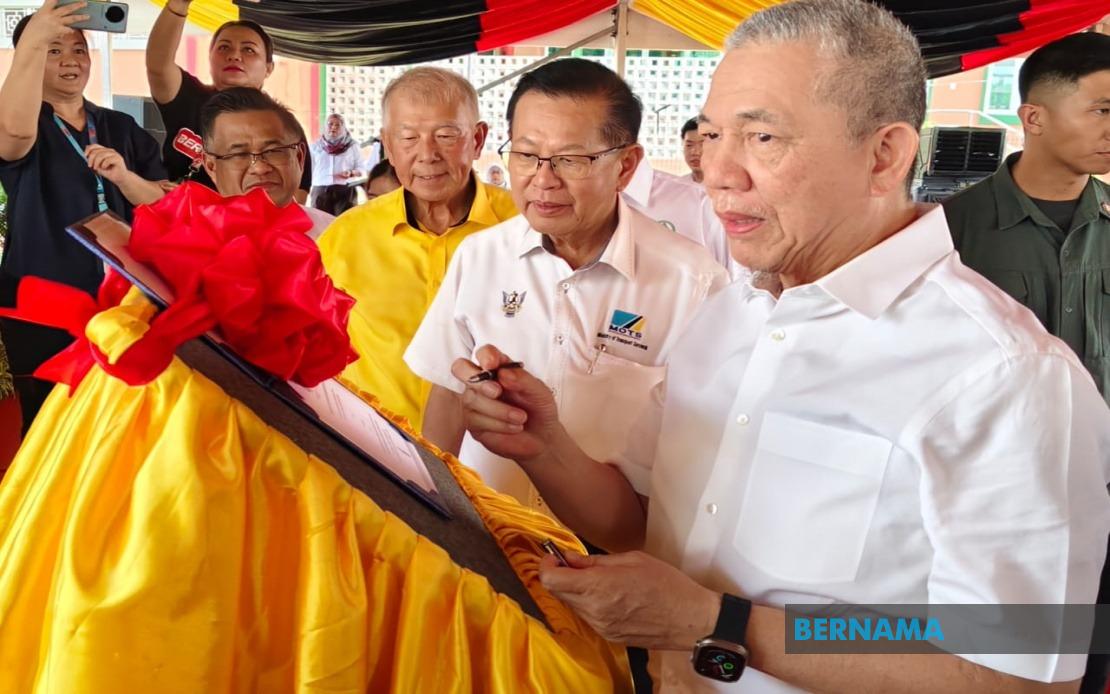
Deputy Prime Minister Datuk Seri Fadillah Yusof has announced the rollout of 52 projects under the Cakna MADANI Programme across Sarawak, collectively valued at RM9.46 million, to tackle the mounting challenges of riverbank deterioration and flooding that continue to threaten communities and critical infrastructure throughout the state. The announcement, made during a site visit to Miri on July 4, reflects growing government attention to environmental vulnerabilities in Malaysia's easternmost state, where seasonal flooding and erosion pose recurring threats to residential areas, agricultural land, and public amenities.
Of the 52 initiatives, twelve have already been finalised and handed over for operation, thirteen are currently in active construction phases, and the remaining 27 remain in preliminary planning and design stages. This staggered implementation approach indicates a deliberate sequencing strategy, allowing project teams to learn from early completions while scaling up execution across multiple locations. Such phased deployment is particularly important given Sarawak's vast geography and diverse terrain, which complicate simultaneous project management across the state.
Fadillah, who simultaneously holds the portfolio for Energy Transition and Water Transformation, spotlighted the Riverbank Stabilisation Project at Tab Cinaq Cemetery in Miri District as an example of on-the-ground action. The initiative, budgeted at RM134,682 and commenced in May, centres on constructing a 50-metre retaining wall designed to arrest ongoing erosion along the riverbank while simultaneously safeguarding the cemetery itself and neighbouring residential and commercial structures. With scheduled completion targeted for November of this year, the project exemplifies targeted infrastructure solutions to localised environmental challenges that affect daily life and cultural spaces in Miri.
Beyond these immediate interventions, the government has sanctioned a substantially larger long-term framework comprising 29 major flood mitigation projects across Sarawak with a combined budget of RM3.834 billion. This expansive portfolio encompasses continuation of existing initiatives under the Flood Mitigation Plan (RTB) and High Priority Flood Mitigation (TBBT) schemes, alongside new coastal erosion management efforts and river conservation undertakings. The scale of this investment underscores official recognition that sporadic flooding events inflict significant economic costs through property damage, service disruptions, and recovery expenses that accumulate over time.
Among these 29 larger initiatives, 18 are extensions of previously approved programmes carrying a combined expenditure of RM3.567 billion, whilst 11 represent entirely new undertakings requiring RM267 million in fresh capital allocation. This composition suggests that policymakers have identified inadequacies in existing protective measures and are augmenting them through both expansion and innovation. The RTB Sungai Miri, for instance, represents a continuation project allocated RM31 million to address flooding challenges specific to the Miri river system. Construction commenced in October 2023, with progress currently standing at approximately 58 per cent, and completion anticipated by November 2026—a timeline extending across roughly three years of sustained engineering effort.
For Malaysian and Southeast Asian observers, Sarawak's experience illustrates broader regional patterns of intensifying climate-related hazards affecting urbanising populations. The state's initiatives reflect a shift from reactive emergency response towards proactive infrastructure investment, a transition that many jurisdictions across the region are attempting to undertake. However, the funding magnitude—whether RM9.46 million or RM3.834 billion—raises pertinent questions about whether current allocations adequately match the scale and frequency of environmental threats facing tropical and equatorial regions increasingly affected by erratic rainfall patterns and rising water tables.
The distribution of projects across Sarawak's diverse constituencies—with three separate Cakna MADANI initiatives in Miri alone—demonstrates attention to geographic equity in infrastructure development. Rural and semi-urban areas often experience disproportionate flood vulnerability due to limited drainage systems and older construction standards, making targeted interventions in locations like Tab Cinaq Cemetery symbolically important beyond their immediate protective functions. Such work signals commitment to protecting not merely economic zones but also community heritage and quality of life across all settlement types.
The broader institutional context matters significantly here. As Energy Transition and Water Transformation Minister, Fadillah's dual responsibilities place water management within a modernised governance framework explicitly linking environmental resilience with energy infrastructure and development paradigms. This integration reflects international best practice, wherein flooding and erosion mitigation integrate considerations of land use planning, urban development control, and sustainable resource management rather than remaining isolated technical concerns.
Looking forward, the trajectory outlined by Sarawak's project portfolio will likely influence approaches adopted elsewhere in Malaysia and the wider region. The state serves as a testing ground for scaling infrastructure solutions across geographically complex, multi-ethnic jurisdictions where coordination between federal and state authorities, private contractors, and community stakeholders proves perpetually challenging. Monitoring completion rates, cost performance, and actual effectiveness of these initiatives in reducing flood damage and protecting lives will provide valuable lessons for other states facing similar environmental pressures and resource constraints.
The emphasis on both completed projects and those still in planning phases indicates that Sarawak's authorities recognise this as an iterative, long-term commitment rather than a discrete intervention. As climate patterns continue evolving and urban expansion accelerates, the adequacy of today's investments will itself require periodic reassessment. For now, the joint deployment of RM9.46 million in smaller, community-scale projects and RM3.834 billion in major flood mitigation infrastructure represents a substantive attempt to rebalance the equation between development and environmental protection in one of Malaysia's most resource-rich but geographically vulnerable states.

