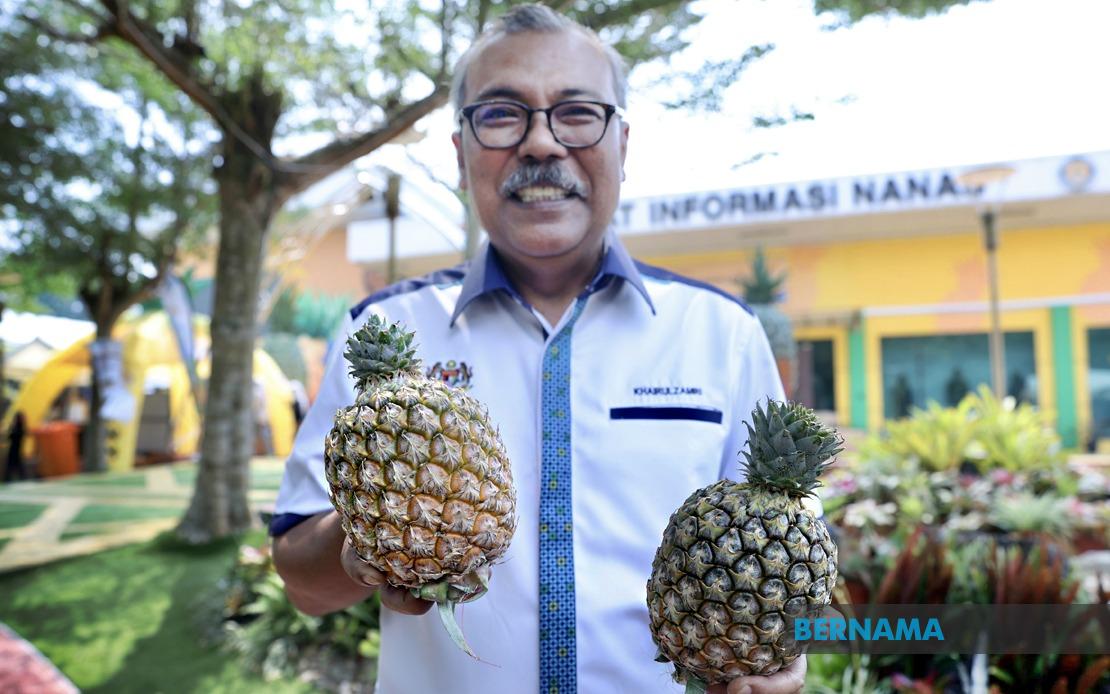
A striking new pineapple variety from Sarawak is capturing attention at Malaysia's premier agricultural showcase, signalling a potential shift in the nation's approach to tropical fruit production and food security. The Sarawak Gold (SG1), on prominent display at Laman Nanas during MAHA 2026, represents the culmination of agricultural innovation aimed at boosting productivity and competitiveness in an industry that has long relied on established methods. Seven tonnes of the premium fruit have been transported from Sarawak to the Malaysia Agriculture Expo Park (MAEPS) in Serdang, offering thousands of visitors an opportunity to experience what industry leaders believe could reshape domestic pineapple farming.
According to Mohd Khairuzamri M. Salleh, director-general of the Malaysian Pineapple Industry Board (LPNM), the SG1 represents more than incremental improvement over existing varieties. The fruit was first identified and developed in Miri, emerging as a carefully cultivated option that addresses longstanding constraints affecting Malaysian pineapple growers. What distinguishes SG1 in a crowded marketplace is its combination of desirable characteristics: the sweetness profile matches the widely favoured MD2 variety, while its distinctive rose-shaped crown provides visual appeal that could command premium positioning in retail environments. Perhaps more significantly, the variety delivers uniform quality and flavour throughout the fruit rather than concentration near the base, a feature that enhances consistency for both fresh consumption and processing applications.
The production timeline represents a substantial competitive advantage that fundamentally alters farming economics. Whereas the industry-standard MD2 requires fourteen months from planting to harvest, SG1 reaches maturity in just nine months—a reduction of roughly thirty-five percent that enables growers to complete more than one full crop cycle annually on the same land. This accelerated timeline means higher cash flow turnover, reduced exposure to pest and disease cycles, and greater flexibility in responding to market demand fluctuations. For smallholder farmers operating on tight margins, the ability to generate revenue faster carries profound implications for farm sustainability and household income stability.
Planting density represents another dimension where SG1 diverges sharply from conventional practice. The variety thrives when cultivated at densities of 25,000 to 30,000 plants per acre, compared to the 8,000 to 10,000 plants per acre typical for competing varieties. This capacity to triple output per unit of land without necessarily expanding cultivation area addresses a critical constraint for Malaysian agriculture: the scarcity of available arable land suitable for intensive farming. For a nation where suitable agricultural terrain is increasingly fragmented and contested with competing land uses, the ability to extract significantly higher yields from existing holdings represents an economically and ecologically prudent development.
The LPNM has already begun strategising expansion of SG1 cultivation beyond its Sarawak origins to Peninsular Malaysia, recognising that geographical diversification strengthens supply security and reduces regional bottlenecks. Industry sources indicate that SG1 seedlings destined for growers throughout the peninsula should reach distribution channels within the coming year, accelerating adoption rates across the nation. This deliberate rollout strategy reflects institutional learning about the challenges of introducing novel agricultural technologies; controlled expansion allows for technical troubleshooting, value chain adjustment, and accumulation of agronomic knowledge before large-scale implementation.
International market prospects appear encouraging based on preliminary export trials. Shipments from Sarawak to Singapore have successfully navigated logistics, quality standards, and consumer acceptance benchmarks, validating the variety's viability for regional trade. The resilience characteristics that enable the fruit to withstand Malaysian growing conditions and shipping procedures position SG1 favourably for penetration into larger Asian markets, particularly China and New Zealand, where pineapple demand exceeds local supply. Access to these premium markets could substantially elevate revenue per unit for Malaysian exporters, attracting investment capital into production expansion and posing strategic advantages over competing suppliers in other nations.
Beyond the individual fruit itself, LPNM has framed the broader showcase around integrated value creation that extends throughout the pineapple plant lifecycle. The 2026 MAHA presentation adopts the conceptual framework "one planting, three harvests," emphasising that commercial viability transcends the fresh pineapple market. Crowns destined for ornamental applications, leaves convertible into fibrous materials for textiles, and processing residue amenable to ruminant feed formulation represent diversified revenue streams that enhance overall farm economics. The capacity to extract commercial value from components typically discarded represents both efficiency gains and waste reduction aligned with contemporary sustainability imperatives.
This diversification aligns strategically with Malaysia's food security objectives by optimising resource utilisation and creating multiple product categories from single cultivation inputs. Rather than concentrating solely on fresh fruit exports vulnerable to price volatility and market saturation, integrated pineapple agriculture generates complementary products serving domestic industrial demand. Ruminant feed production supports the livestock sector, while fibre-based materials feed textile and paper industries, thereby building resilience across multiple agricultural and manufacturing domains. This integrated approach reflects sophisticated understanding of systems-level agricultural policy rather than siloed commodity production.
Meanwhile, MAHA 2026 itself has become a vehicle for recalibrating public perception of pineapple farming as a sector. Spanning August 28 through September 6 at MAEPS, the exposition attracts an anticipated four million visitors and features approximately 2,000 exhibitors representing Malaysian agricultural enterprises, input suppliers, and industry associations. The prominence accorded to pineapple-focused programming within the larger agricultural festival framework signals institutional commitment to elevating the sector's profile and attracting investment, entrepreneurial interest, and consumer engagement.
The emergence of SG1 occurs within a broader context of agricultural modernisation priorities for Southeast Asia. Regional competitors in India, Thailand, and Philippines likewise pursue varietal innovation and production efficiency improvements to capture export market share. Malaysia's capacity to develop and commercialise novel varieties through institutions like LPNM, coupled with existing advantages in technology adoption and export infrastructure, positions the nation competitively within regional pineapple industries. However, sustained advantage requires continuous investment in research capabilities, farmer extension programming, and supply chain development to translate agronomic innovation into sustained commercial returns.
For Malaysian policymakers and agricultural stakeholders, the SG1 narrative extends beyond horticultural interest into broader questions of rural development, export competitiveness, and food systems resilience. Shorter production cycles, higher-density cultivation, and value-added processing opportunities create pathways for agricultural entrepreneurs—particularly younger generations potentially more receptive to innovation-intensive farming. The international trade interest demonstrated through Singapore trials and anticipated penetration into additional markets underscores Malaysia's capacity to compete in globalised agricultural markets through quality differentiation and supply reliability rather than price-based competition.
The successful positioning of Sarawak Gold pineapples at Malaysia's foremost agricultural showcase represents a convergence of research achievement, industry coordination, and strategic market communication. Whether SG1 ultimately achieves widespread adoption depends substantially on extension effectiveness, grower economics at farm scale, and sustained market demand validation. Nevertheless, the variety's characteristics and the institutional support mobilised around its commercialisation signal that Malaysian agriculture retains capacity for productive innovation addressing global market expectations.

