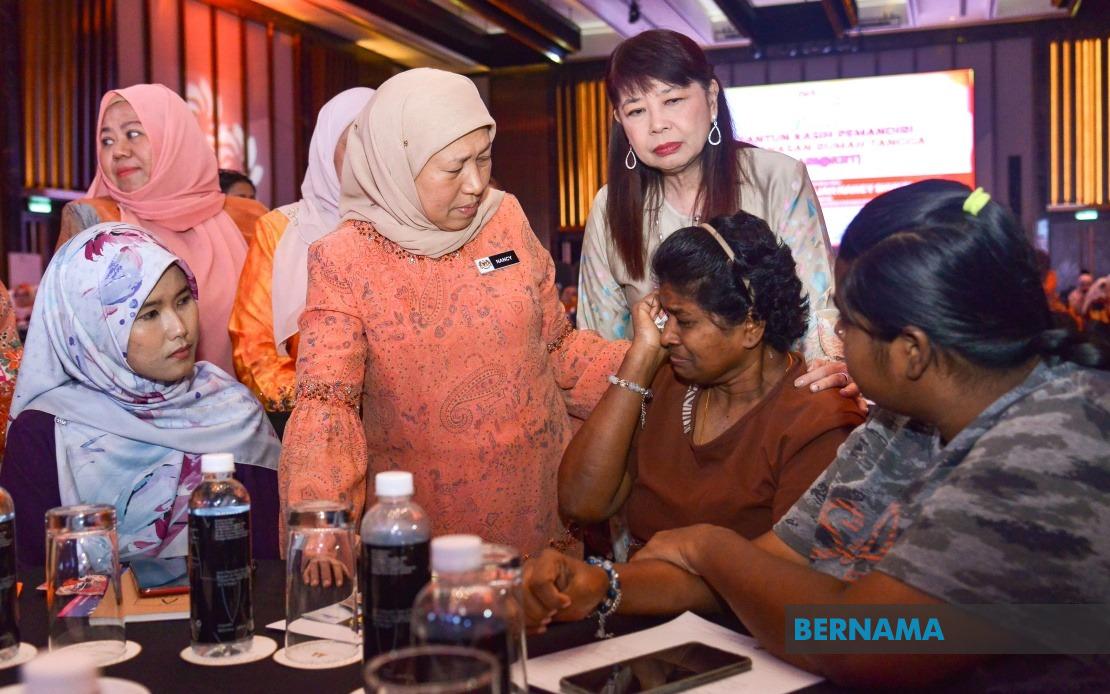
Malaysia's Ministry of Women, Family and Community Development has unveiled an ambitious initiative to rehabilitate domestic violence survivors across the country. The SARI@KRT: Road to Eliminate Violence Against Women (EVAW) 2026 programme, launched by minister Datuk Seri Nancy Shukri, aims to reach at least 1,400 victims through a multi-pronged approach that combines psychological counselling, legal support, and economic assistance designed to help women regain independence and rebuild their lives after traumatic experiences.
The scale of the domestic violence crisis in Malaysia has become increasingly apparent, with official figures revealing a troubling upward trajectory. Police statistics indicate that reported domestic violence cases surged to 4,014 incidents in the first half of this year, up from 3,678 cases during the corresponding period in 2023. This represents a rise of approximately 9 percent year-on-year, though authorities and advocates have cautioned against interpreting raw numbers solely as a worsening problem. Rather, they suggest the increase reflects growing public awareness and, critically, a shift in victim behaviour as women gain confidence to report abuse through formal channels rather than suffering in silence.
Geographical disparities in reported cases paint a complex picture of domestic violence distribution across the nation. Johor emerged as the state with the highest concentration of incidents, recording 721 cases during the first six months of 2024. Selangor followed with 614 reported cases, while Perak recorded 405 incidents. These variations may reflect demographic factors, population density, and the effectiveness of local reporting mechanisms rather than straightforward comparisons of abuse prevalence between regions.
Underlying causes of domestic violence reveal patterns centred on relationship dysfunction and socioeconomic pressures. Misunderstandings and communication breakdowns emerged as the primary driver, accounting for nearly half of all reported cases at 1,967 incidents. Substance abuse issues contributed to 444 cases, while financial strain triggered 378 domestic disputes. These statistics underscore the multifactorial nature of intimate partner violence and suggest that intervention strategies must address both interpersonal dynamics and broader economic vulnerabilities that destabilise households.
Financial abuse, a particularly insidious form of domestic violence, has received increased attention from policymakers recognising its devastating impact on victim autonomy and safety. Nancy highlighted situations where economically capable spouses deliberately withhold financial provision, forcing partners to bear household costs independently. This category of abuse—often invisible compared to physical violence—effectively traps victims through economic dependency and prevents their ability to access resources necessary for escape. The minister emphasised that financial support constitutes a shared responsibility, challenging cultural narratives that position economic provision solely within male domains while simultaneously enabling abusers to exploit economic inequality as a control mechanism.
The SARI@KRT programme operationalises this understanding through comprehensive support structures. At its core, the initiative targets a minimum of 100 programme participants per state, ensuring geographically distributed access across Malaysia's thirteen states and three federal territories. The design incorporates psychosocial interventions recognising that trauma recovery requires sustained psychological support, not merely crisis response. Participants receive counselling and therapeutic services alongside practical assistance navigating legal systems for restraining orders, divorce proceedings, and custody arrangements.
Economic empowerment constitutes a critical pillar of the intervention framework. By enabling survivors to achieve financial self-sufficiency, the programme directly addresses a primary vulnerability exploited by abusers. Training, skills development, and employment placement support help women transition from dependency to independence, simultaneously reducing recidivism risks. The ministry has established special allowance provisions enabling survivors to attend court hearings related to child maintenance claims, removing financial barriers that historically prevented women from accessing justice.
The government's positioning of increased reporting as a positive indicator reflects evolving perspectives on domestic violence statistics. Rather than viewing higher numbers solely as evidence of crisis escalation, authorities increasingly recognise that greater awareness campaigns, improved service accessibility, and shifting social norms encouraging disclosure generate more accurate pictures of abuse prevalence. This reframing proves important for Malaysian readers assessing national safety and comparing outcomes across regions, as it distinguishes between rising violence rates and rising reporting rates—fundamentally different phenomena requiring distinct policy responses.
For Southeast Asian context, Malaysia's systematic approach mirrors international best practices developed over decades in countries with longer histories of coordinated anti-domestic violence frameworks. The programme's integration of legal, psychological, and economic support reflects consensus among experts that compartmentalised interventions—such as offering only counselling or only legal aid—prove insufficient for sustainable recovery. The regional dimension matters because domestic violence patterns in Malaysia share characteristics with neighbouring countries facing similar challenges of rapid urbanisation, economic inequality, and evolving family structures that heighten relationship instability.
Implementation challenges will test the programme's effectiveness across diverse communities with varying access to urban services, legal literacy, and cultural receptivity to government intervention in family matters. Rural and indigenous communities particularly require tailored approaches recognising distinct family structures and traditional dispute resolution mechanisms. Nancy's emphasis on encouraging victims to seek assistance through official channels implicitly acknowledges resistance rooted in shame, family reputation concerns, and scepticism regarding institutional responsiveness.
The government's stated commitment to ensuring victims no longer suffer silently represents a fundamental reorientation toward victim-centred rather than family-preservation approaches historically dominant in Malaysian social policy. This philosophical shift carries significant implications for how authorities balance protection of individual safety against pressures to maintain family units, a tension particularly acute in Malaysian society where family cohesion remains culturally valued. The SARI@KRT programme's existence signals official recognition that safety must supersede preservation when the two objectives conflict.

