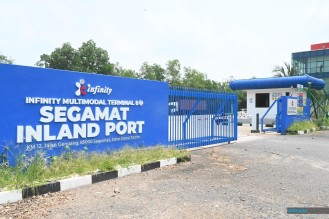
Segamat Inland Port has set its sights on processing over 6,000 twenty-foot equivalent units (TEUs) of containers before 2026 concludes, marking a significant milestone for the facility that restarted operations in late June after languishing largely unused for more than a decade. The facility, now managed by Infinity Logistics & Transport, handled approximately 1,000 TEUs during its first operational month through July, a foundation that port officials believe can be substantially expanded through the remainder of the year.
The resurrection of this inland port reflects a broader strategic pivot by Malaysia's government to strengthen its logistics infrastructure and reduce the environmental and safety costs associated with road-based cargo movement. Located alongside Segamat Railway Station on 20.23 hectares of land—representing only the first phase of a three-phase development plan—the facility represents a critical nodal point in the nation's evolving supply chain architecture. Its reactivation aligns with the Road to Rail initiative, a collaborative effort between the government and Keretapi Tanah Melayu Bhd that seeks to enhance the viability and attractiveness of rail transport for commercial cargo operations.
The timing of the facility's restart coincides with the completion of double-tracking railway infrastructure extending to Johor, a project that fundamentally transforms the operational economics of freight rail in the region. Previously, single-track operations severely constrained scheduling flexibility, requiring cargo trains to yield priority to passenger services. This structural limitation meant the port could accommodate only approximately one cargo dispatch per week. The double-track investment removes this critical bottleneck, enabling SIP to now conduct up to four cargo movements weekly—a four-fold increase in operational capacity that opens fresh possibilities for regional logistics operators.
The economic calculus favouring rail over road transport extends beyond mere scheduling convenience. A single cargo train journey performs the equivalent work of roughly 80 container trucks, dramatically reducing fuel consumption and associated emissions. Furthermore, rail transport mitigates the safety risks inherent in road logistics, where highway accidents and congestion-induced delays impose significant costs on supply chains. These efficiency gains assume particular importance for industrial clusters spread across northern Johor, southern Pahang, southern Negeri Sembilan, and Melaka—geographically dispersed areas where consolidated rail-based logistics can deliver meaningful competitive advantages.
The facility currently employs more than 200 workers drawn from local communities, a figure that port management expects to multiply upon completion of subsequent development phases. This employment multiplication effect represents tangible economic benefit for districts such as Batu Pahat and Kluang, traditionally dependent on agricultural and small-scale manufacturing sectors. Beyond direct job creation, the port's presence may catalyse broader industrial investment, as logistics accessibility functions as a decisive location factor for manufacturers and warehouse operators evaluating site selection decisions.
SIP's operational footprint carries implications extending well beyond Segamat itself. Monthly operations are projected to eliminate approximately 18,000 lorry movements—encompassing both articulated and container-carrying trucks—from public roads. This volume reduction addresses multiple policy objectives simultaneously: alleviating congestion pressure on highways, improving road safety by reducing heavy vehicle density, and optimizing rail network utilization. For Malaysia's transport authorities, such figures translate into deferred infrastructure investment requirements and reduced maintenance demands on road assets subjected to intensive commercial traffic.
The port's connection to major transhipment hubs—Port Klang, Port of Tanjung Pelepas, and Johor Port in Pasir Gudang—positions it as an interface between maritime and inland rail networks. This intermodal connectivity allows shippers to distribute cargo from ports into regional distribution networks more efficiently than road-only alternatives, particularly for destinations in the interior. The competitive advantage accrues especially to time-sensitive and hazardous cargo categories where rail safety advantages prove compelling.
SIP's revival also reflects institutional confidence in Malaysia's broader transport modernization agenda. Transport Minister Anthony Loke Siew Fook, who officiated the facility's June 2026 launch, characterized it as a catalyst for economic development in northern Johor specifically and a contributor to national supply chain efficiency more broadly. This ministerial endorsement signals sustained government commitment to inland port development as a cornerstone of transport policy—a commitment that creates relative certainty for private operators and investors considering long-term involvement in rail-based logistics.
The facility's knowledge-sharing arrangement with Universiti Tun Hussein Onn Malaysia demonstrates integration between operational infrastructure and academic research. Through fieldwork exposure and collaborative studies, UTHM students and researchers gain practical understanding of rail-based port operations, while SIP benefits from academic scrutiny of its processes and access to emerging research on transport efficiency. This symbiosis strengthens both institutional capacity and the evidence base for transport policy decisions.
Looking forward, SIP's trajectory will partly depend on competitive dynamics within the broader logistics sector. Road hauliers may resist cargo diversion to rail, particularly where modal shifting requires investment in complementary infrastructure or operational adjustments. Shippers accustomed to road flexibility face switching costs and coordination challenges. Yet the scale of efficiency advantages—the four-fold increase in scheduling capacity, the 80-to-1 truck substitution ratio, the safety and environmental benefits—suggests structural economics favour gradual rebalancing toward rail for appropriate cargo categories.
The 6,000 TEU target for 2026 represents approximately doubling the facility's first-month throughput across a seven-month window, assuming roughly linear growth. Achieving this trajectory requires sustained demand from regional industries, robust coordination between the port operator and major shipping lines serving Malaysian ports, and continued confidence in rail service reliability. If successful, these metrics will validate the broader inland port investment thesis and potentially encourage similar initiatives at other strategically positioned railway nodes throughout Malaysia.

