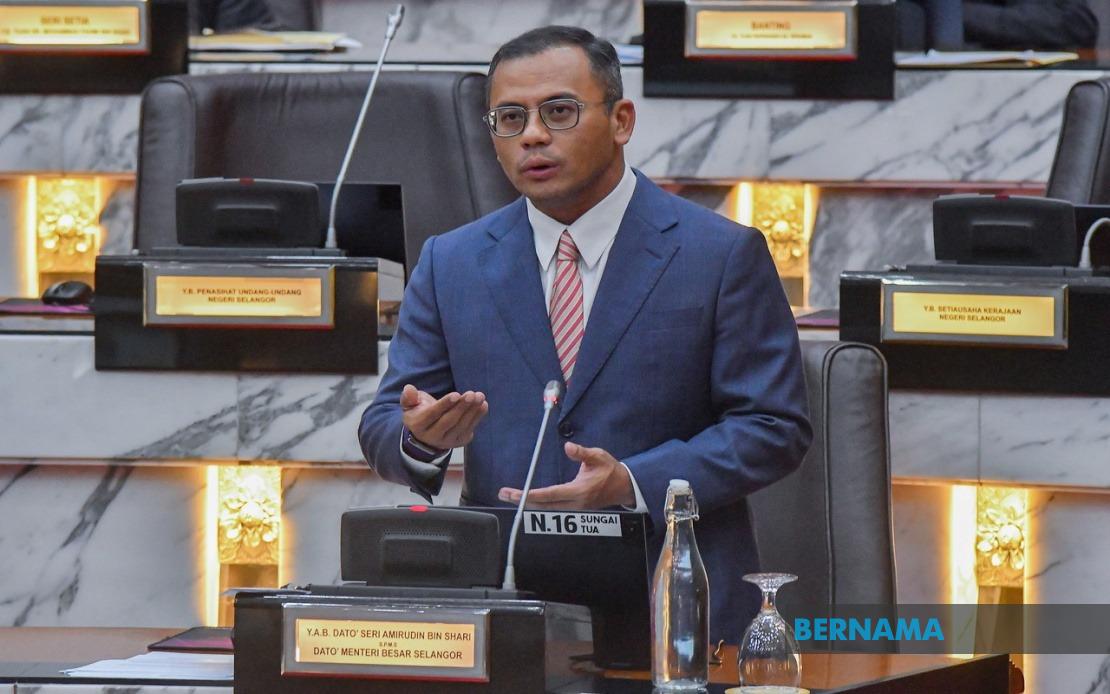
Selangor's Menteri Besar Datuk Seri Amirudin Shari has ordered all local authorities across the state to conduct a comprehensive review of connectivity infrastructure serving public transportation networks. The directive, announced during the State Legislative Assembly's debate on the Selangor Resilience Strengthening Package, signals mounting pressure to address long-standing frustrations with how commuters access bus and rail services from residential areas.
The scrutiny centres on the accessibility of the LRT3 line and other transit hubs, where residents have struggled with inadequate pedestrian pathways, poorly lit walkways, and limited feeder bus routes. These gaps between major transport nodes and surrounding neighbourhoods have become a recurring pain point for commuters, increasingly voiced through social media platforms. Rather than dismissing these complaints as isolated incidents, the state leadership has acknowledged the systemic nature of the problem and committed to finding solutions.
Amirudin emphasised that his government stands prepared to inject additional resources into improving these facilities, contingent on proper planning and execution. Crucially, he stressed that financial investment alone will not resolve the issue—the allocation must be strategic, targeting genuine infrastructure deficiencies rather than being spent inefficiently. This reflects a growing recognition that throwing money at the problem without addressing underlying operational weaknesses would be counterproductive and waste public funds.
The Menteri Besar's comments carried an implicit critique of local authorities for their reactive rather than proactive approach. He called out what he sees as a troubling pattern: municipal bodies waiting for complaints to gain traction on social media platforms like X and Threads before responding, rather than engaging systematically with council members and key stakeholders to anticipate problems. This performance-driven reactivity undermines strategic planning and suggests disconnects between decision-makers and ground-level realities that ordinary commuters face daily.
The broader motivation underpinning this review reflects Selangor's wider policy objective to shift public behaviour towards greater reliance on mass transit. If commuters cannot easily reach bus stops or train stations from their homes, or struggle to complete their journeys once disembarking, they will inevitably revert to private vehicles regardless of state incentives to use public transport. This vicious cycle perpetuates congestion and emissions while wasting the potential of infrastructure investments already made in rail networks.
State Investment, Trade and Mobility Committee chairman Ng Sze Han has been tasked with convening all public transport operators across Selangor to map service coverage comprehensively. The exercise aims to identify precisely where connectivity gaps exist and which areas remain underserved. This data-driven approach should illuminate whether problems stem from absent routes, infrequent scheduling, inconvenient timings, or physical infrastructure deficiencies—or more likely, some combination of these factors.
Amirudin's acknowledgement that government subsidies could ease operator costs points to the financial pressures constraining service expansion. Public transport operators often struggle to maintain profitability on lower-density routes essential for first and last-mile connectivity. Without subsidy support, operators default to cost-cutting measures that include reducing off-peak services, precisely when many commuters depend on consistent access. The state government's willingness to deploy subsidies suggests recognition that market forces alone cannot deliver equitable public transport coverage.
However, Amirudin also delivered a pointed message: subsidies will prove worthless if operators do not utilise them to improve service hours and frequency. Some operators may pocket subsidies without meaningfully expanding their routes or extending operating hours into evening periods when many shift workers commute. This accountability requirement reflects growing sophistication in how authorities approach transport subsidies, moving beyond simple funding transfers toward performance-based mechanisms that tie financial support to verifiable service improvements.
The intervention addresses a tension between Selangor's rapid urbanisation and infrastructure capacity. The state continues attracting new residential and commercial development, often in peripheral areas where transit networks have not caught up. Developers may construct housing estates far from existing rail stations, creating stranded communities dependent on private cars. Coordinating transport planning with land-use development emerges as essential, though rarely executed seamlessly in Malaysian governance.
This review also reflects changing political dynamics in Selangor. The state has experienced relatively consistent governance that permits longer-term planning compared to some other Malaysian states. Public accountability through social media has sharpened, making elected officials more responsive to articulated grievances. The Menteri Besar's explicit acknowledgement of viral social media complaints suggests he recognises that ignoring digital-age constituency demands risks credibility and political consequences.
For Malaysian commuters nationwide, Selangor's experience offers both a template and a cautionary tale. Well-resourced urban centres like Selangor should be able to solve first and last-mile connectivity problems; if they struggle, other states will face even greater challenges. The issue touches on equity—wealthier residents can afford private vehicles to bridge transit gaps, while lower-income households remain trapped in poorly connected areas. Resolving this connects directly to broader social mobility and economic opportunity.
The pathway forward requires sustained political commitment beyond initial announcements. Previous administrations have launched transport connectivity initiatives that lost momentum or failed implementation due to bureaucratic friction, operator resistance, or shifting budget priorities. Amirudin's directive carries weight only insofar as his administration enforces compliance and allocates funds reliably. Commuters and observers will judge success not by statements but by tangible improvements in walkways, lighting, and bus frequencies within measurable timeframes.