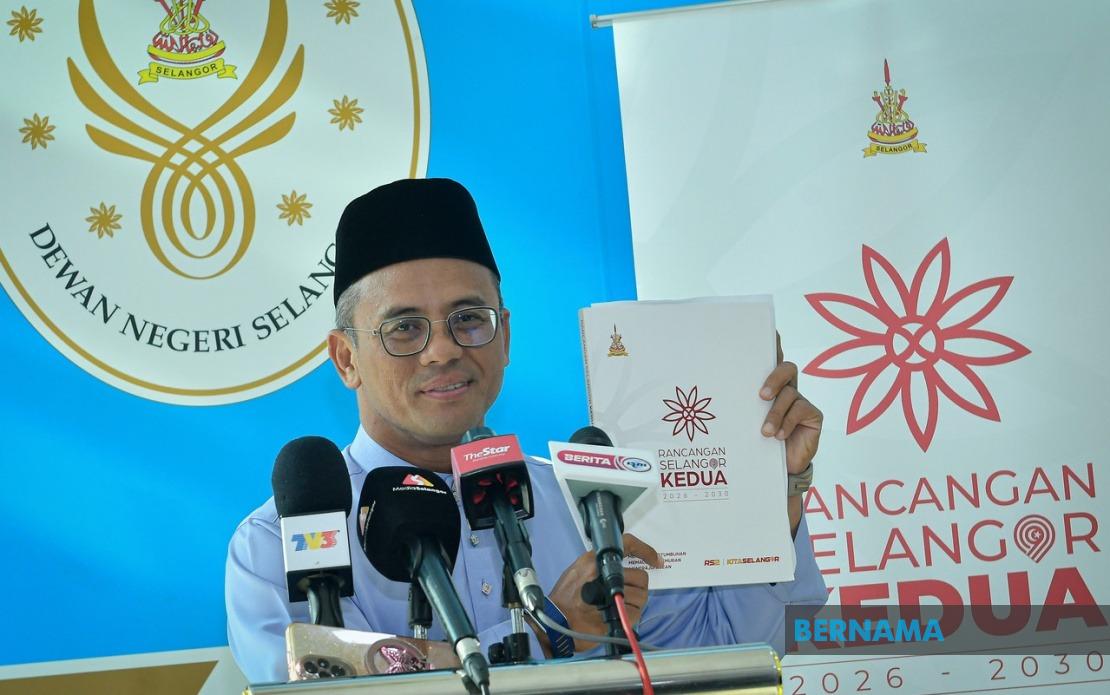
Menteri Besar Datuk Seri Amirudin Shari has set an ambitious performance benchmark for Selangor's municipal landscape, declaring that every local authority in the state must attain and sustain a 95 per cent score under the PBT Star Rating System by the end of the decade. The announcement, made during the tabling of the Second Selangor Plan (RS-2) at the state assembly, represents a significant escalation in service delivery expectations across the state's network of public sector institutions.
The performance target encapsulates a broader philosophical shift within the Selangor administration, moving away from an approach where service excellence is concentrated in a handful of well-resourced municipalities towards a model of universalised quality. According to Amirudin, the mandate reflects the state government's commitment to ensuring that residents throughout Selangor, regardless of their geographical location, have access to consistently high standards of public administration and infrastructure management. This equitable approach stands in contrast to traditional patterns where wealthier or more urbanised local authorities typically outpace their counterparts in performance metrics.
Parallel to the performance overhaul, the state government intends to accelerate its digital transformation agenda, with local authorities tasked to achieve 85 per cent End-to-End Digital Government Service Sharing by 2030. This initiative goes beyond mere digitisation of existing processes; it aims to establish seamless data integration and interoperability across municipal systems, enabling residents to access services through unified digital platforms rather than navigating fragmented bureaucratic channels. For Malaysia's largest economic engine by gross domestic product, such technological standardisation could serve as a template for other states seeking to modernise their administrative infrastructure.
The Menteri Besar's remarks emphasised that local authorities must substantially intensify their operational capabilities and responsiveness to fulfil these ambitious targets. The narrative presented was unambiguous: service quality must become the paramount organisational priority within each municipal structure, displacing other considerations that may have historically commanded resources or attention. This recalibration suggests that Selangor intends to hold local councillors and administrators to measurable, transparent accountability standards that transcend the often opaque performance evaluations that have characterised Malaysian local government.
Feedback mechanisms emerge as a critical element in the performance framework. Amirudin stressed that municipal leaders must demonstrate genuine commitment to addressing grievances emanating from multiple channels, particularly the increasingly influential domain of social media platforms where public dissatisfaction accumulates rapidly and spreads virally. This recognition acknowledges a reality facing contemporary Malaysian governance: citizen expectations have evolved such that responsiveness to digital complaints carries political and institutional consequences. Local authorities that dismiss online criticism or fail to engage constructively with aggrieved residents now face reputational damage that extends far beyond the immediate complainant.
Underlying the performance restructuring is a recognition that Selangor's financial architecture requires fundamental realignment. The Menteri Besar disclosed that land premiums and rental income currently constitute approximately 75 per cent of state revenue, a concentration that Amirudin characterised as representing significant structural vulnerability. This dependency exposes the state to cyclical property market fluctuations and creates perverse incentives favouring land exploitation over sustainable economic development. By framing this as a strategic risk requiring mitigation, the administration signals intent to pursue alternative revenue streams that promise greater stability and alignment with long-term economic diversification objectives.
The RS-2 framework proposes addressing fiscal vulnerability through innovative financing mechanisms and enhanced private sector engagement. Government-linked companies are positioned as principal instruments for executing this reorientation, with the state government committing to strengthen strategic alignment between these entities and overarching policy objectives. This approach reflects lessons drawn from comparable economies where state-owned enterprises function as flexible capital deployment vehicles, capable of navigating regulatory constraints that restrict direct government spending while simultaneously capturing commercial returns.
A particularly significant structural innovation within RS-2 involves the establishment of an integrated State Investment Holding company. This consolidation responds to historical inefficiencies where multiple state-linked entities operated with overlapping mandates, duplicative functions, and internal competitive dynamics that dissipated public capital rather than amplifying it. By centralising control and governance within a unified holding structure, Selangor intends to eliminate functional redundancy whilst enabling subsidiary companies to pursue specialised strategic objectives aligned with the state's identified economic priorities.
The emphasis on technology and service-sector economic development within RS-2 reflects positioning Selangor as a competitor for sophisticated business functions and talent migration within the Southeast Asian region. Rather than pursuing labour-intensive manufacturing or commodity-based activities, the state government explicitly orients its investment strategy towards higher-value-added sectors where Malaysian comparative advantage remains defensible against regional competition. This strategic focus carries implications for local authority development priorities, as municipalities will increasingly be evaluated not merely on operational efficiency metrics but on their capacity to attract and retain knowledge-intensive enterprises.
For practitioners of Malaysian federalism, the RS-2 announcement carries significance beyond Selangor's administrative boundaries. As Malaysia's most economically dynamic and institutionally sophisticated state, Selangor frequently serves as a testing ground for governance innovations subsequently adopted by other states. The performance benchmarking approach, digital integration standards, and revenue diversification strategies outlined here may presage a broader national recalibration of how local government effectiveness is measured and incentivised across the federation.
The 2030 timeframe established by Amirudin provides a defined planning horizon without creating unrealistic implementation burdens. This seven-year window permits municipalities to undertake phased organisational reforms, technology investments, and capability-building whilst delivering incremental performance improvements amenable to measurement and monitoring. For local authorities already operating at lower efficiency levels, the trajectory demands substantial acceleration in improvement rates, positioning the coming years as a critical test of institutional capacity within Malaysia's municipal sector.

