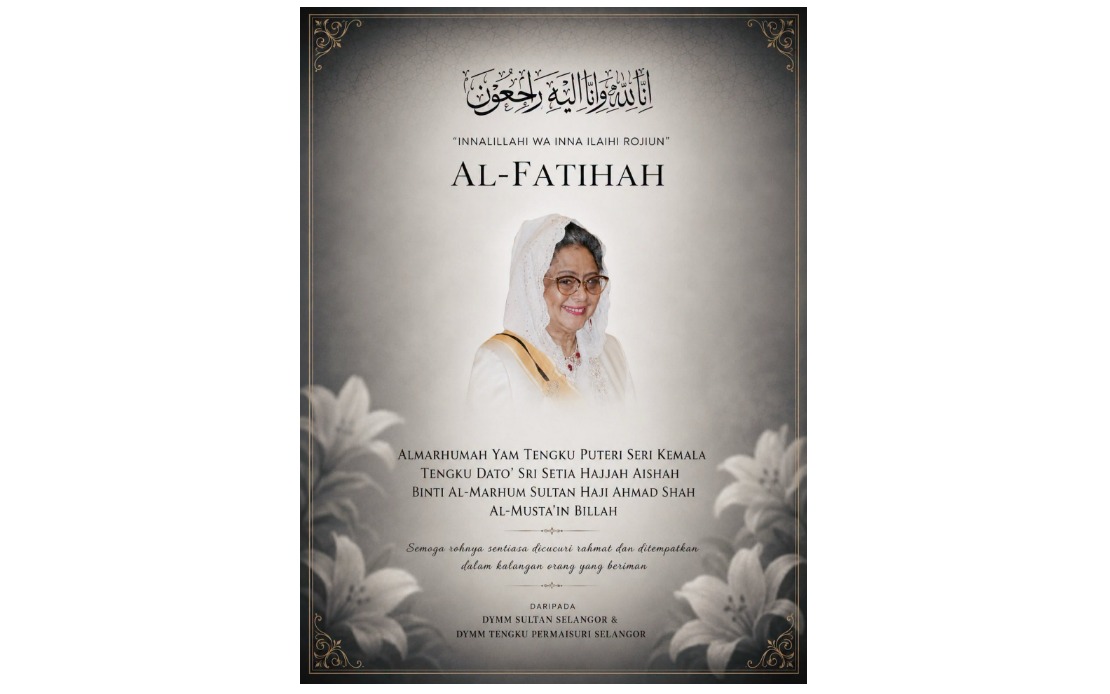
The Sultan of Selangor, Sultan Sharafuddin Idris Shah, and the Tengku Permaisuri of Selangor, Tengku Permaisuri Norashikin, have formally expressed their condolences to the Sultan of Pahang, Al-Sultan Abdullah Ri'ayatuddin Al-Mustafa Billah Shah, following the death of his elder sister, Tengku Puteri Seri Kemala Tengku Datuk Seri Aishah Almarhum Sultan Ahmad Shah. The Selangor Royal Office released a statement on August 27 conveying the bereaved family's sentiments during this period of mourning.
According to the official announcement from the Selangor Palace, Sultan Sharafuddin and Tengku Permaisuri Norashikin expressed profound sadness at the news of the passing. Their statement reflected the deep sorrow felt at the loss of a member of the extended royal family, underscoring the bonds that unite Malaysia's various sultanates through shared lineage and institutional kinship. The formal expression of sympathy represents an important tradition within the royal households, where condolences between state rulers serve as an acknowledgement of shared grief and mutual respect.
Tengku Datuk Seri Aishah, who held the title of Tengku Puteri Seri Kemala, passed away at a hospital in Kuala Lumpur at 9.15 pm on August 26. She was a member of the Pahang royal family and held significance within the state's institutional hierarchy. Her death marks the loss of an elder family member whose life spanned much of modern Malaysian history, having been born during the era before independence and witnessing the nation's development into a constitutional monarchy.
The Selangor Palace statement included a religious invocation for the deceased, requesting that Allah's mercy be granted to her soul and that she be numbered among the faithful. This expression, captured in the traditional Islamic prayer "Al-Fatihah," reflects the spiritual dimension that frames royal mourning practices in Malaysia's Islamic constitutional framework. Such prayers underscore how religious observance remains central to official state ceremonies and personal expressions of grief within the royal institution.
Following customary royal protocols, Tengku Datuk Seri Aishah's remains were transported to the Pahang Royal Mausoleum in Pekan for burial. The funeral arrangements adhered to full royal honours and were conducted according to established royal customs, reflecting her status within the Pahang royal household. The return of the deceased to Pekan, the state capital, represents a homecoming of sorts, as the royal mausoleum serves as the final resting place for members of Pahang's ruling family and their close relatives.
The exchange of condolences between the sultanates of Selangor and Pahang demonstrates the interconnected nature of Malaysia's royal system. Although each state maintains its own sovereign ruler and institutional framework, bonds of kinship, marriage, and shared constitutional responsibility create networks of mutual obligation and respect among the nine sultanates. These gestures of sympathy, while sometimes overlooked in media coverage, represent important ceremonial anchors within the constitutional monarchy.
Tengku Datuk Seri Aishah's passing also highlights the generational transitions occurring within Malaysia's royal families. As an elder sister of the current Sultan of Pahang, she represented a link to previous eras of the state's governance and family history. Her death signals the natural passage of time affecting those who witnessed earlier chapters of the nation's institutional development, including the period of the Emergency and the early post-independence decades.
The formal nature of the Selangor Palace's public statement reflects institutional practices around royal mourning in Malaysia. Rather than remaining entirely private, significant deaths within the royal families are marked by official announcements that serve multiple functions: they provide factual information to the public, demonstrate respect through formal acknowledgement, and reinforce the protocols that govern interactions between state rulers. Such statements are carefully crafted to balance personal emotion with official decorum.
For the Sultan of Pahang, this period represents a time of personal and family reflection. As a reigning sultan managing significant state responsibilities, he must navigate both his private grief and his public duties. The support expressed through condolences from other state rulers, including those from Selangor, provides a form of collective acknowledgement that recognises both the personal loss and the significance of his position within Malaysia's constitutional framework. These expressions of solidarity have historical precedent and reflect enduring protocols within the Malaysian royal system.
The funeral arrangements conducted with full honours underscore the respect accorded to senior members of royal families, regardless of whether they held formal political office. The burial at the Pahang Royal Mausoleum in Pekan places Tengku Datuk Seri Aishah among other significant figures in the state's history, preserving her memory within the institutional narrative of Pahang's royalty. This practice of honouring elders through ceremonial burial reflects Islamic principles combined with Malaysia's particular tradition of respecting age and family seniority within hierarchical structures.

