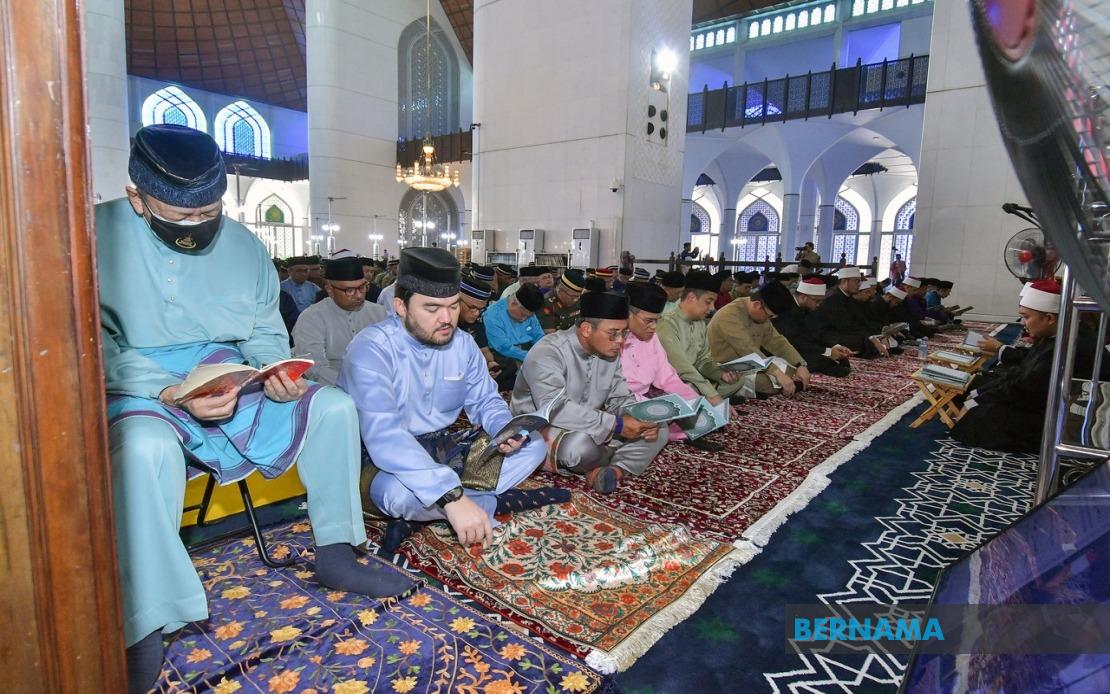
Sultan Sharafuddin Idris Shah, the reigning Sultan of Selangor, participated in a Surah Yassin recitation and tahlil ceremony on Wednesday, 28 August, at Masjid Sultan Salahuddin Abdul Aziz Shah in Shah Alam, in a solemn spiritual observance timed ahead of the nation's Independence Day commemoration. The event drew together state and religious leadership, with Raja Muda Tengku Amir Shah Sultan Sharafuddin Idrs Shah standing alongside His Majesty throughout the proceedings, underscoring the royal family's commitment to leading spiritual occasions for the state.
When the Sultan arrived at the mosque, he received a formal welcome from Selangor Menteri Besar Datuk Seri Amirudin Shari and Dr Mohammad Fahmi Ngah, who chairs the State Islamic Affairs and Innovation Culture Committee. The gathering also included key figures from Selangor's Islamic administration: Datuk Mohd Shahzihan Ahmad, director of the Selangor Islamic Religious Department (JAIS), and Datuk Salehuddin Saidin, who leads the Selangor Islamic Religious Council (MAIS). This convergence of state executives and religious officials reflected the ceremonial significance attached to the occasion.
Approximately 1,000 worshippers participated in the Surah Yassin recitation, a practice that holds deep spiritual meaning in Islamic tradition. Notably, the attendees included personnel from the security forces deployed throughout Selangor, representing a cross-section of the state's communities and services. The inclusion of uniformed servicemen and women signalled the inclusive nature of the religious observance, transcending conventional mosque attendance to encompass public servants.
Following the recitation, Sultan Sharafuddin led the Friday congregational prayers, an act that reaffirmed his ceremonial and spiritual role as head of Islam in Selangor. The sermon, titled "Merdeka Daripada Belenggu Kerakusan" (Freedom from the Shackles of Greed), was delivered by Muhammad Farhan Wijaya, the Grand Imam of Masjid Sultan Salahuddin Abdul Aziz Shah, who simultaneously led the prayer proceedings. The sermon's theme carried deliberate resonance with the Merdeka season, weaving spiritual messaging about restraint and liberation from material excess into the Independence Day period.
The timing of this religious gathering carries symbolic weight beyond its immediate ceremonial function. By conducting these prayers in the days immediately preceding the national celebration, the Sultan positioned spiritual reflection and Islamic observance as foundational to Malaysia's identity and values. This approach mirrors practices across Malaysia's sultanates, where state rulers frequently lead or participate in religious ceremonies that reinforce the connection between monarchy, Islam, and national identity.
For Selangor specifically, the event at Masjid Sultan Salahuddin Abdul Aziz Shah—one of the state's most prominent religious landmarks—served as a visible reminder of the state's Islamic heritage and institutional commitment to religious values. The mosque, a notable architectural and spiritual center in the Klang Valley region, provided an appropriate venue for this gathering of civil and religious dignitaries.
The state-level National Day celebrations will proceed with full pageantry at Kajang Stadium on Sunday, 30 August, commencing at 8 pm. The event will operate under the theme "Malaysia MADANI: Kesejahteraan Dinikmati" (Malaysia MADANI: Prosperity Enjoyed), directly aligning with the federal government's broader Malaysia MADANI framework. This thematic consistency suggests that Selangor's Independence Day programming will emphasise inclusive prosperity and collective well-being as central to the national narrative.
The Malaysia MADANI theme, which has become increasingly prominent in official government messaging since its introduction, emphasises values of unity, prosperity, and good governance. By incorporating this framework into Selangor's celebrations, state authorities signal alignment with federal priorities while adapting the message to local contexts. The inclusion of the phrase "Kesejahteraan Dinikmati" (Prosperity Enjoyed) suggests an emphasis on tangible improvements in citizen welfare—a politically significant messaging choice in a state where economic management and development have remained central to political discourse.
From a Southeast Asian perspective, Malaysia's integration of Islamic observance with national celebrations reflects the country's distinctive constitutional position. Unlike some neighbours where religion and state remain formally separated, Malaysia's system constitutionally recognises Islam's special position while maintaining a multi-faith framework. Such events at the state level, particularly when led by sultans who hold constitutional roles as heads of Islam in their respective states, demonstrate how this arrangement functions in practice.
The broader significance of this pre-Merdeka prayer gathering extends to contemporary Malaysian political dynamics. State-level religious observances, especially those involving ruling sultans, attract scrutiny regarding the intersection of traditional authority, Islamic institution governance, and secular state administration. The presence of both civil administrators and Islamic officials at Wednesday's event exemplified this institutional interplay.
For Selangor residents and observers across the Klang Valley, Wednesday's gathering also represented continuity in ceremonial practice. The Sultan's personal participation in religious observances at major mosques occurs regularly, yet such events gain additional symbolic resonance when scheduled proximate to national commemorations. The timing thus reinforced the principle that spiritual foundation underpins national identity.
As Malaysia prepares to commemorate its Independence Day, Selangor's pre-Merdeka religious programme demonstrated that the state's approach to national celebration encompasses not merely civic and patriotic elements, but also spiritual reflection grounded in Islamic tradition. The subsequent stadium-based festivities at Kajang will complete the ceremonial cycle, offering a contrast between the contemplative mosque gathering and the dynamic public celebration. Together, these complementary events encapsulate Selangor's vision of how a diverse, modern Malaysian state can honour Independence Day through both spiritual depth and communal celebration.

