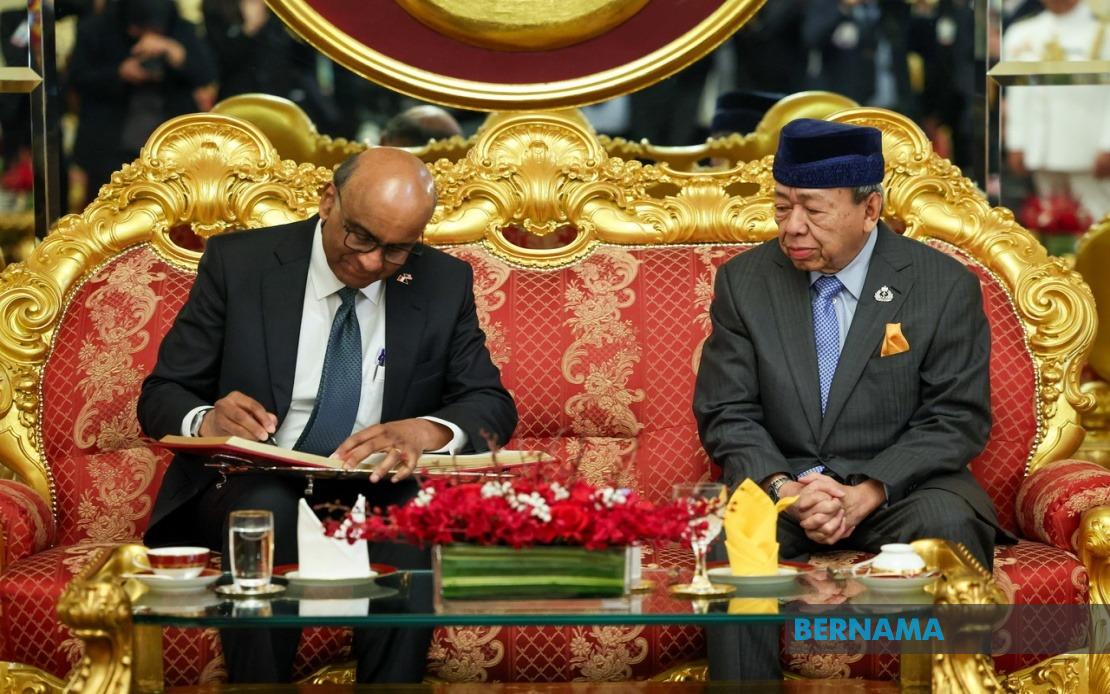
Singapore President Tharman Shanmugaratnam held a formal audience with the Sultan of Selangor, Sultan Sharafuddin Idris Shah, at Istana Alam Shah in Klang on July 14, underscoring the ceremonial dimensions of his ongoing state visit to Malaysia. The meeting, which commenced at 11 am and extended for approximately ninety minutes, represented a significant diplomatic engagement between Malaysia's most industrialised state and the city-state, culminating just before 12.40 pm.
The president's reception was handled with full protocol, with Raja Muda of Selangor Tengku Amir Shah greeting the visitor upon arrival at the palace. Entrepreneur Development and Cooperatives Minister Steven Sim attended the audience in his capacity as the designated minister-in-attendance, reflecting the structured nature of the diplomatic occasion. The presence of ministerial representatives ensures that bilateral conversations can address both formal state matters and practical cooperation areas between the two nations.
The audience occurs within the context of Tharman's three-day official visit to Malaysia, which commenced on July 13 and continues through July 15. This visit represents a reciprocal arrangement, as it follows His Majesty Sultan Ibrahim, King of Malaysia, who undertook a state visit to Singapore on May 6 and 7, 2024. Such mutual state visits form the backbone of formal diplomatic relations and provide opportunities for leadership to discuss strategic matters beyond the scope of routine bilateral meetings.
The timing and nature of this engagement highlight the enduring importance of Malaysia-Singapore relations at the highest levels. Both nations maintain extensive interconnections spanning trade, security, education, and cultural affairs. The formal exchange of state visits at the presidential and royal level signals continuity in the relationship despite periodic disagreements or misunderstandings that occasionally surface in public discourse.
From an economic perspective, Singapore's role as Malaysia's second-largest trading partner globally carries substantial weight in bilateral considerations. More significantly, within the ASEAN framework, Singapore serves as Malaysia's largest trading partner among member states, a distinction that underscores the intensity and sophistication of their commercial engagement. This economic interdependence provides a substantial foundation for sustained political cooperation and regular high-level dialogue.
The choice of venue—Istana Alam Shah, the official residence of the Selangor Sultan—carries symbolic importance. Rather than conducting the meeting exclusively at federal level, the inclusion of Selangor's royal household reflects Malaysia's federal structure and the prominence of state-level institutions in the country's governance architecture. This approach also acknowledges Selangor's status as the most economically developed state in Malaysia, home to major commercial centres and industrial zones that contribute significantly to Malaysia's GDP.
The ninety-minute duration of the audience suggests substantive conversation beyond ceremonial pleasantries. Senior state and national officials typically allocate such extended time only when substantive matters warrant discussion. These conversations likely encompassed trade facilitation, regional security cooperation, the state of ASEAN affairs, and potentially specific bilateral issues requiring leadership-level attention. The presence of the Entrepreneur Development and Cooperatives Minister also suggests that business facilitation and economic cooperation featured prominently in discussions.
For Malaysian stakeholders, particularly businesses and investors in Selangor, such high-level exchanges between Singapore and Malaysia carry practical implications. State visits often result in announcements regarding new cooperation initiatives, trade agreements, or investment commitments. The diplomatic goodwill generated through these formal interactions creates more favourable conditions for commercial negotiations and project implementations at lower institutional levels.
From a Southeast Asian perspective, the Malaysia-Singapore relationship occupies a special position. The two nations share a common language, historical links, and geographic proximity, while simultaneously maintaining distinct political systems and development trajectories. The regular exchange of state visits at the highest levels reinforces the region's commitment to peaceful, rules-based engagement and sets a positive example for inter-ASEAN relations.
The Foreign Ministry's explicit notation that this visit reciprocates the King's earlier Singapore journey demonstrates the diplomatic courtesy and balance that characterises mature bilateral relations. Such reciprocal visits prevent any perception of asymmetry and affirm that both nations regard each other as equals worthy of top-level attention. In contemporary international relations, where many countries struggle with diplomatic tensions, the smooth execution of state visits between Malaysia and Singapore reflects stable, professionally managed relations.
Moving forward, observers should monitor any official statements or joint declarations emerging from this visit, as these often outline the framework for future cooperation. Whether addressing specific regional challenges, announcing new trade corridors, or reinforcing existing security partnerships, such high-level engagements typically generate follow-up actions at various institutional levels. The audience at Istana Alam Shah, though not widely publicised internationally, forms an important component of Malaysia's broader diplomatic engagement with one of its most important neighbours.

