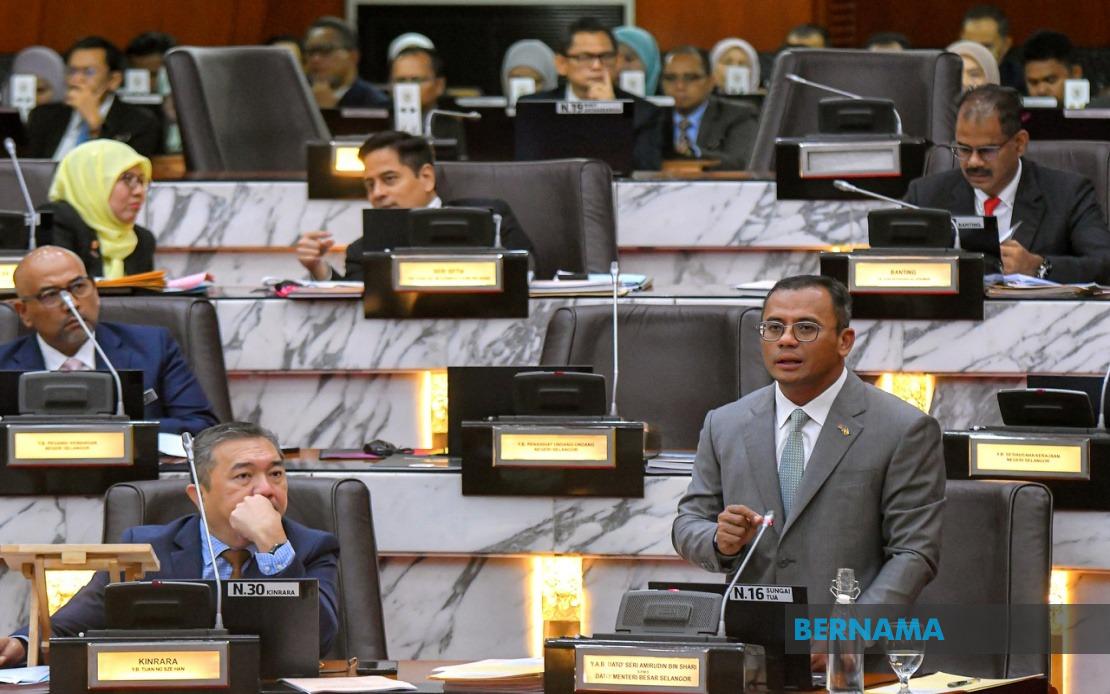
The Selangor government is moving to significantly expand its education assistance programme, with Menteri Besar Datuk Seri Amirudin Shari announcing plans to raise the number of Higher Education Institution Study Incentive (HPIPT) recipients from the current 3,000 to 5,000 in next year's budget. The decision reflects mounting pressure on the state's social support system as more students seek financial help to pursue tertiary studies across public and private institutions throughout Malaysia.
Demand for the scheme has far outpaced available places, with the state government receiving more than 5,000 applications in both the current year and in 2025. This substantial gap between applicants and funded recipients has forced the state administration to conduct a comprehensive financial review to determine whether expanding the programme is feasible within Selangor's budgetary constraints. Amirudin indicated that the expansion could potentially reach between 5,000 and 6,000 recipients, depending on how the state's revenue position develops over the coming months.
The HPIPT provides RM1,000 in direct financial assistance to eligible Selangor students, a modest but meaningful contribution toward tuition and related expenses. The scheme covers students pursuing qualifications at recognised higher education institutions, encompassing both public universities and private colleges, as well as those enrolled in Level 4 Skills Certificate programmes, diplomas, and bachelor's degree courses. For many families in Selangor, this support removes a critical barrier to education access during the crucial transition from secondary school to tertiary study.
Selangor's commitment to expanding the scheme carries particular significance for the broader Southeast Asian region, where Malaysia has positioned itself as a hub for higher education. The state's growing population and robust economy mean that educational demand continues to rise, placing strain on public assistance mechanisms. By doubling its commitment, Selangor signals that it recognises education as central to economic competitiveness and social mobility, aligning with national aspirations to develop a skilled workforce capable of driving regional innovation and growth.
Beyond simply increasing recipient numbers, the state government is undertaking a more substantive review of how the HPIPT operates administratively. Officials are examining the application window to ensure students have adequate time to apply after confirming their admission to higher education institutions, a gap that has reportedly caused logistical difficulties in past cycles. The timing challenge is particularly acute in Malaysia's education system, where students often receive IPT confirmations at different points depending on their chosen institutions and application pathways.
To address this structural problem, Amirudin indicated that the government is exploring the possibility of opening HPIPT applications twice annually rather than once per year. This would accommodate students who enrol at different times of the year and reduce the time pressure that has prevented eligible applicants from submitting their documentation. Such a shift would modernise the scheme's administration and reflect the reality that Malaysia's tertiary education landscape no longer operates on a single rigid intake cycle.
The announcement came in response to a parliamentary question from Datuk Noorazley Yahya, the state representative for Bukit Melawati under Perikatan Nasional, highlighting how education support has become a politically salient issue across party lines in Selangor. The cross-party interest in expanding the programme underscores its perceived importance to constituents, even as fiscal constraints limit the rate at which such commitments can grow. The fact that an opposition parliamentarian raised the issue suggests that education financing remains a practical concern for voters regardless of their political affiliation.
For Malaysian students and families, particularly those in Selangor, the expansion of HPIPT represents a tangible improvement in access to financial support during a period of significant economic transition. Many Malaysian households struggle with rising costs of tertiary education, whether at public universities where accommodation and living expenses mount quickly or at private institutions where tuition fees themselves can be prohibitive. A RM1,000 grant may appear modest in absolute terms, but it often makes the difference between a student's ability to enrol or deferring studies due to financial hardship.
The programme also reflects the state government's broader social policy orientation. Under Amirudin's leadership, Selangor has positioned itself as a relatively progressive administrator compared to some other Malaysian states, with education and welfare support featuring prominently in policy announcements. The HPIPT expansion fits within this framework, though critics might note that despite the doubling of recipients, the scheme still reaches only a fraction of applicants who seek assistance.
Looking forward, the success of this expansion will depend partly on whether Selangor's revenue growth continues at projected levels. The state has benefited from strong economic activity and a growing tax base, but any slowdown in economic conditions could constrain the government's ability to fully implement the increased allocation. Amirudin's conditional language in describing the expansion as dependent on "Selangor's revenue position" suggests that while the intention is firm, fiscal realities may impose limits.
The initiative also opens broader questions about the sustainability and adequacy of state-level education support in Malaysia. With each state operating its own assistance schemes according to its fiscal capacity, student assistance varies considerably across the country. Selangor's relative wealth gives it more flexibility than poorer states, potentially widening disparities in educational opportunity based on where students live rather than merit or need alone. This dynamic may ultimately place pressure on the federal government to establish more uniform or supplementary support mechanisms.
Implementation of the expanded programme will also require careful coordination with higher education institutions to ensure that the application process remains streamlined and that funds reach recipients in time to support their studies. The administrative improvements proposed by the government, particularly the shift to twice-yearly application windows, will be essential to avoiding bottlenecks that could frustrate eligible applicants.
Ultimately, the Selangor government's decision to expand HPIPT recognises that education remains the most powerful tool for social advancement and economic participation. By removing some financial barriers to tertiary study, the state is investing in its own long-term development while responding directly to constituent demand for practical support during a crucial transition in young Malaysians' lives.

