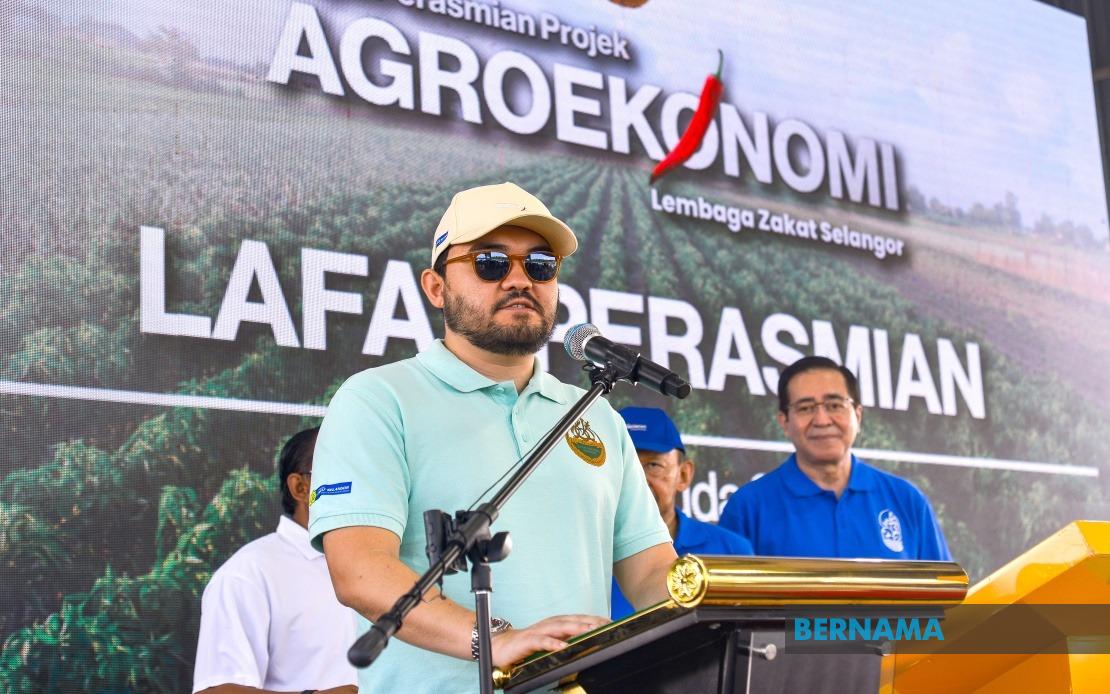
The Selangor Zakat Board has taken a significant step toward transforming welfare support into self-sustaining economic opportunity by launching its flagship Agroeconomic Project at Laman Agro Ehsan in Bukit Beruntung on July 1. The initiative, which represents a departure from conventional cash assistance models, channels RM26 million into creating viable agricultural livelihoods for disadvantaged communities. The Raja Muda of Selangor, Tengku Amir Shah Sultan Sharafuddin Idris Shah, formally opened the facility, underscoring the state government's commitment to addressing poverty through enterprise development rather than dependency on temporary handouts.
Spanning 110 acres with 76 acres dedicated to active agro-production, the project represents a substantial physical and financial commitment to economic empowerment. The core agricultural operation centres on fertigation chilli cultivation, a high-value crop suitable for commercial distribution and increasingly in demand across Malaysian food production chains. This crop selection reflects careful market research, as chilli is a staple ingredient in local cuisine with consistent demand from food manufacturers, restaurants, and retail outlets. By focusing on a specific commodity with proven market viability, Zakat Selangor has positioned the project to generate predictable, scalable returns rather than experimenting with speculative agricultural ventures.
The programme structure reveals sophisticated planning around participant development. Forty-eight carefully selected asnaf individuals have enrolled in a three-year capacity-building programme that combines theoretical knowledge with practical field experience. Each participant receives a 0.5-acre cultivation plot containing 2,000 chilli plant bags, creating a distributed farming model that allows for individual autonomy whilst maintaining collective support systems. During each planting cycle, the initiative deploys approximately 96,000 plant units across the participant network, generating significant agricultural output that can be consolidated for market distribution. This scale suggests that Zakat Selangor has negotiated bulk marketing arrangements or established processing partnerships to handle participant harvests efficiently.
Beyond agricultural production, the project addresses fundamental barriers to rural economic participation that often prevent low-income individuals from accessing farming opportunities. Participants receive fully subsidised accommodation at the Prima Beruntung housing area throughout the three-year period, eliminating a major financial obstacle that would otherwise force farmers to choose between residential stability and agricultural investment. This housing provision transforms the project from a part-time supplementary activity into a comprehensive relocation programme, allowing participants to immerse themselves in farming without competing financial pressures. The removal of rental costs represents a crucial recognition that sustainable poverty alleviation requires addressing basic living needs alongside income-generating activities.
Financial projections suggest substantial economic impact for programme participants. Once agricultural operations achieve stable production and efficient crop management, individual farmers anticipate monthly incomes reaching RM4,000, representing a significant departure from asnaf poverty thresholds. This income trajectory, if realised across 48 participants, could generate approximately RM1.92 million in monthly household earnings collectively. For families previously dependent on zakat distributions and government welfare, such income levels represent transformative opportunities for educational investment, healthcare access, and basic quality-of-life improvements. However, these projections remain conditional on successful market linkages and sustained crop yields, making ongoing technical support and market facilitation essential to project success.
The selection of participants involved rigorous screening processes designed to identify candidates with genuine commitment and appropriate aptitude for agricultural work. Collaboration with the Kuala Langat Area Farmers' Organisation (PPKKL) brought institutional agricultural expertise into the vetting process, ensuring that selected individuals possessed or could rapidly develop the necessary competencies. This selective approach contrasts with universal welfare distribution, establishing accountability mechanisms where participants must demonstrate engagement and competence to retain their benefits. The participant cohort includes individuals like Norfhadilah Mohd Shafiin, a 45-year-old mother of five, and Raimi Rusydi Rodi, a father of two, representing typical asnaf demographic profiles whose family responsibilities drive motivation toward stable income generation.
Financial architecture for the project involves creative partnership structures that leverage zakat institutional capacity alongside commercial banking and government resources. Strategic partners contributed RM2.07 million through wakalah arrangements, with contributions from the Pilgrims Fund Board, RHB Islamic Bank Berhad, and Cagamas Berhad. This multi-stakeholder funding approach distributes financial risk whilst aligning diverse institutional interests around poverty alleviation objectives. The Pilgrims Fund Board's participation reflects recognition that hajj savings can support complementary Islamic social welfare initiatives, whilst Islamic banking contributions align with shariah-compliant social responsibility mandates. Such collaborative funding models could serve as templates for other Malaysian state zakat boards seeking to launch capital-intensive antipoverty initiatives.
The agro-economy project exemplifies evolving Islamic charity philosophy that emphasises empowerment over dependency. Rather than perpetuating recipient relationships where asnaf communities rely indefinitely on zakat distributions, the initiative invests in productive capacity that enables self-reliance and community contribution. Participants benefit from structured technical training encompassing crop monitoring, cultivation techniques, pest management, and post-harvest handling. This knowledge transfer transforms farming from subsistence activity into professional enterprise, equipping participants with marketable skills applicable across agricultural contexts. The three-year programme duration recognises that sustainable economic transformation requires extended engagement, moving beyond short-term training interventions that often fail to produce lasting behavioural change.
For Malaysia's broader agricultural economy, the project signals important trends in rural employment and smallholder farming development. Whilst Malaysia has pursued capital-intensive, technology-driven agribusiness development, small-scale farming remains economically marginal despite employing significant rural populations. The Selangor initiative demonstrates recognition that targeted government support for disadvantaged rural communities can enhance agricultural productivity whilst addressing poverty simultaneously. Expanded to other crops suited to different geographical regions, such models could establish sustainable farming pathways for Malaysia's rural poor, reducing dependence on urban migration and irregular informal employment.
The project also addresses gender dynamics in Malaysian agriculture, where women often face barriers to farm ownership and resource access. The inclusion of female participants like Norfhadilah reflects intentional programme design recognising that asnaf populations include significant numbers of single mothers and widows requiring income opportunities. By facilitating women's participation in commercial chilli farming, Zakat Selangor challenges conventional gender divisions in Malaysian agriculture and expands economic opportunity networks for marginalised female-headed households. Such inclusive approaches strengthen both social cohesion and economic efficiency.
Participant testimonials underscore the psychological and practical dimensions of the initiative beyond financial metrics. Norfhadilah emphasises that the programme provides not merely income opportunity but also knowledge, experience, and self-confidence necessary for long-term self-reliance. Raimi highlights community aspects, noting that collaborative farming with fellow participants builds social capital and mutual support networks that extend beyond agricultural production. These relational dimensions transform the project from transaction into transformation, where participants acquire not just income but also dignity, competence, and belonging within productive communities.
Moving forward, project sustainability depends on securing reliable market access for participant harvests. Agricultural production without guaranteed buyer relationships often fails as farmers struggle to find affordable transportation, competitive pricing, and storage facilities. Zakat Selangor's success will ultimately measure not merely through initial income generation but through participant retention, yield consistency, and capacity to graduate toward independent farming enterprises. If the board can establish permanent aggregation and marketing infrastructure, the model could establish sustainable pathways where initial asnaf participants eventually employ others, multiplying poverty reduction impact across extended community networks and demonstrating how well-designed Islamic social finance can catalyse broad-based rural transformation.

