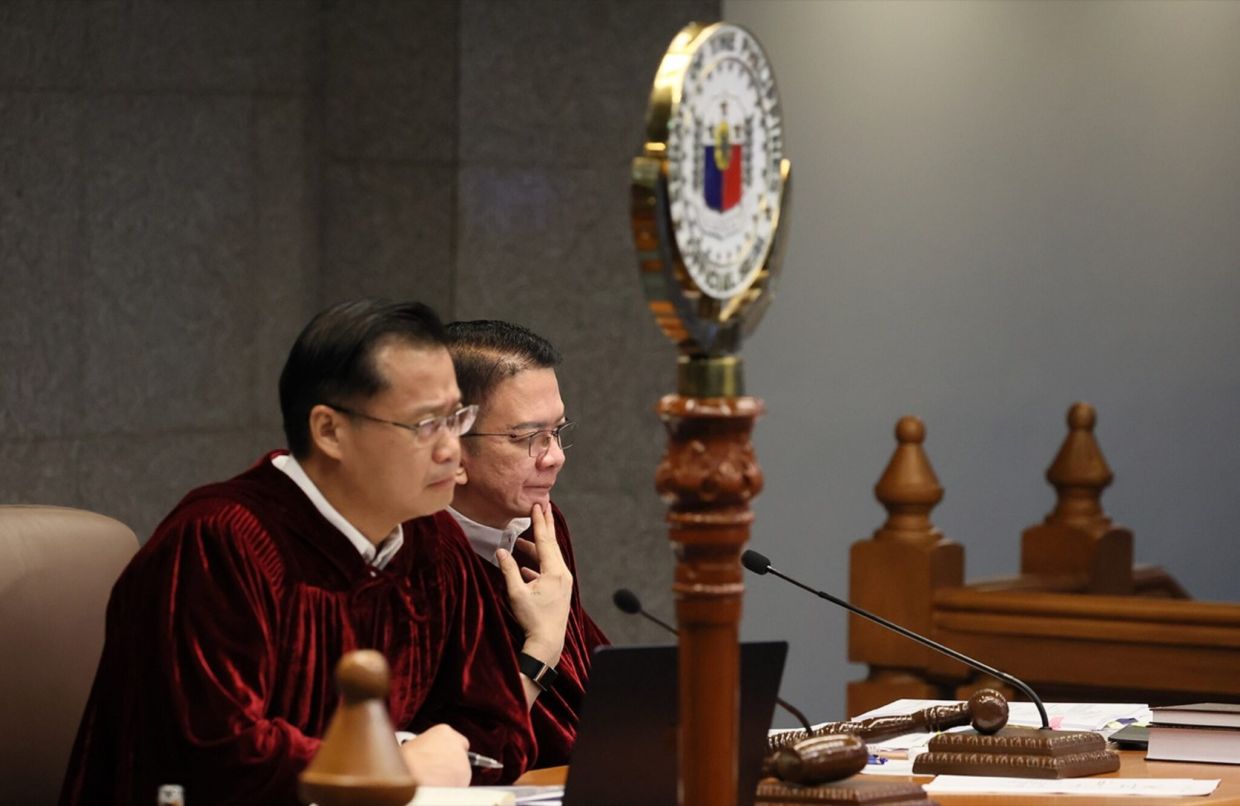
The Philippine Senate impeachment court faces a pivotal procedural decision on Monday afternoon that could reshape the trajectory of Vice President Sara Duterte's removal trial. House prosecutors have publicly expressed strong confidence that the chamber's 24 senators will vote to compel the release of Duterte's comprehensive financial documentation, including bank accounts, tax records and materials held by the Anti-Money Laundering Council, alongside similar records belonging to her husband, lawyer Manases Carpio. Prosecution spokesperson Benjamin Tolosa Jr. characterised the subpoena request as having "strong basis," suggesting the legal and evidentiary foundation for disclosure outweighs competing concerns about financial privacy.
The impeachment trial, now in its seventh day, has transformed into a sustained examination of whether Duterte illegally accumulated wealth while serving as a public official. The prosecutors specifically contend that Duterte's financial records are indispensable to substantiating allegations under Article II of the impeachment articles, which address supposedly undeclared and unexplained riches. An Anti-Money Laundering Council report presented to the House revealed that Duterte's financial activity exceeded PHP 3 billion during the 2007 to 2013 period alone, a figure that prosecutors believe warrants judicial scrutiny through direct access to contemporaneous banking and tax documentation.
The legal framework underpinning the prosecution's confidence rests on well-established precedent and statutory exception. The 1987 Philippine Constitution and Republic Act No. 1405, commonly known as the bank secrecy law, explicitly carve out impeachment proceedings from standard confidentiality protections. Tolosa pointed to the 2012 impeachment trial of former Chief Justice Renato Corona, during which the Senate ordered the production of bank records notwithstanding bank secrecy restrictions, as direct precedent supporting disclosure in high-stakes constitutional proceedings. The prosecution maintains that when the Senate sits as an impeachment court, it exercises constitutional authority that transcends ordinary statutory confidentiality regimes.
Prosecutor Chel Diokno advanced a comprehensive argument for disclosure based on the constitutional supremacy doctrine and the impeachment exception's explicit statutory language. He contended that the Senate derives its impeachment authority directly from the Constitution itself, enabling it to compel disclosure of otherwise confidential financial records necessary to ascertain whether the Vice President violated the constitutional prohibition on public officials engaging in constitutionally prohibited business interests. Diokno further argued that both the Data Privacy Act and the bank secrecy law's impeachment exception permit disclosure when a valid subpoena is issued by the impeachment court. Critically, he identified financial records spanning Duterte's tenure as Davao City vice mayor and mayor as relevant to determining whether she accumulated unexplained wealth across her entire career in public service.
The defence team, led by Michael Poa, has mounted a vigorous constitutional counteroffensive grounded in due process principles and statutory construction. Poa characterised the subpoena request as an impermissible "fishing expedition," arguing that prosecutors strategically sought financial evidence only after impeachment complaints had already been formally lodged, suggesting the request lacked proper evidentiary foundation and targeted the Vice President's records without specific probable cause. The defence additionally contends that the subpoena's temporal scope—reaching back nearly two decades—exceeds reasonable bounds, particularly regarding Duterte's service as Davao vice mayor, a position Poa asserts falls outside impeachable offices under the 2025 Supreme Court ruling in Duterte v. House of Representatives, which establishes that impeachable offences must be committed while occupying an impeachable office.
Poa's more sophisticated constitutional argument addresses the distinction between formal subpoena power and its lawful exercise within constitutional constraints. While acknowledging that the bank secrecy law recognises impeachment as an exception to confidentiality, he maintains that disclosure is neither automatic nor self-executing but instead requires satisfaction of due process protections. Critically, the defence observes that the Anti-Money Laundering Act and the National Internal Revenue Code contain no impeachment exception permitting disclosure of AMLC reports and tax records, suggesting that even assuming impeachment authority exists, statutory gaps preclude the compelled production sought by prosecutors. Additionally, Poa objects to the inclusion of Carpio's financial records on the basis that he does not occupy an impeachable office and therefore cannot reasonably be subjected to discovery in a constitutionally framed removal proceeding.
Civil society organisations have mobilised to publicly support the subpoena request, invoking the catastrophic historical consequences of withholding key evidence in presidential impeachment proceedings. The August Twenty-One Movement, referencing the deeply controversial "second envelope" vote during former President Joseph Estrada's 2001 impeachment trial, warned against repeating the procedural manipulation that observers credited with fuelling public outrage and ultimately precipitating Estrada's downfall. The advocacy group appealed directly to the senator-judges' commitment to constitutional integrity, framing approval of the subpoena as essential to preserving the legitimacy of the impeachment process and ensuring that either Duterte's exoneration or culpability rests on complete evidentiary foundations rather than enforced ignorance.
The faith-based coalition Kingdom Keepers advanced a complementary moral and accountability argument, contending that public officials bear an affirmative obligation to demonstrate financial rectitude and cannot invoke privacy protections as a shield against legitimate scrutiny of wealth accumulation. The group, which includes activist priest Fr. Robert Reyes and social anthropologist Dr Melba Padilla Maggay, directly challenged the presumption that a public official faced with serious allegations of unlawful enrichment should be permitted to withhold documentary evidence, rhetorically questioning why an innocent person with nothing to conceal would resist disclosure of historical financial records. This framing shifts the evidentiary burden implicitly, suggesting that resistance to financial transparency itself warrants suspicion.
Duterte confronts four articles of impeachment encompassing allegations of misappropriating confidential funds, amassing unexplained wealth, and making threatening statements directed at President Ferdinand Marcos, First Lady Liza Araneta-Marcos, and former Speaker Martin Romualdez. Conviction on any article would trigger automatic removal from office and permanent disqualification from holding any future public position, rendering this impeachment proceeding uniquely consequential for Duterte's political survival and institutional role. The stakes extend beyond individual consequences, as the procedural handling of the subpoena request will establish precedent governing evidentiary discovery in future impeachment trials and shape the institutional balance between executive confidentiality and legislative investigative authority.
The Senate's pending vote crystallises a fundamental tension embedded in democratic constitutional frameworks: the competing imperatives of individual privacy protections and collective accountability for those wielding state power. The Corona precedent, which permitted Senate access to extensive banking records in an earlier high-profile impeachment, establishes that the Senate has previously resolved this tension in favour of transparency in removal proceedings. However, the intervening decade has witnessed significant expansion of data privacy jurisprudence and statutory protections, potentially shifting the constitutional calculus underlying financial confidentiality. The senator-judges must navigate between precedent favouring disclosure and contemporary privacy frameworks, determining whether the 2025 Duterte v. House ruling and evolving constitutional sensibilities modify the Corona approach.
The National Bureau of Investigation is scheduled to present testimony on Tuesday addressing its investigation into Duterte's alleged threats against the President and First Lady, with prosecutors suggesting that NBI findings establish the remarks reflected systematic planning rather than spontaneous outbursts. This testimony, combined with the Senate's ruling on financial documentation, will substantially shape the trial's trajectory and determine whether prosecutors possess sufficient evidence to sustain their removal allegations. For Malaysian observers and Southeast Asian commentators monitoring Philippine institutional dynamics, the impeachment proceeding exemplifies both the robustness of presidential removal mechanisms and their susceptibility to political weaponisation, raising broader questions about the appropriate balance between legislative accountability power and executive institutional autonomy in presidential systems.

