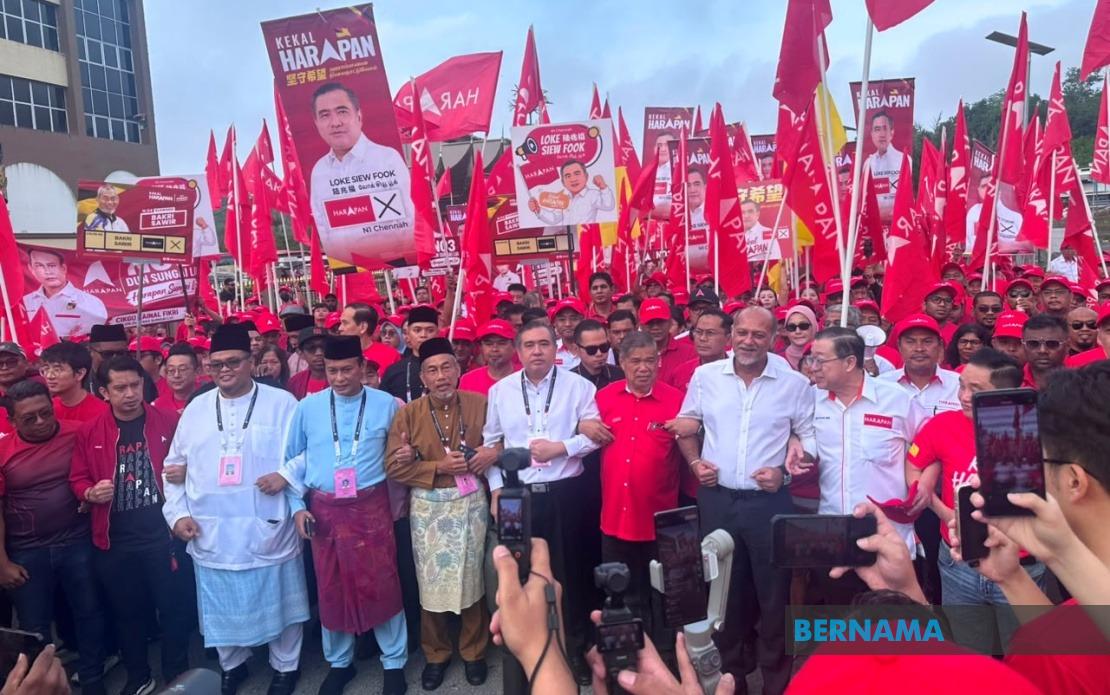
The Pakatan Harapan coalition demonstrated its organisational muscle in Negeri Sembilan on July 18 as high-profile party figures fanned out across multiple nomination centres to support candidates advancing their bids for the state legislature. The coordinated show of strength, with ministers and party chiefs appearing alongside nominees in constituencies across the state, underscores PH's strategy to consolidate voter backing ahead of the August 1 polling date. The visible presence of top leadership signals the coalition's confidence in its position while also energising grassroots supporters and reinforcing party unity during the campaign.
Transport Minister Anthony Loke, who serves as DAP secretary-general, filed his own nomination papers for the Chennah seat in Jelebu, arriving at the Dewan Besar Kuala Klawang nomination centre early in the morning. His participation was bolstered by the attendance of several prominent colleagues, including DAP chairman Gobind Singh Deo, former Penang chief minister and DAP adviser Lim Guan Eng, and Amanah president Datuk Seri Mohamad Sabu. The presence of leaders from two coalition parties at a single nomination venue reflects PH's cross-party coordination during this critical electoral phase.
Communications Minister Datuk Seri Fahmi Fadzil emerged as a central figure in the nomination day activities, positioning himself as the chief escort for four PH candidates across the Jempol district. Arriving at the Jempol District and Land Office nomination centre just before 9 am, Fahmi oversaw the filing of nomination papers for candidates contesting the Serting, Palong, Jeram Padang and Bahau seats. This concentration of ministerial attention on a single district reveals PH's determination to retain what may be regarded as strategically significant territory, particularly given that two of these constituencies have sitting PH representatives seeking re-election.
Deputy Communications Minister Teo Nie Ching, who also leads the Women's Wing of the DAP, accompanied her namesake Teo Kok Seong as he submitted his bid for the Bahau seat. Kok Seong represents continuity for PH in this constituency, having held the seat since the 2018 general election. The involvement of a female deputy minister at his nomination underscores both the profile PH wishes to project around Bahau and the coalition's efforts to ensure women leaders remain visible throughout the campaign period. The three other candidates supported by Fahmi—Yaacob Mahmood, Muhammad Zahin Zinal Abidin, and Manivanan Gowin—represent fresh faces for PH, suggesting the coalition is seeking to balance experienced incumbents with new candidates.
Menteri Besar Datuk Seri Aminuddin Harun, the head of PH's Negeri Sembilan chapter, filed his nomination for the Linggi seat in Port Dickson with an impressive entourage that included DAP deputy secretary-general Hannah Yeoh, PKR secretary-general Datuk Dr Fuziah Salleh, and the Prime Minister's political secretary Datuk Farhan Fauzi. The presence of federal-level figures, particularly the Prime Minister's political representative, signals that Kuala Lumpur is taking the Negeri Sembilan contest seriously and views the state result as significant for the broader PH narrative. Aminuddin's re-election as Menteri Besar depends partly on PH maintaining its legislative plurality, giving added weight to the turnout of such senior figures.
Three incumbent PH representatives—Chuah Yew Boon Lye seeking to hold Chuah, Lukut's Choo Ken Hwa, and Dr G Rajassekaran defending Sri Tanjung—appeared at the Port Dickson nomination centre. Their participation alongside top party brass reinforces the message that sitting members enjoy continued party support and face no internal challenges to their candidacy. This demonstration of backing for sitting members can help prevent any perception of vulnerability that opposition parties might exploit.
Entrepreneur and Cooperatives Development Minister Steven Sim arrived at the Wisma Majlis Bandaraya Seremban nomination centre to shepherd six PH candidates through the filing process. Sim's attendance alongside Selangor State Legislative Assembly Speaker Lau Weng San, Bukit Gelugor MP Ramkarpal Singh, and PKR vice-president Datuk Seri R. Ramanan extended the visible reach of PH leadership into Seremban's urban constituency. The involvement of a Selangor assembly speaker hints at potential coordination between the two neighbouring states' political structures and underscores PH's effort to present a unified front across multiple electoral jurisdictions.
The August 1 polling represents the first state election test for PH's federal government since taking power in late 2022. In the previous state election held in 2023, PH secured 17 of 36 seats, while Barisan Nasional captured 14 and Perikatan Nasional took five. Maintaining PH's majority in Negeri Sembilan carries symbolic importance beyond the state itself, as it would demonstrate the coalition's continued electoral viability and might bolster morale ahead of potentially difficult contests in other states. Any loss of ground to BN or PN would invite questions about PH's momentum and internal cohesion.
The staggered arrival times of various ministers and party officials—most appearing between 8:30 and 9 am—suggest a carefully choreographed schedule designed to generate sustained media coverage throughout the morning's nomination proceedings. This sequencing strategy, wherein high-profile figures appear in succession rather than simultaneously, ensures that news outlets and photographers maintain focus on the nomination centres across multiple hours. Such tactical media management reflects the professionalism with which PH approached the campaign's opening formal procedures.
For Malaysian observers and regional analysts monitoring PH's performance, the Negeri Sembilan contest offers an early barometer of public sentiment towards the coalition. The state's diverse demographics—encompassing urban voters in Seremban, rural communities, and mid-range constituencies—provides a microcosm of challenges PH faces nationally. Poor performance in Negeri Sembilan could embolden opposition parties and create internal pressure within the coalition, whereas a successful defence of the state would provide PH with momentum and credibility heading into potential future electoral contests elsewhere in Malaysia.
The Election Commission has scheduled early voting for July 28, allowing those unable to vote on polling day to exercise their franchise early. This compressed campaign period—between the nomination deadline and election day—means that the intensity of nomination day activities effectively marks the beginning of an accelerated contest to persuade voters. The deployment of ministerial-level figures at this very outset signals that PH intends to maintain high visibility and engagement throughout the campaign rather than building momentum gradually. For Malaysian voters in Negeri Sembilan and political observers nationwide, these coming weeks will demonstrate whether PH's organisational advantages and federal resources translate into electoral success at the state level.

