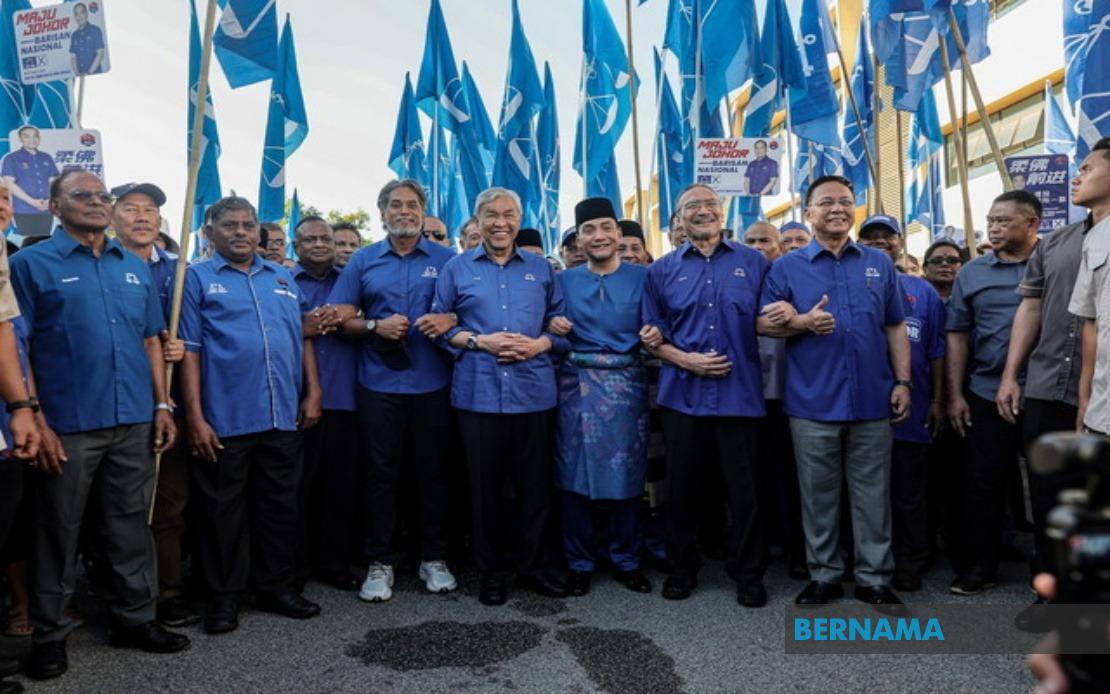
The Johor Barisan Nasional election campaign gained momentum on June 27 when Datuk Onn Hafiz Ghazi, the coalition's state chairman and incumbent Machap assemblyman, formally submitted his candidacy papers at the Muafakat Hall of the Simpang Renggam District Council. His filing at 9.10 am marked a symbolic moment for UMNO's leadership in the state, drawing a notable contingent of the party's senior echelon to witness the submission and publicly demonstrate unity within the coalition.
The decision to stage the nomination with maximum fanfare reflected the strategic importance of both Onn Hafiz's position and the broader contest for control of Johor's state assembly. UMNO president Datuk Seri Dr Ahmad Zahid Hamidi attended the ceremony alongside Sembrong MP Datuk Seri Hishammuddin Tun Hussein and former minister Khairy Jamaluddin, sending a clear message about party hierarchy and expectations for the campaign ahead. Their physical presence at the nomination centre underscored the symbolic weight that the national leadership places on retaining and strengthening UMNO's grip on Johor, historically one of the party's most significant strongholds in peninsular Malaysia.
The turnout of such prominent figures was not merely ceremonial. Each represented distinct constituencies within UMNO's broader power structure. Ahmad Zahid's attendance as party president carried particular significance, affirming his backing for Onn Hafiz as a capable administrator and votary of the coalition model. Hishammuddin's presence as a federal parliamentarian and long-serving establishment figure lent additional weight, signalling continuity and establishment credentials at a time when Johor voters may harbour concerns about political stability and effective governance. Khairy's inclusion, despite his former ministerial role, demonstrated efforts to project a coalition that spans different generations and perspectives within UMNO's ranks.
Former Johor Menteri Besar Datuk Seri Hasni Mohammad also graced the occasion, further extending the ceremonial significance of the moment. Hasni's presence provided a direct link to previous administrations and a visual reminder of established governance networks. Such layered support structures in nomination proceedings serve multiple purposes: they amplify media coverage, energise grassroots activists who draw confidence from visible leadership unity, and project an image of institutional strength to both supporters and detractors. In the context of Malaysian state politics, where personality cults and factional tensions frequently undermine party cohesion, the assembled gathering conveyed deliberate messaging about internal harmony.
The nomination centre itself witnessed scenes characteristic of Malaysian election campaigns, with supporters clustering in surrounding areas dressed in party colours and brandishing flags and banners. These demonstrations reflected the grassroots mobilisation that precedes formal polling and indicate the level of competitive intensity that the Johor contest generates among political activists. For many UMNO members and sympathisers, the visible presence of national leadership provided reassurance that their state remained a priority and that resources would flow toward securing a strong electoral outcome. The optics of leadership attendance at local nomination proceedings filter outward through social networks and media channels, shaping perceptions about which candidates and coalitions possess momentum.
Johor's political significance cannot be overstated within Malaysia's broader democratic architecture. The state has consistently demonstrated capacity to influence national political calculations. A strong UMNO performance in Johor reinforces the party's legitimacy as a nationwide political force and provides crucial parliamentary numbers to any federal coalition seeking to govern. Conversely, electoral setbacks in Johor reverberate through UMNO's organisational structure and influence internal power dynamics for years afterward. The assembly turnout at Onn Hafiz's nomination filing reflected awareness of these cascading implications.
The campaign period represents a critical testing ground for UMNO's electoral machinery and messaging strategies. The concentration of senior figures at a single nomination ceremony suggests deliberate coordination to establish a narrative early in the campaign cycle. Whether focused on economic management, infrastructure development, or defence of bumiputera interests, the BN coalition's early positioning would shape media coverage and public discourse throughout the polling season. The appearance of Ahmad Zahid, Hishammuddin, and others signals that national headquarters intends to remain engaged throughout the campaign rather than delegating entirely to state-level operatives.
Malaysian state elections frequently reveal fault lines within federal coalitions and expose vulnerabilities in party organisation that might remain hidden during normal governance periods. Johor's electoral contest would provide data about UMNO's capacity to retain support among rural constituencies, urban middle-class voters, and younger demographics entering the electorate. The nomination filing itself, while procedurally routine, carries weight as an opening ceremonial act that sets tone and expectation. The choice to make it a high-profile gathering with multiple senior attendees conveyed the seriousness with which national leadership approached the campaign.
For Onn Hafiz personally, the support displayed at his nomination represented validation of his position within party hierarchies and institutional networks. As Johor BN chairman, he occupies a pivotal role in translating national party strategy into state-level implementation. The visible backing from Ahmad Zahid and others provided political capital that would assist him in consolidating support among party members, coordinating campaign activities, and managing the complex negotiations required to maintain coalition unity across multiple parties and factions competing under the BN banner in different constituencies.
The broader Southeast Asian context also matters. Johor shares maritime and economic links with Singapore and possesses demographic and cultural characteristics distinct from other Malaysian states. Elections here attract regional attention and can influence perceptions about political stability and governance capacity that ripple beyond Malaysia's borders. The organised, well-coordinated approach to Onn Hafiz's nomination filing conveyed institutional competence and internal discipline to external observers who assess Malaysia's political trajectory and investment climate.

