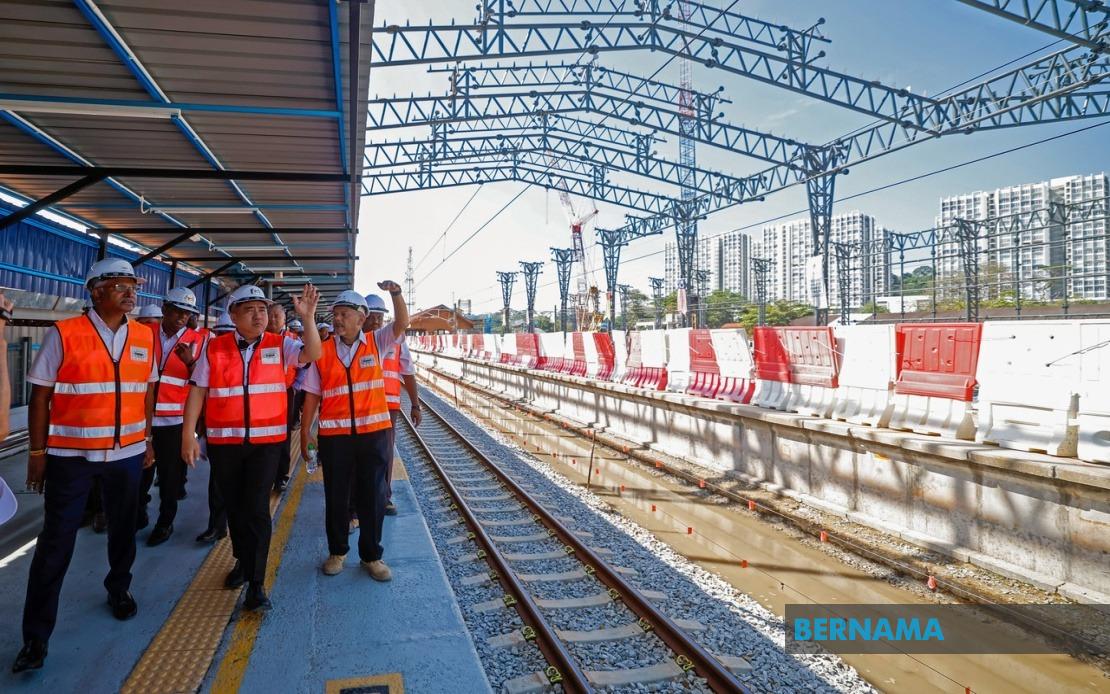
Malaysia's ambitious Seremban Sentral railway station project is progressing steadily towards its March 2027 completion target, with construction now at the 35 per cent mark following the successful completion of foundational work that had previously constrained the project's pace. Transport Minister Anthony Loke visited the Negeri Sembilan site to update stakeholders on progress, noting that the most technically demanding phases—deep piling and underground utility relocation—have now been finished, positioning the development for accelerated progress over the coming months.
The roughly RM100 million initiative represents a significant infrastructure investment aimed at transforming Seremban's transport landscape by creating an integrated hub that marries the heritage 100-year-old KTMB station with a purpose-built contemporary facility. According to Loke, the initial construction phase deliberately moved slowly due to the complexities of establishing precise piling positions and safely relocating underground cables and utilities that predate the project. These preliminaries, which consumed considerable time and resources, have now cleared the pathway for faster installation of structural elements including the roof, glazing systems, and finishing works that will define the station's appearance and functionality.
The architectural design incorporates green building principles and draws inspiration from Minangkabau cultural elements, signalling an approach that balances environmental sustainability with regional identity. The station will feature new retail and commercial spaces, supporting the broader economic revitalisation strategy for Seremban town. The completed heritage renovation of the original KTMB station was finished in June, involving electrical system upgrades and essential safety improvements to preserve the historic structure while ensuring modern operational standards. A critical addition to the infrastructure involves a new sewerage system designed specifically to mitigate recurring flash flood problems that had previously disrupted station operations—stormwater will now drain directly into Sungai Temiang rather than flowing through the station precinct, eliminating the risk of platform and track inundation during heavy rainfall.
Capacity planning reflects optimistic growth expectations for passenger traffic through Seremban. The initial phase will accommodate 30,000 daily passengers, with the infrastructure designed to ultimately scale to 120,000 daily users as demand increases. The station layout includes six platform positions, though only three will be constructed initially, with the remaining three reserved for future development as ridership patterns justify additional capacity. This phased approach allows the project to remain cost-effective while maintaining long-term flexibility, potentially serving passenger demand for 30 to 50 years. Loke indicated that once the associated double-tracking upgrades are finalised, service frequency for Komuter, ETS, and other rail operators will increase substantially to encourage greater uptake of public transport among Seremban residents.
Traffic management has been incorporated into the station design through dual entrance points and drop-off zones positioned at both the Jalan Tunku Antah frontage and the rear of the facility, reducing congestion around the station perimeter. The project transcends merely rail infrastructure, positioning itself as a linchpin for Seremban's broader development trajectory. The station will anchor the transit-oriented development (TOD) Seremban Sentral project situated behind the main facility, which envisions mixed-use commercial and residential development concentrated around efficient public transport access.
The Seremban project exists within a broader regional rail enhancement programme. Concurrently, the Klang Valley Double Track Phase 2 (KVDT2) upgrade has achieved 55.8 per cent completion, signifying sustained investment in peninsular rail infrastructure. Temporary reductions in afternoon Komuter service frequency have been implemented strategically to accelerate construction activities following the temporary closure of one track, demonstrating how service adjustments enable faster project delivery. For Malaysian travellers and residents, these concurrent projects signal a deliberate shift towards enhanced rail connectivity and capacity across the Klang Valley and beyond, potentially reshaping commuter patterns and reducing vehicular traffic on congested highways.
From a Malaysian and Southeast Asian perspective, Seremban Sentral represents the type of integrated transport-oriented development increasingly adopted in rapidly urbanising regions. The convergence of heritage preservation, modern sustainability standards, and capacity planning reflects global best practices in transport infrastructure. For Seremban specifically, the station's completion will establish a modern gateway befitting a state capital, while catalysing secondary economic development through the adjacent TOD project. Regional observers watching Malaysian urban development will view Seremban as a test case for successfully integrating historical railway infrastructure with contemporary transportation demands—a challenge faced by dozens of cities across Southeast Asia managing aging colonial-era rail networks alongside growing metropolitan populations.
The project's emphasis on flash flood mitigation through dedicated stormwater drainage also addresses climate adaptation concerns increasingly critical for Malaysian infrastructure planning. As weather patterns become more volatile, designing transport hubs with resilience against inundation exemplifies forward-thinking urban planning. The completion of Seremban Sentral in March 2027 will represent not merely a station replacement but a comprehensive modernisation effort reflecting Malaysia's commitment to world-class transport infrastructure and sustainable urban development.

