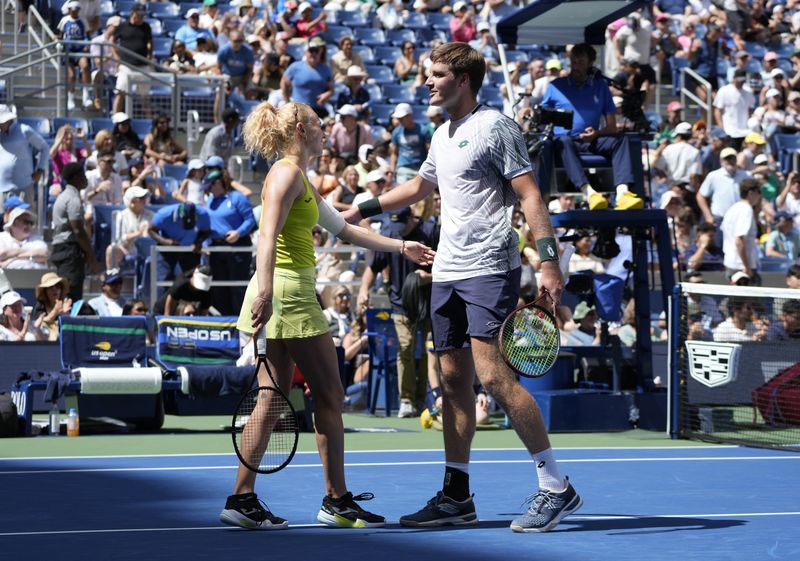
Serena Williams' long-awaited return to competitive tennis captured the imagination of tennis fans globally as the 23-time Grand Slam champion teamed with young star Carlos Alcaraz to secure a commanding victory at the US Open on Tuesday. The mixed doubles pairing dispatched Erin Routliffe and Lloyd Glasspool 5-3, 4-1 in their opening encounter, advancing to the quarter-finals with considerable ease. The result represented far more than a routine win for Williams, who has not played at Arthur Ashe Stadium since her tearful departure from professional tennis in September 2022, igniting scenes of emotional celebration among the crowd.
The 44-year-old Williams' appearance at the tournament electrified the venue, with thousands of spectators rising to their feet as she took the court once more. The iconic stadium, long regarded as the heartland of American tennis achievement, erupted with deafening applause throughout her performance. Just over two months prior, Williams had announced her competitive comeback, signalling her intention to return to the sport she has dominated throughout an illustrious career. For many observers, her appearance at this particular tournament held special resonance, given her previous dominance at the facility and the layoff that preceded this moment.
The on-court chemistry between Williams and Alcaraz, who is 21 years younger than his partner, proved immediately apparent to observers. Despite the significant age gap and their lack of prior partnership history, the duo demonstrated genuine comfort alongside one another, regularly exchanging smiles and moments of levity as they progressed through their match. Alcaraz, a seven-time major champion himself despite his youth, appeared energized by the opportunity to compete with one of tennis' greatest figures. The younger player has faced an extended absence from competition due to injury, with his last tournament appearance occurring in April, yet he showed few signs of rust in this return to action.
Williams' technical prowess remained evident from the opening moments of play. Her first shot of the match—a backhand winner—immediately drew roaring approval from the packed house. The declaration of intent continued as the match progressed, with a particular highlight arriving during the seventh game when Williams delivered a 120-mile-per-hour ace that visibly stunned onlookers with its velocity and precision. Alcaraz subsequently closed out the opening set with an authoritative forehand winner, establishing the partnership's dominance. The second set proved almost formative, as the pairing moved through their service games with minimal resistance, ultimately embracing one another at match conclusion while attired in matching royal purple outfits.
The mixed doubles draw this year continues a format overhaul that has fundamentally reshaped how this category functions at Flushing Meadows. Beginning with last year's inaugural implementation, tournament organizers deliberately repositioned mixed doubles to feature prominent singles competitors rather than dedicated doubles specialists. This strategic rebranding intended to broaden the event's commercial appeal and capture audiences who might otherwise ignore doubles competition. The initiative has achieved considerable success from a revenue perspective, generating sellout crowds and engaging numerous elite singles players who might traditionally avoid doubles contests. However, this restructuring has prompted criticism from some quarters of the doubles community, with established pairing specialists arguing the shift has marginalized their professional opportunities and diluted the quality of competition.
While Williams and Alcaraz progressed comfortably, the tournament produced a stunning upset elsewhere in the draw. Top-seeded pairing Novak Djokovic and Aryna Sabalenka, representing the tournament's most prominent singles talent entering mixed doubles, fell to experienced doubles professionals Henry Patten and Katerina Siniakova by a decisive 1-4, 4-2, 10-2 scoreline. The loss demonstrated that even the highest-ranked singles players cannot automatically translate their dominance into mixed doubles success when confronting seasoned doubles tacticians. Siniakova clinched victory with characteristic flair, delivering an ace down the sideline on match point that definitively ended any Djokovic-Sabalenka comeback hopes. The shortness of mixed doubles sets means individual lapses carry disproportionate consequences; as Patten noted post-match, the format punishes consistency lapses severely, with one poor service game potentially deciding an entire set.
The defending champions' trajectory proved equally problematic. Italian duo Sara Errani and Andrea Vavassori, who claimed the previous year's title, could not replicate their success against Russian pairing Mirra Andreeva and Andrey Rublev, surrendering their title with a 1-4, 4-1, 11-9 defeat in a closely contested encounter. Errani and Vavassori's elimination from title contention represents a significant development for the tournament narrative, removing the previous year's victors from their opportunity to achieve consecutive championships. Their conquerors will face the winner of the Casper Ruud-Diana Shnaider versus Jessica Pegula-Taylor Fritz matchup, suggesting intriguing quarter-final confrontations ahead.
The broader draw structure continued to produce competitive fixtures across multiple pairings. Married partnership Gael Monfils and Elina Svitolina secured their advancement into the semi-final stage through dominant performances, as did the Czech pairing of Karolina Muchova and Jakub Mensik. These results indicated that the mixed doubles competition maintained depth and competitive balance throughout the draw, with numerous combinations capable of delivering upset results against seeded opponents. The format's inherent volatility—compressed sets that can swing dramatically on individual games—has created an environment where upsets occur with notable frequency.
For Williams specifically, this victory carries implications extending beyond the immediate tournament context. Her return to professional competition at age 44 represents a remarkable athlete's decision to extend her competitive window and presumably add to her already-legendary achievement portfolio. The reception she received at Arthur Ashe Stadium underscored her continued status as tennis' most iconic contemporary figure, transcending generational boundaries in her appeal. As she continues through this tournament, her partnership with Alcaraz will face increasingly challenging opposition in quarter-final and potentially later-round matchups, including the scheduled encounter against Belinda Bencic and Flavio Cobolli later on Tuesday. The outcome of these advancing rounds will provide clearer indication of whether this partnership possesses sufficient depth to contend for the championship.

