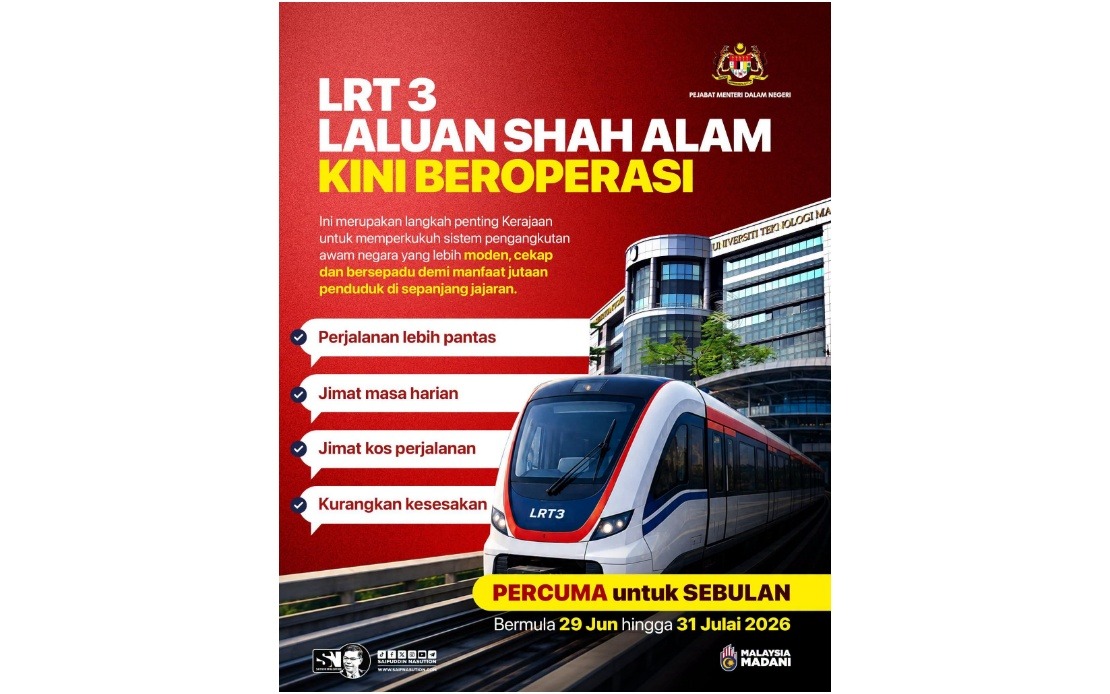
The inauguration of the Shah Alam Line LRT3 represents a pivotal moment in the country's efforts to reshape urban mobility, with Home Minister Datuk Seri Saifuddin Nasution Ismail positioning the rail project as tangible evidence of the MADANI Government's commitment to delivering a more contemporary and seamlessly integrated public transport network. Speaking on the milestone shortly after Prime Minister Datuk Seri Anwar Ibrahim's official launch ceremony, Saifuddin emphasised how the new corridor directly addresses transportation challenges facing millions of daily commuters traversing one of Southeast Asia's most congested metropolitan regions.
The Shah Alam Line addresses a critical mobility gap in the Klang Valley's transport infrastructure. By creating a dedicated rapid transit corridor serving Shah Alam, Klang, Subang and intermediate stations, the project tackles the chronic gridlock that has long plagued this economically vibrant but heavily trafficked zone. The Minister articulated how the new line fundamentally transforms commuter choices by expanding the practical alternatives available to those previously dependent on private vehicles, particularly workers, students and those managing routine daily activities who collectively contribute to peak-hour congestion across the corridor.
Beyond simple congestion relief, the LRT3's operational launch carries broader implications for Malaysia's urban development trajectory and quality-of-life considerations. Saifuddin framed the infrastructure investment within the government's wider strategic vision to enhance daily living standards for ordinary Malaysians. By shortening journey times and reducing commuting expenditures, especially for lower-income populations who dedicate disproportionate shares of household budgets to transport, the initiative addresses equity dimensions often overlooked in infrastructure debates. This aligns with the MADANI administration's stated priorities of inclusive development and economic accessibility.
The strategic timing of the free-fare promotional period—running from June 29 through July 31—reflects a carefully calculated approach to driving adoption during the crucial early operational phase. Rather than relying solely on fare structures to attract ridership, the government has opted for a confidence-building strategy that removes financial barriers and enables potential users to directly experience service quality before committing to regular patronage. This methodology acknowledges that many Klang Valley residents require tangible proof of reliability and convenience before abandoning established commuting patterns centred on personal vehicle use.
Saifuddin's public messaging explicitly encourages residents to treat the free-fare window as an extended trial period, framing the initiative in inclusive, accessible language designed to reach beyond typical early-adopter demographics. His call for commuters to temporarily abandon personal vehicles and experience the LRT3 ecosystem directly reflects confidence in the service's ability to convert trial users into regular passengers. This confidence appears grounded in the comprehensive nature of the system, which extends beyond the main rail line to encompass Prasarana Malaysia Bhd feeder bus services that promise genuine first-mile and last-mile connectivity.
The feeder bus integration represents a crucial design element often absent from earlier rapid transit investments in Malaysia. By ensuring that residents throughout the surrounding catchment area can physically access the main LRT3 stations through coordinated bus services, the project addresses a fundamental weakness that has historically limited public transport adoption in automobile-dependent suburban environments. This systems approach acknowledges that rail infrastructure in isolation cannot transform commuting patterns; genuine modal shift requires convenient, reliable connections enabling seamless journey-making from residential areas to transit stations and onward to employment and educational destinations.
From a Southeast Asian perspective, the Shah Alam LRT3 contributes to Malaysia's positioning as a regional leader in metropolitan rapid transit development. While larger regional economies like Indonesia and Thailand continue grappling with severe congestion challenges, Malaysia's systematic expansion of rail networks demonstrates a sustained policy commitment to modernising transport infrastructure. This trajectory carries implications for the country's attractiveness to multinational corporations seeking cities with functional public transportation systems and for talent retention among young professionals prioritising lifestyle quality indicators including commuting convenience.
The government's investment decision reflects broader recognition that transport infrastructure fundamentally shapes economic productivity, environmental outcomes and social equity simultaneously. Congested transport corridors impose measurable productivity losses through wasted time, increase local air pollution and particulate matter concentrations affecting public health, and disproportionately burden lower-income households lacking flexible work arrangements. By directly attacking these interconnected challenges through rail development, the MADANI Government addresses multiple policy objectives through a single infrastructure asset.
Looking forward, the success metrics for the Shah Alam Line extend well beyond immediate ridership figures during the promotional period. The government will likely assess service reliability, passenger satisfaction, integration effectiveness with feeder networks, and longer-term modal shift patterns once regular fares commence in August. These outcomes will inform subsequent rapid transit expansion decisions across Peninsular Malaysia, particularly within the Selangor and Kuala Lumpur metropolitan areas where congestion-related challenges intensify annually. The LRT3's performance trajectory will also influence private sector confidence in public-private partnership models for transport infrastructure, given that future expansion projects may require private participation to achieve the scale and pace of development necessary for meaningful congestion relief across the region.

