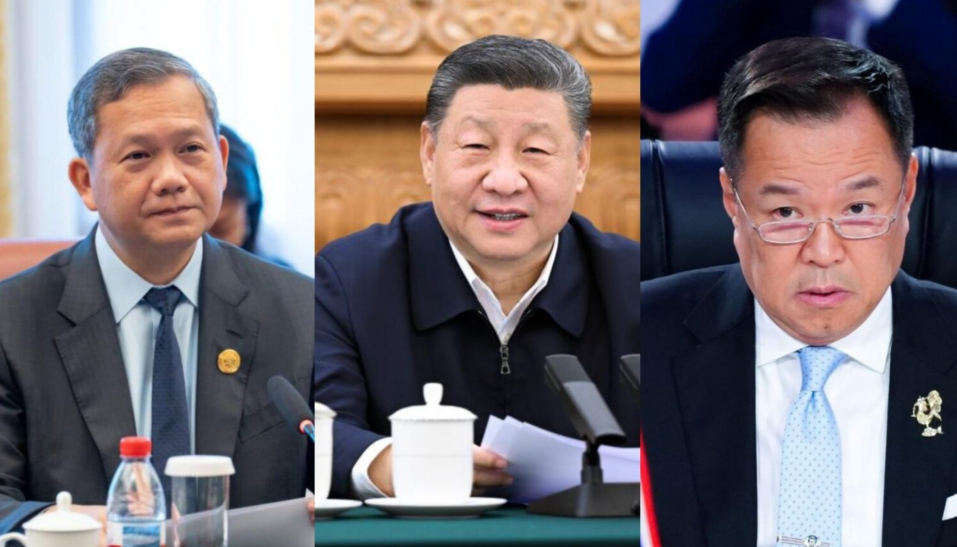
Prime Ministers Hun Manet of Cambodia and Anutin Chanvirakul of Thailand are preparing for high-level engagements in Shanghai on July 17, when both leaders have been invited by Chinese President Xi Jinping to attend the opening of the World AI Conference 2026. The visit carries significance beyond its official agenda of technology discourse, as observers see an opportunity for China to assert diplomatic pressure toward resolving a festering territorial dispute that has kept the two Southeast Asian nations from substantive negotiations for months. The last formal border talks occurred in December, leaving a considerable gap in direct dialogue on the matter.
Hun Manet's delegation, departing Cambodia on July 15, includes a notably expansive contingent of senior officials signalling the importance Phnom Penh attaches to the visit. Foreign Minister Prak Sokhonn and Defence Minister Tea Seiha will accompany the prime minister, alongside Sun Chanthol, first vice-chairman of the Council for the Development of Cambodia. This composition suggests that Cambodia intends to address multiple dimensions of bilateral ties during the Shanghai visit, from diplomatic channels to security cooperation. Thailand's participation mirrors this approach, with Foreign Minister Sihasak Phuangketkeow expected to join Anutin in the Chinese metropolis.
Both leaders will secure separate audiences with President Xi and Premier Li Qiang, granting each nation individual opportunities to articulate concerns and priorities in bilateral forums. The Cambodian government has already framed the visit as a continuation of deepening engagement with its principal ally, emphasising the "Comprehensive Strategic Partnership of Cooperation" and broader frameworks including the "Diamond Cooperation" initiative. These rhetorical touchstones underline Cambodia's strategic orientation toward Beijing, a relationship that has defined much of Phnom Penh's foreign policy architecture in recent years. Thai officials have similarly emphasised strengthening ties with China, though the border tensions with Cambodia complicate Bangkok's position in the region.
The broader context matters considerably for Malaysian and Southeast Asian readers. When Hun Manet and Anutin last appeared together at the Asean Future Forum in Hanoi during early June, their interaction was ceremonial—a handshake before cameras with no substantive border discussions. That shallow engagement underscored how intractable the dispute has become without external mediation. China, as the leading trading partner for both nations and a permanent arbiter of Southeast Asian geopolitical calculations, is well-positioned to employ economic leverage and diplomatic weight to move the conversation forward. Analysts expect Beijing to exploit this positioning during the Shanghai conference.
The territorial disagreement centring on Thai-occupied areas of Cambodia presents a human dimension that amplifies its urgency. Approximately 20,000 Cambodian civilians remain unable to return to their homes in disputed zones, a humanitarian consequence that persists despite formal high-level statements about resolving differences. This civilian displacement distinguishes the border row from routine diplomatic friction, transforming it into a matter affecting ordinary lives and regional stability more broadly. The prolonged separation of these communities raises questions about whether incremental pressure from Beijing can catalyse the political will needed for serious negotiations.
Kin Phea, director of the Royal Academy of Cambodia's International Relations Institute, has articulated a critical analytical perspective on obstacles to resolution. He identifies the Thai military as the primary impediment, suggesting that civilian Thai officials have agreed to agreements that the military establishment subsequently undermines through unilateral actions and territorial encroachment. This civil-military divide in Thailand complicates external mediation efforts, since diplomatic pressure on the civilian government may not translate into military compliance. Beijing's challenge will be to navigate this institutional friction while persuading both governments that peaceful settlement serves their collective interests.
The December 2025 Fuxian Consensus, brokered by China itself, established principles for resolving the dispute through diplomatic consultation and international law. That both nations signed the consensus suggests rhetorical commitment, yet implementation has stalled, particularly regarding Thai troop withdrawal and resumption of Joint Boundary Commission work. Phea's recommendation that China should assume a more active arbitrator role indicates that specialists believe Beijing has not yet wielded sufficient pressure to compel compliance. The Shanghai conference may therefore represent an inflection point where China transitions from facilitating frameworks to enforcing accountability for adherence.
For the broader Southeast Asian community, the Cambodia-Thailand dispute reflects wider tensions about territorial integrity and the rule of law in inter-state relations. Malaysia, Vietnam, and other regional states have watched closely as the dispute persists, conscious that their own boundary questions could face similar intransigence. A Chinese-brokered resolution would strengthen Beijing's credibility as a regional mediator and reinforce the narrative that Beijing can effectively manage smaller-power disputes. Conversely, failure to advance talks would suggest that even Chinese pressure cannot surmount nationalist sentiment and military resistance in Thailand.
The optics of the Shanghai conference present both opportunity and risk for all parties. For Cambodia, appearing before Xi and Li with Thailand's premier creates conditions for visible progress, whether bilateral or through Chinese intervention. For Thailand, the venue offers a chance to demonstrate commitment to regional stability while addressing legitimate security concerns. For China, orchestrating meaningful movement on the border dispute would represent a significant diplomatic victory, proving that economic interdependence and shared membership in regional frameworks can resolve acute disputes. The challenge lies in converting photographic moments of diplomatic engagement into substantive agreements that address the underlying causes of Thai military activity in Cambodian territory and restore normalcy to border communities.

