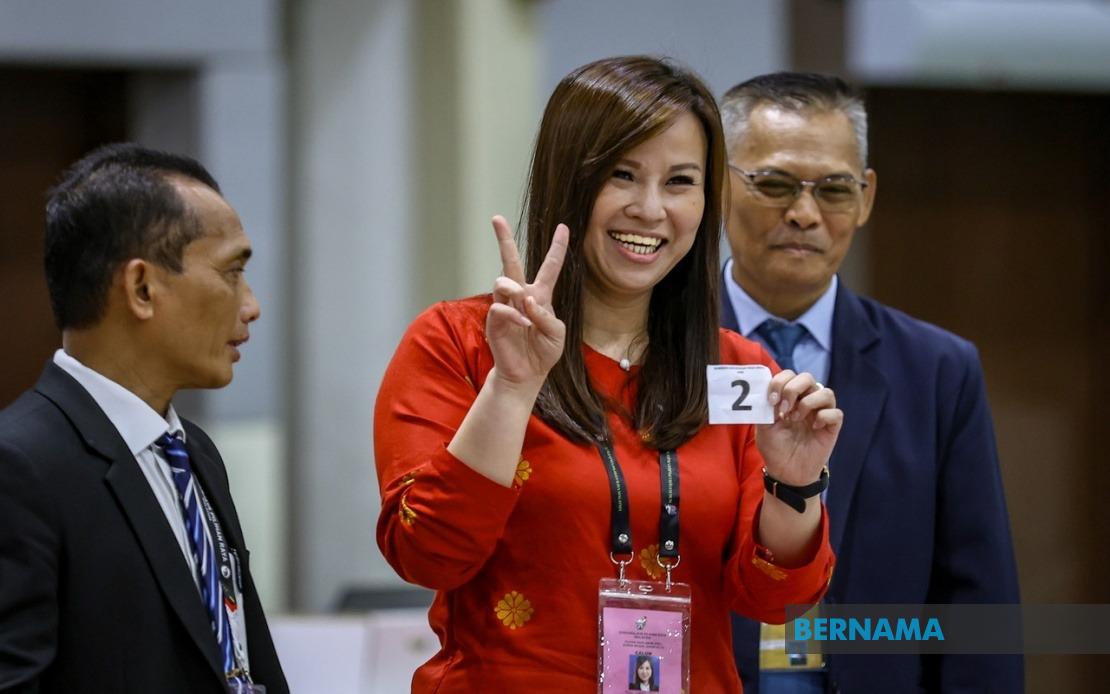
Sharon Teo, the Pakatan Harapan candidate for Permas, is taking her challenge to the incumbent Barisan Nasional representative directly to the ground, hammering home two core issues that residents have repeatedly raised during her campaign visits: the state of local roads and the welfare of ordinary people. Speaking to media after nomination day proceedings at Dewan Muafakat in Taman Mawar on June 27, the Johor Amanah Women's Youth chief underscored that infrastructure quality is not merely a convenience issue but fundamentally a matter of public safety that deserves priority attention. Her campaign strategy reflects a careful reading of grassroots sentiment, with the messaging clearly aligned to everyday concerns that dominate conversation among constituents.
The Permas seat sits within the Pasir Gudang parliamentary constituency, a region in Johor that encompasses nearly 114,000 eligible voters. This is a substantial electorate with considerable sway in state politics, and both major coalitions recognise the significance of the contest. Sharon Teo carries relevant experience from her previous role as an aide in the Pulai parliamentary constituency under the late Amanah deputy president Salahuddin Ayub, giving her exposure to constituent services and policy advocacy at the state level. That background positions her as someone versed in the mechanics of addressing local grievances through administrative and legislative channels, rather than a political newcomer unfamiliar with parliamentary procedures and the limits of state representation.
Incumbent Baharudin Mohamed Taib, who secured the seat for Barisan Nasional in the 2022 Johor election, acknowledges that retaining his mandate will require sustained effort and vigilance. In his own remarks to media, he demonstrated awareness that each opposing candidate brings distinct strengths and constituency appeal, suggesting he cannot rely on default voter loyalty or organisational advantages alone. His cautious tone contrasts with the confidence often projected by incumbents in safe seats, indicating that either internal polling shows tightening margins or that Barisan strategists view this particular contest as genuinely competitive. He indicated his intention to rely on the broader coalition's state manifesto rather than a personalised campaign platform, a decision that may reflect either party discipline or a strategic choice to link himself to wider party messaging.
The Permas contest has evolved into a four-way race, a configuration that could fragment the vote and produce unpredictable outcomes. Beyond the two major contenders, Perikatan Nasional fields T. Vela while Parti Bersama Malaysia puts forward Dr Zamil Najwah. In Malaysian state elections, splitting the opposition vote can work decisively in the incumbent's favour, though the presence of a third major challenger on the pro-government side complicates that traditional advantage. With over 113,000 eligible voters on the rolls, the mathematical possibility exists for a winning candidate to prevail with considerably less than an outright majority if votes are sufficiently dispersed across four candidates.
Sharon Teo has committed to unveiling a detailed manifesto outlining her specific vision and mission for the constituency, suggesting she is preparing a comprehensive policy platform to differentiate herself from the incumbent and other challengers. The timing of such announcements typically builds momentum heading toward polling day and gives voters concrete pledges against which to measure her performance should she win office. Infrastructure complaints are particularly potent in Malaysian electoral discourse because bad roads affect daily commuting, vehicle maintenance costs, and in worst cases, public safety through accidents or inadequate emergency access. By centring her campaign on this tangible issue, she is targeting voter frustration with problems that affect household budgets and quality of life directly.
The welfare dimension of her campaign speaks to another set of concerns that resonate across socioeconomic strata in constituencies like Permas. As Malaysia grapples with inflation pressures and cost-of-living challenges, voters increasingly evaluate candidates on their capacity and willingness to advocate for targeted assistance, subsidy mechanisms, and social support programmes. Pakatan Harapan, having held power at federal level between 2018 and 2022, has articulated various welfare-focused policies, and Sharon Teo's emphasis on this theme aligns with the coalition's broader messaging about prioritising ordinary people over entrenched elites.
Barisam's decision to campaign on the party's state manifesto rather than individual candidate pledges reflects a classical approach to defending government control, effectively putting the entire coalition's record and plans before voters rather than limiting focus to one representative's promises. This strategy can work when the governing party's popularity is high and when the broader agenda resonates with the electorate, though it can also dilute a candidate's perceived personal commitment to local issues. Baharudin's acknowledgment that the fight will be difficult suggests Barisan does not view this contest as reliably safe, which is telling given that they won it in the 2022 election less than two years prior.
The Permas constituency embodies broader dynamics unfolding across urban and semi-urban Johor, where voter sentiment can shift notably between federal and state elections, where coalition allegiances are less locked in, and where specific local governance issues often determine outcomes more than national political narratives. The presence of multiple candidates also reflects fragmentation within Malaysia's political landscape, with Perikatan Nasional establishing itself as a meaningful alternative to both Barisan and Pakatan in several states, and newer entrants like Bersama attempting to carve out space as independent voices. The July 11 polling date, with early voting on July 7, will determine not only which candidate wins Permas but will also contribute to signals about voter sentiment across Johor more broadly as the state enters a new electoral cycle.
For Malaysian readers and observers tracking state-level politics, the Permas race exemplifies contemporary Malaysian elections in miniature: traditional government-opposition battles are now increasingly complicated by additional challengers; local concerns about infrastructure and welfare dominate campaign messaging over ideological positioning; and voter sentiment can surprise political establishments accustomed to secure majorities. The contest will provide meaningful data points about the electoral positioning of all participating coalitions in a state that remains crucial to national political calculations given its population size and historical role as a political bellwether.

