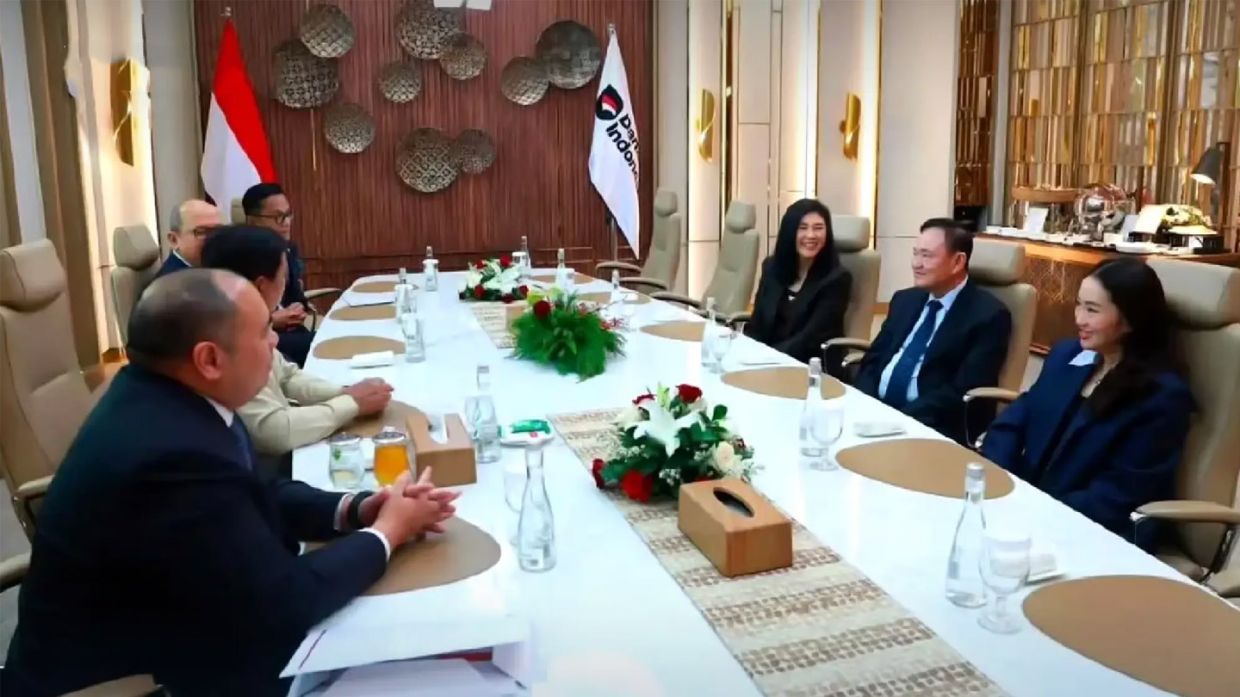
Three prominent members of Thailand's Shinawatra political dynasty convened with Indonesian President Prabowo Subianto in Jakarta this week to explore investment avenues and economic cooperation between the two Southeast Asian nations. The gathering brought together former Prime Ministers Thaksin Shinawatra, Yingluck Shinawatra, and Paetongtarn Shinawatra at the Danantara building on July 9, according to Indonesian Cabinet Secretary Teddy Indra Wijaya. The presence of all three former leaders at a single meeting underscores the significance Jakarta places on deepening ties with Thailand's influential business and political establishment during a period of regional economic uncertainty.
Thaksin led Thailand's government between 2001 and 2006, implementing populist policies that fundamentally reshaped Thai politics. Yingluck subsequently took the helm from 2011 to 2014, continuing many of her brother's initiatives before facing political upheaval that forced her into self-imposed exile. Most recently, Paetongtarn held the premiership from 2024 to 2025, representing the family's return to executive power after years of political contestation. The convergence of three generations of Shinawatra leadership in Indonesia signals the family's enduring network across Southeast Asia and their continued relevance in shaping regional economic discourse.
Photographs released by Indonesia's Cabinet Secretariat on social media depicted the three former premiers alongside President Prabowo and senior executives from Danantara, Indonesia's state-owned investment management agency. The visual documentation of this meeting served both diplomatic and domestic purposes, demonstrating Prabowo's commitment to fostering relationships with significant economic actors in neighbouring countries while simultaneously showcasing Thailand's political establishment engaging constructively with Jakarta's development agenda.
Thaksin holds a position on Danantara's advisory board, a role that has previously positioned him at the centre of discussions surrounding Indonesia's strategic investment priorities and long-term economic transformation goals. His presence as an international economic figure within the agency reflects Indonesia's broader strategy of recruiting globally recognised business and political minds to guide national asset development. During the July 9 session, Thaksin offered insights and exchanged perspectives with both Prabowo and Danantara's leadership, leveraging his experience in managing large-scale economic initiatives and navigating complex political environments.
Danantara Indonesia functions as the government's primary instrument for managing, optimising, and deploying strategic state assets in service of the nation's economic modernisation objectives. The institution oversees substantial portfolios spanning energy, infrastructure, telecommunications, and financial services—sectors fundamental to Indonesia's development trajectory. By engaging with seasoned regional figures like Thaksin, Danantara seeks to access expertise in portfolio management, asset optimisation, and cross-border investment strategies that could enhance returns on state holdings while advancing broader development priorities.
The formal agenda centred on identifying viable investment prospects, refining asset management methodologies, and formulating economic development frameworks capable of generating sustainable growth over extended timeframes. Such discussions carry particular weight for both nations as Southeast Asia navigates slower global growth, intensifying regional competition, and the imperative to upgrade industrial capacity. Thailand and Indonesia, as the region's two largest economies outside Singapore, share mutual interests in identifying investment opportunities that can generate employment, technology transfer, and industrial upgrading while maintaining macroeconomic stability.
Danantara's senior leadership directly participated in these discussions, with Group Chief Executive Officer Rosan Roeslani, Chief Operating Officer Dony Oskaria, and Chief Investment Officer Pandu Sjahrir all in attendance. Their involvement underscores the meeting's substance and institutional significance—this was not a courtesy call but rather a substantive engagement between decision-makers capable of advancing concrete economic initiatives. These executives manage billions of dollars in state assets and possess authority to authorise cross-border investments, making their direct engagement with the Shinawatra delegation meaningful for both parties.
Indonesia's government characterised the engagement as reflecting its broader diplomatic strategy of expanding international cooperation and solidifying the nation's standing amid volatile global conditions. Regional geopolitical tensions, supply chain disruptions, and competing great power interests have intensified pressure on Southeast Asian nations to cultivate diverse economic partnerships while maintaining strategic autonomy. Hosting prominent figures from neighbouring economies and facilitating substantive discussions about mutual investment serves Jakarta's objective of positioning Indonesia as a reliable, business-friendly investment destination.
The July 9 meeting represented merely one element of a broader engagement programme between Prabowo and the Shinawatra family. The Indonesian president separately hosted Thaksin and his family members at his private Jakarta residence in what the Cabinet Secretariat characterised as a warm and collegial atmosphere. These dual engagements—one formal and institutional, the other personal and familial—suggest a multifaceted relationship aimed at cementing both official and personal connections between Indonesian and Thai leadership circles.
For Malaysian observers, this diplomatic choreography illustrates how regional economic cooperation increasingly occurs at the intersection of government institutions and private networks. The Shinawatra family's sustained influence over Thai politics and economics, despite periods of formal exclusion from power, demonstrates how family-based capital accumulation and networks survive political turbulence in Southeast Asia. Prabowo's cultivation of relationships with figures like Thaksin reflects Jakarta's recognition that significant regional economic actors operate partially outside formal governmental structures, wielding influence through advisory roles, business holdings, and political networks.
The discussions also carry implications for ASEAN cohesion and intra-regional investment flows. As individual member states compete for foreign direct investment and seek to attract regional capital, high-level diplomatic engagement becomes an essential tool for creating investor confidence and signalling political stability. By demonstrating openness to dialogue with prominent Thai business figures and former leaders, Prabowo communicates to investors across the region that Indonesia offers a welcoming environment for significant economic actors seeking exposure to Southeast Asian growth opportunities.
Looking forward, the meeting may generate concrete outcomes in the form of cross-border investment vehicles, joint ventures in infrastructure or resource sectors, or collaborative initiatives within Danantara's portfolio companies. Such developments would benefit both economies by channelling Thai capital and expertise toward Indonesian growth sectors while providing Thai investors with participation in transformative infrastructure projects. The Shinawatra family's consistent focus on identifying and executing large-scale economic projects positions them well to identify and pursue opportunities aligned with Indonesia's development objectives.

