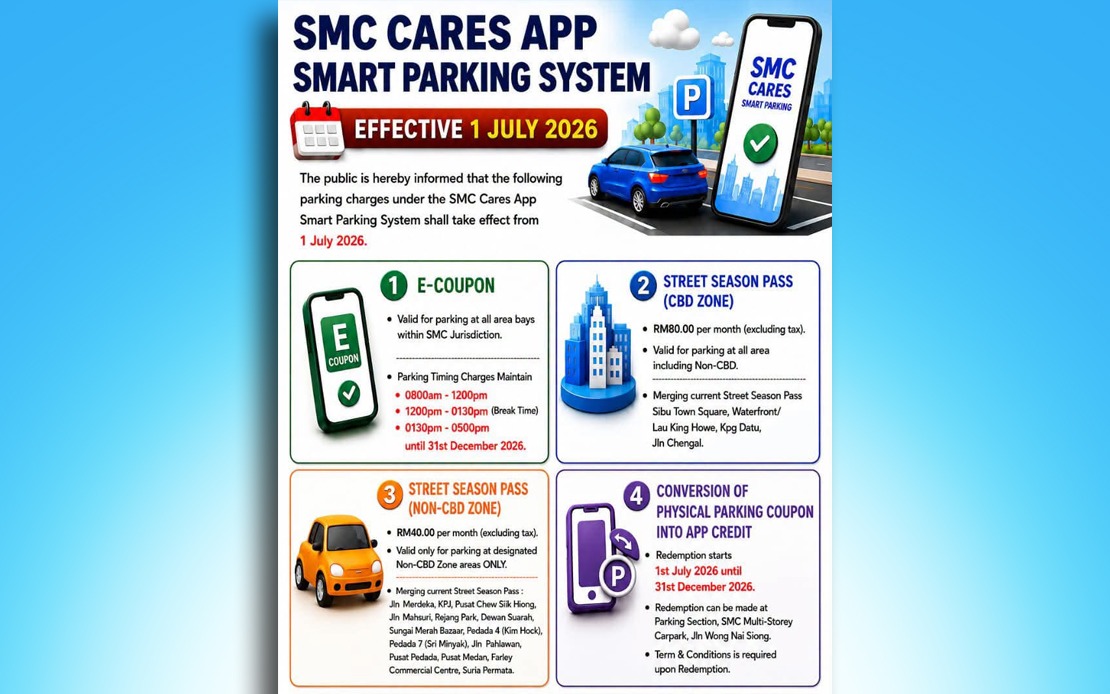
The Sibu Municipal Council has moved to address mounting public dissatisfaction with its digitised parking enforcement system by introducing a five to ten-minute buffer before penalty notices are automatically generated. The decision comes after sustained criticism since the SMC Cares Smart Parking system was fully activated earlier this month, with frustrated motorists taking to social media to air grievances about the speed at which Over Parking Notices are issued and the technical difficulties plaguing the application itself.
Chairman Clarence Ting Ing Horh revealed that the council has directed Primal Solution Sdn Bhd, the technology provider managing the system, to programme this grace window into the enforcement framework. The rationale appears straightforward: most users require time to locate a parking space, exit their vehicle, and then navigate the mobile application to activate their parking session. By compressing this sequence into a rigid timeline without flexibility, the system was effectively penalising users for actions beyond their immediate control. Ting characterised the grace period as essential to making the platform genuinely user-centric rather than punitive, signalling a philosophical shift from the aggressive enforcement that triggered the initial backlash.
Beyond the grace period, the council plans to launch a dedicated Senior Citizen Parking Pass scheme commencing in August for drivers aged 60 and above. This recognises that elderly motorists often find smartphone-based systems challenging to adopt and operate, and may require extended time to complete transactions. While full details remain pending, the initiative addresses one of the most frequently cited barriers to system adoption among Sibu's older population, who either lack digital literacy or face physical difficulties in managing application interfaces. This demographic consideration is particularly relevant for Malaysia, where an ageing society increasingly intersects with rapid technological rollout in municipal services.
The council has simultaneously acknowledged the appeal mechanism for motorists who believe notices were issued in error, whether due to misidentified registration numbers or other legitimate circumstances. Every enforcement action is underpinned by photographic evidence retained in the system, providing an audit trail. However, the existence of an appeal process—however well-intentioned—does place the burden on citizens to challenge administrative action rather than preventing erroneous notices from being issued in the first place. The grace period represents a more proactive intervention to avoid these disputes altogether.
Ting also clarified the boundary between parking enforcement, which sits with contracted wardens, and broader traffic violations such as obstruction or illegal parking, which remain the responsibility of SMC's own enforcement division and the Royal Malaysia Police. This distinction emerged because social media rumours alleged that parking wardens were issuing compounds for offences beyond their remit. The council has instructed these wardens to remove face coverings except for valid medical reasons, ostensibly to improve transparency and accountability through easy identification, and to adopt a more approachable demeanor when assisting users unfamiliar with the application.
A dedicated support counter at Sibu Public Library has been established to provide in-person guidance on registration and app navigation, addressing complaints that the initial onboarding process was unnecessarily complicated, especially for senior citizens. This hybrid approach—combining digital infrastructure with physical customer support—acknowledges that a purely app-based system without human assistance creates exclusionary barriers, particularly in a Malaysian context where digital divide issues remain pronounced across age groups and socioeconomic backgrounds.
Concerns about Sibu's parking charges being among the highest in Sarawak were met with comparative analysis suggesting the rates remain competitive with other local authorities in the state. The council further clarified that all parking revenue flows directly to SMC's coffers, while Primal Solution receives compensation through a separate service contract. This transparency about revenue flows is important, as public perception that private contractors profit excessively from enforcement can fuel distrust in the system's underlying purpose.
Since its introduction, SMC Cares has attracted over 93,000 registered users, and the council anticipates surpassing its original target of 100,000 registrations by year-end. These figures suggest meaningful uptake despite the technical problems and user experience issues that dominated early feedback. The trajectory also indicates that with the grace period and senior citizen provisions now in place, adoption could accelerate further, provided that the underlying application performance issues are resolved in parallel.
The original complaints catalogue reveals the systemic nature of user dissatisfaction. Beyond the issue of rapid penalty issuance, motorists reported a complicated registration workflow, an unintuitive interface design, sluggish system performance, involuntary logouts, payment processing delays, and—most critically—compounds being generated before users could finalise their parking payments. These problems suggest that the system was rushed to full implementation without adequate testing or user acceptance trials. A grace period ameliorates one symptom, but resolving the technical foundation remains essential to genuine system improvement.
For Malaysian municipalities considering similar smart parking deployments, Sibu's experience offers instructive lessons. Rapid digitalisation of traditionally manual services without sufficient user education, technical stability, or accommodations for vulnerable populations tends to generate public backlash that undermines the initiative's credibility and adoption. The council's responsiveness in introducing the grace period and senior citizen pass demonstrates a willingness to adapt, yet suggests these features should ideally have been built into the original design rather than bolted on afterwards. As cities across Malaysia and Southeast Asia pursue smart city agendas, the Sibu experience underscores the importance of balancing technological ambition with practical usability and inclusive access.

