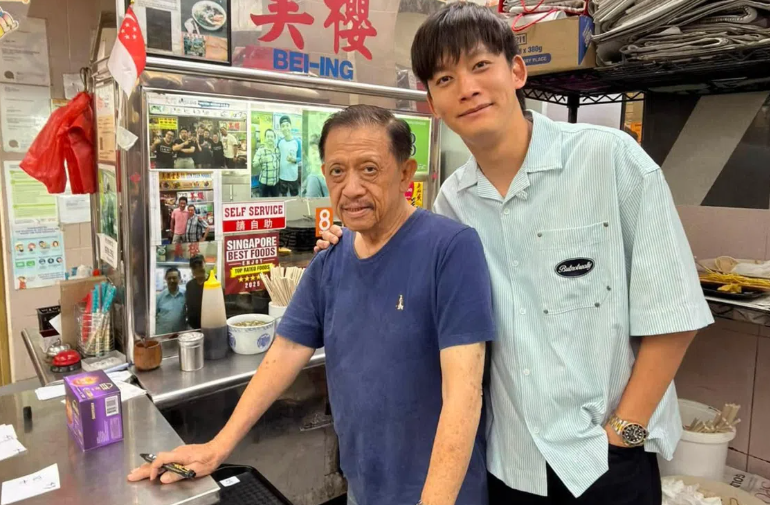
Singaporean actor Noah Yap has pushed back forcefully against online accusations that his decision to visit an injured elderly hawker represented a calculated bid for public attention and favourable media coverage. The controversy erupted after Yap posted about seeing Bei-Ing Wanton Noodle owner Yeo following an altercation at Roxy Square, with detractors suggesting the actor was leveraging a tragic incident to boost his profile.
In his rebuttal, Yap disclosed that his connection to the hawker stall extends back more than two decades, spanning from his formative years through primary school into adulthood. This lengthy patronage fundamentally contradicts the narrative that his recent visit was motivated purely by opportunism. Yap elaborated that Yeo and his family had consistently shown personal interest in his life over the years, with the elderly stall owner developing something akin to a familial attachment as he witnessed the young man mature from a schoolboy customer into an adult.
The underlying incident that prompted Yap's visit occurred on August 15, when a confrontation between Yeo and a younger man unfolded at the coffee shop location. According to statements from Yeo and his family members, the elderly hawker had noticed a young girl at a nearby table whom he found endearing, leading him to reach out and gently pat her head—a gesture intended as a harmless, paternal display of affection rooted in traditional Southeast Asian cultural norms where such behaviour towards children is commonplace among older members of the community.
The situation escalated dramatically when the girl's father took exception to the gesture and confronted Yeo. Security footage that subsequently circulated online appeared to document the younger man physically grabbing the elderly hawker and forcibly pushing him to the ground, resulting in visible injury. The severity of the incident prompted a formal police report, with investigators continuing to examine the circumstances surrounding the clash between the two individuals.
Yap made the decision to visit Yeo the day following the altercation, on August 16, motivated by genuine concern for his long-time acquaintance's wellbeing. During the visit, he found the elderly hawker in reasonably good spirits despite the traumatic experience, though notably Yeo initially displayed reluctance to pursue formal medical evaluation for his injuries—a hesitation that reflects patterns common among older members of working-class communities who prioritise continuity of their livelihoods over seeking healthcare.
When Yap subsequently chose to document his visit through social media, he framed the post as a mechanism to generate broader public awareness about the incident rather than as self-promotion. This deliberate communication strategy appears designed to highlight the circumstances of the altercation and the treatment of an elderly service worker. In his response to critics, Yap expressed exasperation at the suggestion that he possessed sufficient free time to engineer a publicity campaign, responding with the colloquial rebuttal, "Get a life la. I'm not as free as you think."
The controversy reflects broader societal tensions regarding the boundaries between genuine civic engagement and performative activism in the age of social media. For Malaysian observers, the situation mirrors ongoing debates about whether publicising one's charitable actions or support for vulnerable community members constitutes authentic compassion or opportunistic image management. The distinction becomes particularly salient when examining whether raising awareness about incidents of violence against elderly workers—traditionally a marginalised demographic in both Singapore and Malaysia—ultimately serves a valuable public interest function regardless of the motivations of those amplifying the message.
Yap's core message throughout his defence emphasises that violence remains fundamentally incompatible with civilised society and that individuals across communities should endeavour to practise greater interpersonal kindness and tolerance. He articulated this position as a moral principle rather than merely a response to this specific incident, suggesting a genuine conviction about social harmony and respect for vulnerable populations. The emphasis on non-violence carries particular resonance in the context of altercations involving elderly individuals who occupy a weaker physical position and rely on community respect and protection.
The incident and subsequent online discourse illuminate how digital platforms amplify both genuine concerns and unfounded scepticism simultaneously, often without sufficient information to distinguish between the two. Yap's 20-year connection to the hawker provides contextual evidence that complicates the simplistic narrative of opportunistic celebrity involvement. For regional audiences, the case study demonstrates how quick judgments circulated through social media can obscure underlying relationships and motivations that might otherwise be apparent to those within the immediate community.
The police investigation into the physical altercation remains ongoing, with authorities gathering evidence and witness accounts to determine culpability and appropriate legal responses. This investigative process will ultimately determine whether criminal charges emerge from the incident. Meanwhile, the public discourse continues to wrestle with questions about celebrity responsibility, the ethics of social media documentation of personal acts, and the broader imperative to protect vulnerable elderly workers within service economies across Southeast Asia. The case ultimately transcends individual personalities to raise systemic questions about how communities treat their most defenceless members.

