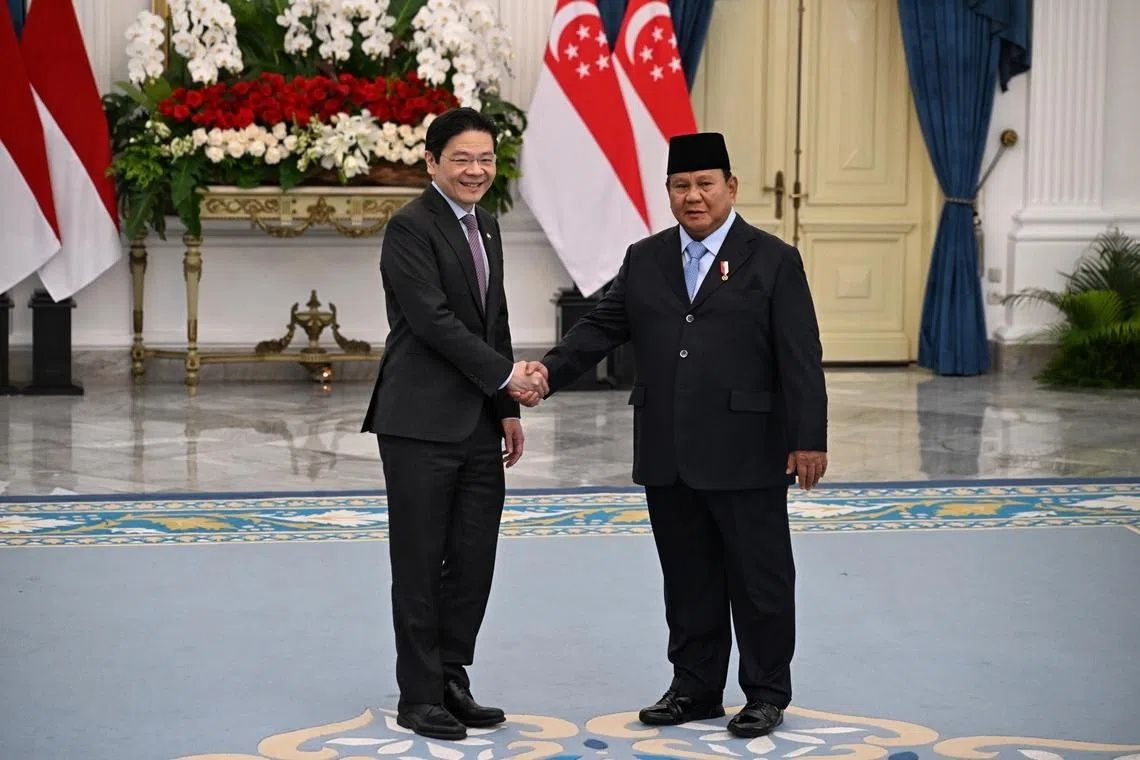
The strategic partnership between Singapore and Indonesia reached a significant milestone when Prime Minister Lawrence Wong and President Prabowo Subianto met on July 6 at an annual leaders' retreat in Jakarta, jointly pledging to safeguard the Strait of Malacca as a vital corridor for global commerce. The two nations underscored that keeping this critical waterway accessible and secure remains central to both their national interests and the broader stability of Southeast Asia, signalling an escalation in how they view maritime security within their bilateral relationship.
The Strait of Malacca, separating Malaysia's peninsula from Indonesia's Sumatra island and linking the Indian Ocean to the South China Sea, ranks among the world's most consequential shipping lanes. Roughly one-third of global maritime trade and a similar proportion of the world's seaborne oil supply transit through these waters annually, making disruptions here capable of rippling through international markets within days. Recent turmoil in the Middle East, particularly strain on the Strait of Hormuz following geopolitical tensions with Iran, has illustrated how quickly chokepoints in global shipping can amplify economic uncertainty worldwide—a reality that has concentrated minds in Singapore and Indonesia on the need for robust protection of their own vital waterway.
President Prabowo articulated Indonesia's position with clarity, framing the strait's security as inseparable from the nation's geographic identity and economic welfare. He emphasised that Indonesia, alongside Singapore, bears direct responsibility as a littoral state bordering these waters, and that maintaining the strait as a passage free for all parties reflects both countries' commitment to international law and principles of maritime freedom. Beyond the baseline of openness, Prabowo highlighted Indonesia's determination to coordinate with fellow Southeast Asian nations Malaysia and Thailand to prevent accidents, pollution, piracy and robbery—challenges that have periodically threatened shipping in the region and undermine confidence in the waterway's safety.
PM Wong echoed these sentiments while connecting maritime security to the broader geopolitical context affecting Southeast Asia. He invoked recent Middle Eastern disruptions as a cautionary example of what happens when major sea lanes become contested or unstable, drawing an implicit contrast with the Strait of Malacca's critical need to remain predictable and secure. By framing Singapore and Indonesia as "strategically aligned" on this issue, Wong signalled that the two nations view their coastal positions not as sources of friction but as complementary responsibilities requiring coordinated stewardship. This alignment is particularly significant given historical sensitivities around territorial boundaries and maritime rights in the region.
The commitment to maritime security formed only part of a broader conversation about deepening economic and strategic ties between the two countries, particularly as they prepare for a major milestone. With 2027 marking 60 years of formal diplomatic relations, both Singapore and Indonesia appear intent on demonstrating that their partnership has evolved from a post-colonial accommodation into a dynamic, multifaceted collaboration. The retreat featured substantive discussions extending well beyond traditional areas of trade and investment, reflecting how both economies recognise that their future competitiveness depends on cooperation in emerging sectors.
Electricity trade across borders emerged as perhaps the most concrete and symbolically significant outcome of the discussions. Indonesia announced that its sovereign wealth fund Danantara would lead implementation efforts, with Singapore-based firms including Keppel Electric, Sembcorp Industries and Singapore Energy Interconnections signing new agreements to advance cross-border electricity cooperation. For Malaysia and Southeast Asia, this development carries particular resonance because it points toward the possibility of a truly integrated regional power market—an ASEAN Power Grid—where electricity could flow across borders based on generation capacity and demand, rather than remaining locked within national boundaries. Such infrastructure could enhance energy security across the region by allowing nations to balance supply and demand more efficiently, reducing dependence on expensive imports during peak periods.
PM Wong portrayed the electricity initiative as a "win-win" arrangement that would benefit both nations while providing a foundation for broader regional energy architecture. Singapore, with limited land area and minimal hydroelectric or coal resources, stands to gain access to Indonesia's substantial renewable energy potential, particularly as the archipelago develops solar and geothermal capacity. Indonesia, meanwhile, gains investment in infrastructure, technological expertise and market access for its power generation sector. The arrangement also carries strategic value by deepening economic interdependence, making both nations more invested in maintaining regional stability and cooperative frameworks.
Beyond energy, discussions encompassed digital infrastructure, cybersecurity and supply chain resilience—areas increasingly understood as foundational to economic competitiveness in the 21st century. The emphasis on supply chain resilience reflects lessons from recent years when pandemic disruptions and geopolitical tensions exposed the risks of overly concentrated production networks. By enhancing cross-border coordination on supply chains, Singapore and Indonesia can help ensure that neither nation becomes hostage to disruptions elsewhere in regional manufacturing ecosystems. Digital infrastructure and cybersecurity cooperation, meanwhile, address the reality that future economic activity—from financial services to manufacturing—depends entirely on secure, reliable digital networks.
PM Wong used the retreat as an occasion to publicly reinforce Singapore's confidence in Indonesia's economic trajectory, a gesture of political significance beyond mere diplomatic courtesy. Singapore's investments in Indonesia extend across multiple sectors and geographies, from the Batam, Bintan and Karimun zones to the Kendal Industrial Park in central Java. The industrial park's achievement of full capacity by 2026, combined with plans for a 1,000-hectare expansion, exemplifies how foreign direct investment from Singapore continues generating employment, technology transfer and backward linkages within Indonesia's domestic economy. Wong's repeated emphasis on Singapore's desire for Indonesia to succeed conveyed that the city-state sees Indonesia not as a competitor but as a partner whose development strengthens both nations.
For Malaysian observers and policymakers, these developments carry multilayered implications. The strengthened Singapore-Indonesia partnership on maritime security implicitly includes Malaysia, which shares littoral responsibility for the Strait of Malacca. While Malaysia was not represented at the bilateral retreat, the explicit commitment by President Prabowo to coordinate with Malaysia and Thailand underscores that Kuala Lumpur's cooperation remains essential to implementing any serious maritime security framework. The emphasis on cross-border electricity trade also carries regional significance, particularly as ASEAN nations contemplate interconnected power grids that could eventually include Malaysia. Such arrangements could position Malaysia as either a transit point or a generator within future regional electricity networks, depending on how domestic policy evolves.
The retreat reflected a broader strategic recalibration in Southeast Asia, where major powers—including China and India—have invested heavily in building influence. By elevating their partnership across multiple dimensions simultaneously, Singapore and Indonesia have positioned themselves as drivers of regional integration and stability rather than passive recipients of external pressure. The emphasis on openness, rules-based frameworks and multilateral coordination distinguishes this approach from zero-sum strategic competition. For the broader Southeast Asian region, a strengthened and forward-looking Singapore-Indonesia partnership offers ballast against centrifugal forces that might otherwise pull the region toward greater fragmentation.

