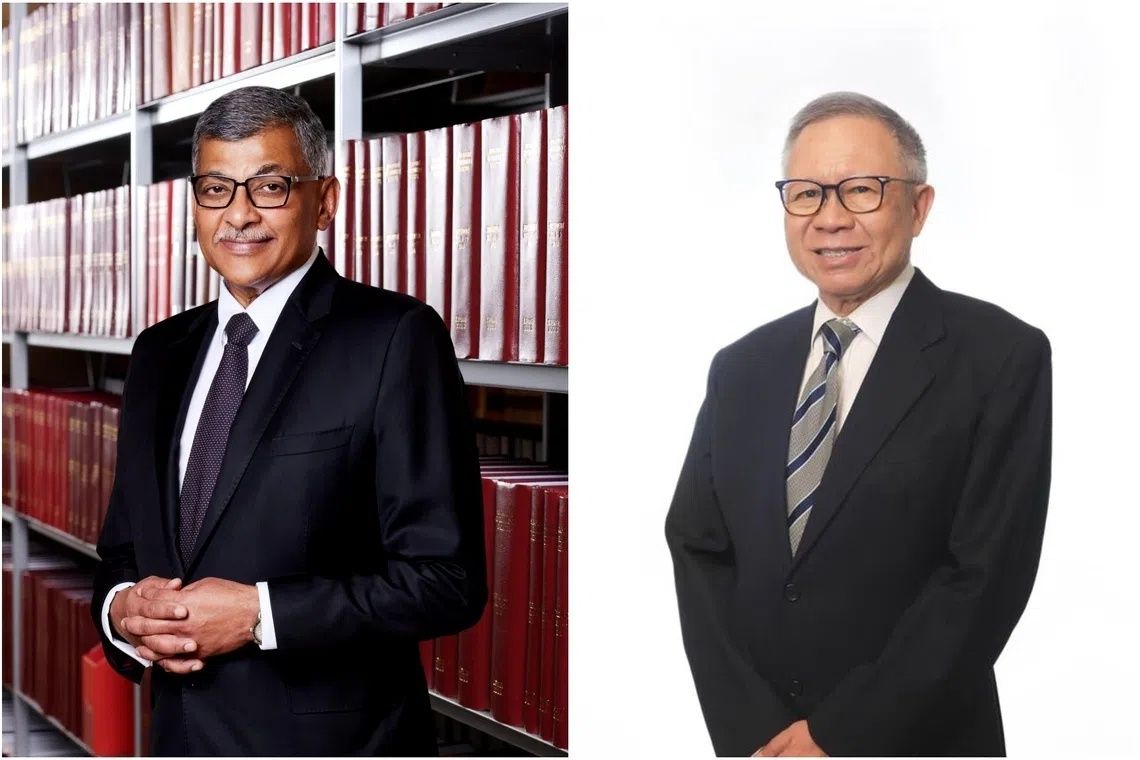
Singapore has honoured two of its most prominent public figures with the nation's highest civilian award, recognising their transformative contributions across the judiciary and broader civil service. Chief Justice Sundaresh Menon, 62, and former Council of Presidential Advisers (CPA) chairman Eddie Teo, 79, are among 7,491 individuals receiving National Day honours in 2026. Both will be conferred the Order of Temasek (With Distinction), an accolade reserved for exceptional service that has fundamentally shaped the country's institutional fabric.
Menon's appointment as Chief Justice in November 2012 came at a pivotal moment for Singapore's legal system, when questions about modernisation and global competitiveness were gaining momentum. Over his 14-year tenure, set to conclude on February 26, 2027, he has fundamentally reshaped how justice is administered in the city-state. His vision extended beyond courtroom improvements to encompass a complete reimagining of the judiciary's operational and cultural foundations. The judiciary under his leadership introduced cutting-edge digital infrastructure, recognising that efficiency and accessibility are central to maintaining public confidence in the rule of law. For Malaysian observers, Menon's approach offers instructive parallels to ongoing discussions about judicial modernisation in the region.
The institutional innovations Menon championed have proven structurally significant. The establishment of the Appellate Division of the High Court addressed longstanding questions about case resolution timelines and judicial hierarchy. More notably, the creation of the Singapore International Commercial Court positioned the nation as a regional alternative for complex cross-border disputes, attracting litigation from across Southeast Asia and beyond. This development underscores how judicial infrastructure directly influences economic competitiveness and foreign investment. The Singapore Judicial College, which Menon established, represents a conscious investment in judicial education standards, ensuring that the bench maintains expertise as legal landscapes evolve.
Beyond infrastructure, Menon introduced a therapeutic justice framework that marked a philosophical departure from purely punitive approaches. The Family Justice Courts and Youth Courts, operating under this model, emphasise rehabilitation and restorative principles rather than retribution alone. This shift reflects evolving global understanding about how courts can serve broader social interests, particularly in cases involving vulnerable populations. For Southeast Asian jurisdictions wrestling with similar challenges around juvenile justice and family law, Menon's institutional examples provide practical templates.
In his statement upon receiving the honour, Menon emphasised the collaborative nature of judicial strength, noting that building a world-class legal system requires commitment across government, the judiciary, and the legal profession. He positioned the award as recognition for all who contribute to sustaining public confidence in justice administration. Notably, he highlighted the significance of the honour coinciding with the bicentennial of Singapore's legal and judicial system, framing his tenure within a longer historical arc of institutional development.
Eddie Teo's career, spanning nearly six decades in public service, represents a different but equally consequential trajectory. Beginning in 1970 with the Ministry of Defence's Security and Intelligence Division, Teo rose to lead that sensitive agency by age 31, a remarkable ascent that reflects both extraordinary capability and the meritocratic principles that have defined Singapore's civil service. His subsequent movement through permanent secretary roles in defence and the Prime Minister's Office positioned him at the intersection of security policy, economic planning, and strategic governance. Each posting built upon the previous one, creating a comprehensive understanding of how different government portfolios interconnect.
Teo's tenure as Public Service Commission chairman from 2008 to 2018 introduced deliberate diversity to an institution traditionally dominated by career bureaucrats. By recruiting commissioners from academia, law, and social work, Teo recognised that civil service leadership benefits from varied professional perspectives and experiences. This institutional evolution matters for understanding Singapore's governance philosophy: the belief that exposure to different intellectual traditions and professional cultures strengthens public administration. His subsequent appointment as CPA chairman extended his influence into a constitutionally significant role, one responsible for advising the President on matters of national importance.
The COVID-19 pandemic tested Teo's judgment in his CPA role in ways that illuminated the stakes of institutional decision-making. When the Government sought to withdraw approximately S$40 billion from past reserves—the largest amount in Singapore's history—the CPA and then-President Halimah Yacob engaged in thorough deliberation before granting approval. This process demonstrated how constitutional safeguards and institutional checks operate in practice. Teo's willingness to discuss this episode reflects confidence that the decision process strengthened rather than undermined public trust. For Malaysia and other Southeast Asian nations with accumulated reserves, Teo's experience offers a case study in how institutional oversight of large fiscal withdrawals can enhance rather than constrain responsive governance.
Teo's reflection on his early career emphasises learning directly from Singapore's founding generation, including Lee Kuan Yew and Goh Keng Swee. This intergenerational knowledge transmission, now largely unavailable as that pioneer cohort passes from the scene, shaped Teo's understanding of governance during nation-building. His explicit hope that his career demonstrates public service as worthwhile addresses a significant challenge facing governments across Southeast Asia: attracting talented individuals to public sector careers when private sector compensation often exceeds government salaries. Teo's willingness to articulate this trade-off candidly, while defending the intrinsic rewards of public service, reflects realistic engagement with contemporary recruitment challenges.
The broader 2026 National Day honours process recognised exceptional contributions across multiple sectors. Land Transport Authority chairman Alan Chan received the Distinguished Service Order for transforming rail reliability metrics from 393,000 mean kilometres between failures in 2017 to two million by 2026—a transformation that required sustained coordination across multiple operators and technical investments. This improvement exemplifies how institutional leadership translates into measurable service delivery enhancements. Chan's simultaneous service on the Public Service Commission illustrates the interlocking nature of Singapore's leadership networks, where individuals move between related portfolios, building institutional memory and ensuring policy coherence.
Former Civil Aviation Authority of Singapore chairman Edmund Cheng's recognition for contributions spanning aviation, ex-offender rehabilitation, and the arts demonstrates how individual leaders contribute across institutional boundaries. This pattern of multi-sectoral engagement reflects Singapore's expectation that senior public figures will contribute to national development beyond their primary portfolio. For Malaysian observers assessing governance models, such cross-institutional involvement reveals how smaller, more integrated civil services can achieve policy coordination that might prove more difficult in larger systems.
The 2026 honours collectively illustrate Singapore's conscious effort to celebrate institutional stewardship and long-service commitment. Both Menon and Teo represent what might be termed professional completeness: mastery of their respective fields combined with explicit attention to institutional sustainability and succession. As Menon approaches his retirement in February 2027 and Teo reflects on his transition from active public service, the state is marking their contributions while still actively engaged in governance. This timing acknowledges that institutional memory and knowledge transfer matter profoundly during leadership transitions.
For Southeast Asian governance discussions more broadly, these honours signal how successive Singapore administrations have invested in judicial and civil service modernisation as foundational to development. Both Menon and Teo managed periods of substantial institutional change while maintaining public confidence—a balance that remains challenging for most governments. Their recognition underscores that sustained institutional strengthening, executed with technical competence and public trust, constitutes the kind of achievement that endures beyond individual tenures and shapes how societies function across generations.

