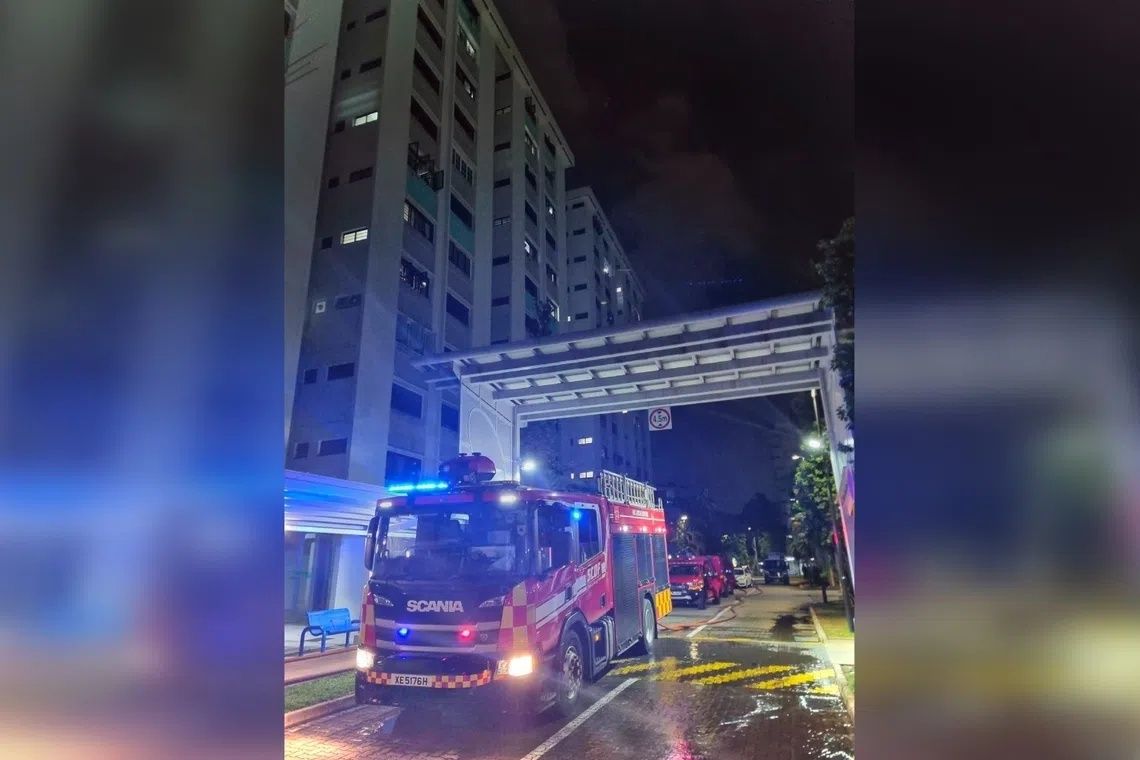
A fatal fire in a Clementi Housing and Development Board flat has claimed the life of a solitary occupant, while leaving two members of Singapore's firefighting services with burn-related injuries. The incident unfolded late on Friday at Block 309 Clementi Avenue 4, underscoring the persistent fire safety challenges in high-density residential environments across the island.
The Singapore Civil Defence Force received an emergency alert at approximately 11.10 pm on July 31, dispatching crews to the eighth-floor unit where visible flames were already consuming the living area. Upon arrival, SCDF personnel found the blaze had taken hold of furnishings and other items within the common living space, necessitating forced entry to access the premises. The rapid response team deployed two water jets to bring the spreading fire under control.
During the intensive firefighting operation, responders located a victim unconscious in the kitchen area of the flat. The individual was rushed to Ng Teng Fong General Hospital but was pronounced dead upon arrival, according to Holland-Bukit Timah GRC Member of Parliament Sim Ann. Preliminary indications suggest the deceased had been residing in the unit without household members present, a circumstance that may have delayed discovery and hindered immediate assistance.
The human cost extended beyond the resident. Two SCDF firefighters suffered thermal injuries sustained while battling the flames and extracting the victim from the premises. Both were conveyed to Singapore General Hospital for treatment, though one was discharged the same morning and has since been recuperating at home. The second firefighter's condition and discharge timeline were not immediately disclosed in official statements.
In response to the emergency, police and SCDF personnel evacuated approximately 40 residents from the affected tower block as a protective measure, though most had returned to their homes by 1.30 am on August 1. Sim, who doubles as Second Minister for Foreign Affairs and Second Minister for Home Affairs, noted that structural damage beyond the origin point remained minimal, with repairs to common areas already underway. She pledged that residents whose residential units or personal possessions sustained fire-related damage would receive government assistance.
The cause of the fire remains under active investigation, with authorities yet to establish whether the blaze originated from electrical faults, cooking mishaps, negligent use of appliances, or other sources. Such investigations are critical for developing preventive strategies and informing public safety campaigns in public housing precincts where fire risks concentrate among large populations.
Sim's public acknowledgment of the emergency response reflected broader coordination among multiple agencies. The Singapore Civil Defence Force, Singapore Police Force, residents' network volunteers, the People's Association, and local town council personnel all played coordinated roles in managing evacuation procedures, maintaining public order, and providing support services during the crisis response phase.
The fatality arrives against a backdrop of rising fire-related casualties across Singapore. According to SCDF's annual statistics released in February, injury figures climbed significantly from 80 recorded cases in 2024 to 94 in the current year—a concerning trajectory for a densely urbanized jurisdiction where residential concentrations create compounded vulnerability. Fire fatalities showed slight improvement, declining from seven deaths in 2024 to six thus far in 2025, though even this lower figure reflects persistent structural risks.
Overall fire incident frequency has also ticked upward, with total notifications rising three percent year-on-year from 1,990 recorded incidents in 2024 to 2,050 in 2025. This climbing trend suggests that despite public awareness campaigns and building code enforcement, residential fire hazards remain inadequately contained. The Clementi incident exemplifies how even modern public housing with presumed safety infrastructure remains vulnerable to catastrophic outcomes when occupants face isolation and emergency response windows prove insufficient.
For Malaysian observers, the Singapore situation carries direct relevance. Malaysian conurbations including Kuala Lumpur, George Town, and Johor Bahru host comparable concentrations of high-rise residential development where similar fire risks accumulate. The frequency of fatal and injury-producing residential fires in Singapore suggests that even relatively prosperous, well-resourced jurisdictions with advanced firefighting capabilities continue struggling to prevent tragedies in tower blocks.
The broader regional implication underscores the necessity for Southeast Asian cities to invest in comprehensive fire prevention infrastructure, resident education initiatives targeting kitchen safety and electrical hazard awareness, and building design standards that incorporate multiple evacuation pathways. The isolated resident found unconscious in the Clementi kitchen—unable to alert emergency services or escape unaided—represents a particular vulnerability profile common across Asian urban housing where elderly occupants, migrant workers, and solitary individuals occupy high-rise units with limited peer networks capable of rapid intervention.

