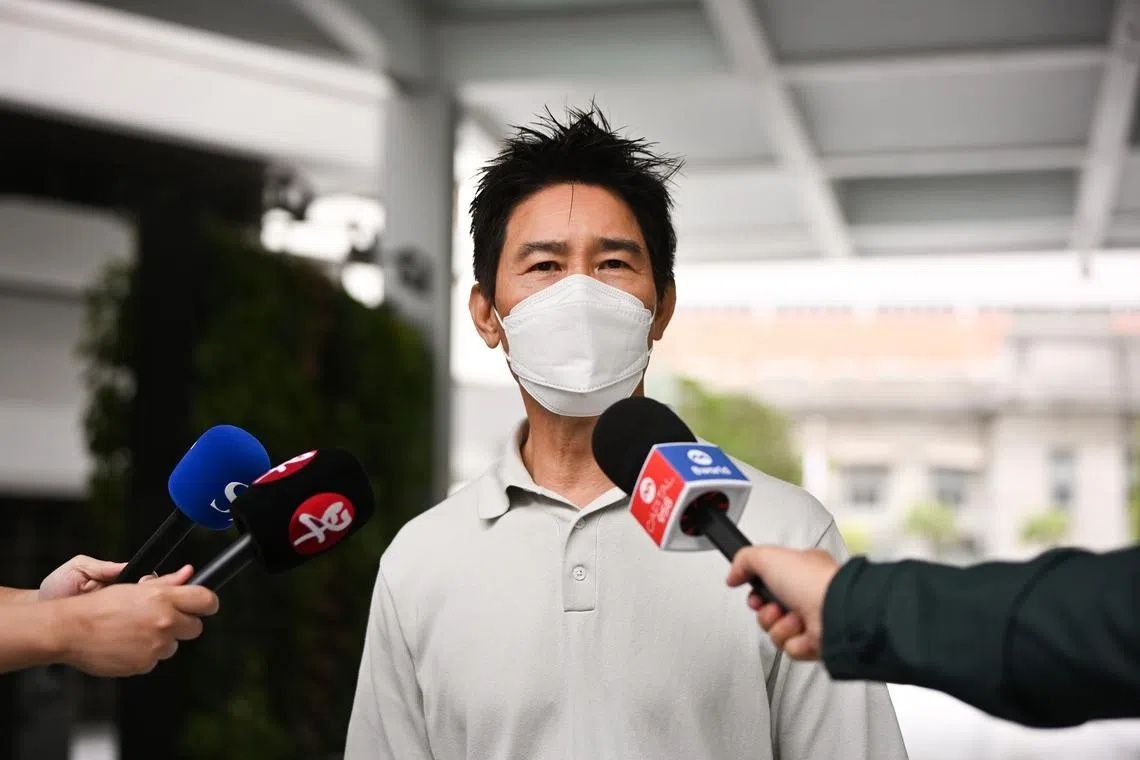
Singapore's High Court has dramatically reduced the custodial sentence handed down to former actor Edmund Chen, cutting his jail term from five days to a single day for his role in a traffic accident that injured a young motorcyclist. The decision, delivered on Monday by Justice Hri Kumar Nair, represents a significant victory for the 64-year-old television personality, whose legal name is Tan Kai Yuan, though the judge maintained that the original district judge was not necessarily wrong in crossing the custodial threshold.
The incident that led to the conviction occurred on March 4, 2025, along the Ayer Rajah Expressway as traffic merged onto the Central Expressway. Chen, driving on the fourth lane, suddenly slowed his vehicle almost to a standstill to filter across the third lane in order to access the correct exit for the CTE/SLE interchange. The manoeuvre proved catastrophic when a 21-year-old motorcyclist travelling behind him, despite attempting to swerve away, collided directly with Chen's car. The rider sustained multiple wrist fractures severe enough to require surgical intervention at Singapore General Hospital, where the procedure was performed under local anaesthesia. The victim spent two days hospitalised and received 99 days of medical leave but did not develop any permanent disability.
Chen's response to the accident drew praise from prosecutors and defence counsel alike. He immediately stopped his vehicle to render assistance to the injured motorcyclist and has cooperated fully with authorities throughout the legal process. In January, a district judge sentenced him to five days in jail, a decision that surprised many observers given that prosecutors themselves had requested only a fine ranging from S$3,000 to S$5,000. The judge also imposed a five-year driving disqualification, a penalty that the appellate court maintained.
The appeal centred on arguments presented by Senior Counsel Abraham Vergis from Providence Law Asia, who took over Chen's representation following the initial conviction. Vergis mounted a multifaceted defence strategy, first contending that the threshold for imposing custodial punishment had not been met and that the maximum fine of S$5,000 combined with the driving ban would be proportionate. He presented dashcam footage from Chen's vehicle to argue that the former actor had activated his indicator lights before filtering and that another passing vehicle had obscured the motorcycle from view due to the curvature of the road. The footage also suggested that Chen had crossed white chevron markings only after the collision had already occurred.
A critical dimension of Vergis's argument involved the severity and nature of the victim's injuries. The lawyer characterised the fractures as falling within the less severe spectrum of grievous hurt, emphasising that the damage was localised to the wrist extremities and required only local anaesthesia for surgical repair. This framing, supported by medical evidence, contrasted sharply with the district judge's apparent weight-giving to the severity of harm. Vergis further noted that the absence of permanent disability and the relatively short hospitalisation period underscored the limited long-term impact of the injuries, arguing against the necessity of incarceration as a preventive or punitive measure.
The appellate court's decision hinged on Justice Nair's assessment that five days constituted manifest excess, even while acknowledging the district judge's discretionary authority to cross the custodial threshold. This distinction—accepting the principle of imprisonment while rejecting its scale—suggests judicial recognition of the borderline nature of the case. The reduction from five days to one day effectively preserves the symbolic statement of custodial punishment while dramatically diminishing its practical impact, a compromise position that reflects ambivalence about whether such a sentence was truly warranted.
Deputy Public Prosecutor Ben Tan had argued during the appeal that the district judge had landed on the higher end of the sentencing spectrum but had not erred so egregiously as to require appellate intervention. The prosecutor highlighted that as Chen executed his manoeuvre, drivers in two adjacent vehicles had sounded their horns in warning, yet he persisted regardless—a detail that suggested a degree of culpability beyond mere momentary inattention. The prosecution advocated for the maximum S$5,000 fine combined with the five-year driving disqualification, essentially conceding that imprisonment was not essential to the interests of justice.
For Malaysian readers, the case offers instructive insights into Singapore's approach to traffic-related offences and sentencing principles. Singapore's courts have generally moved toward stricter standards for road safety violations, particularly where serious injury results. However, this case demonstrates that appellate oversight remains calibrated to prevent disproportionate punishment even within this framework. The five-year driving disqualification, which the appellate court retained, reflects the seriousness with which Singapore regards dangerous driving, a threshold that Malaysian authorities and courts might consider as road safety incidents continue to plague both nations.
Chen's rehabilitation efforts and background appear to have influenced the appellate judge's reasoning, though not explicitly stated. The actor told reporters before his hearing that he had prepared five days' worth of medication and that his family had been unable to sleep the night before proceedings, underscoring the toll the conviction had exacted. By engaging Senior Counsel Abraham Vergis after his initial conviction, Chen signalled his commitment to contesting what he and his legal team considered an excessive punishment. This strategic recalibration, moving from Invictus Law's representation to Providence Law Asia's Kelvin Ong and Dickson Chew, to eventually engaging Vergis for the appeal, illustrates the significance of appellate advocacy in moderating sentences.
Chen was a prominent television personality whose career spanned several decades, with notable appearances in dramas including Star Maiden and Patrol. He stepped away from the entertainment industry in 2000 to care for his daughter, Chen Yixin, though he returned occasionally for select projects such as the 2017 drama Life Less Ordinary. His spouse is veteran actress Xiang Yun, celebrated for her roles in acclaimed television productions such as The Awakening, Double Happiness, and The Little Nyonya. The couple's standing within Singapore's cultural landscape may have provided context for the appellate court's consideration of proportionality.
The reduction from five days to one day, while seemingly modest numerically, carries substantial symbolic and practical weight. Chen will now serve his sentence before resuming his life, though the five-year driving ban ensures a prolonged consequence that underscores the court's determination to prevent recurrence. For Southeast Asian road users and policymakers, the case exemplifies the ongoing tension between deterrence and proportionality in traffic law enforcement. As both Singapore and Malaysia grapple with rising road fatalities and serious injuries, the judiciary's calibration of penalties becomes increasingly significant in shaping public behaviour and expectations of accountability.

