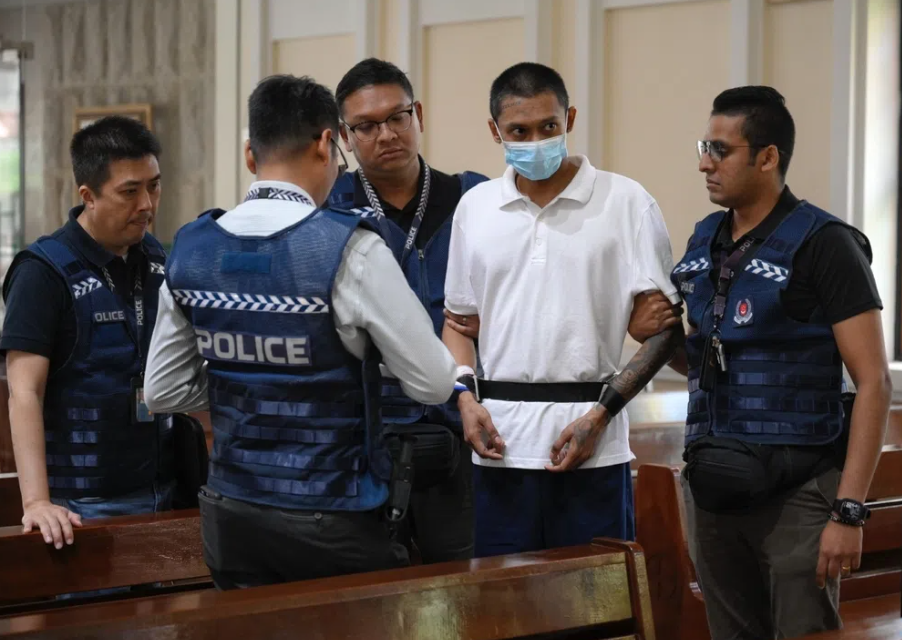
A Singapore court has delivered a sentence of four years and three months' imprisonment along with nine strokes of the cane against Basnayake Keith Spencer, 38, for the unprovoked stabbing of Reverend Christopher Lee at St Joseph's Church during a children's mass last November. The case marks a troubling incident of religious violence in the city-state and raises concerns about security at places of worship across Southeast Asia, where such incidents remain relatively rare but deeply unsettling when they occur.
Barrister Spencer pleaded guilty on Friday, August 21, to charges of voluntarily causing grievous hurt with a dangerous weapon and illegal possession of a weapon. His guilty plea came nearly two years after the violent assault on Father Lee, who was 57 years old at the time of the attack. The timeline highlights how the Singapore legal system processed this case through the courts, with the defendant appearing via video link from custody, dressed in white and maintaining a blank expression as the prosecution outlined the circumstances of his crime.
The attack unfolded during evening mass on November 9, 2024, when approximately 900 parishioners had gathered at the church. According to court documents presented by Deputy Public Prosecutor Xu Sijia, Basnayake arrived alone around 5:30 pm and seated himself on a pew in the central section of the church hall. In the period leading up to the assault, he ingested five pills in total—two initially to maintain focus, and then three additional tablets taken just before communion, which he consumed in an apparent attempt to steady his nerves after realising the mass was designated for children.
At approximately 6:15 pm, Father Lee and another priest positioned themselves at the front to administer communion to the congregation. Basnayake initially queued behind the second priest but then repositioned himself to the back of Father Lee's line. When his turn arrived, he produced a 23-centimetre foldable knife with a 10-centimetre blade and drove it directly into the priest's mouth in a sudden, explosive attack. The violence shocked the assembled worshippers and immediately drew responses from multiple directions within the congregation.
The injury inflicted was severe. Father Lee sustained an 8-centimetre laceration across his tongue, a 3-centimetre wound on his upper left lip, and a 4-centimetre cut at the corner of his mouth. He bled profusely from the stab wound to the lower part of his mouth but demonstrated remarkable presence of mind by quickly seizing the rear pocket of Basnayake's jeans to prevent further attacks on other parishioners. Members of the congregation, including an off-duty police officer among those present, swiftly subdued and restrained Basnayake until law enforcement arrived at the scene.
Investigations revealed that Basnayake had been carrying multiple weapons beyond the knife used in the assault. Police discovered a 14.5-centimetre penknife, a flip knife, and a fishing gaff—a pole with a sharp hook—in his possession. The prosecution emphasized the premeditated nature of his weapon accumulation and described him as posing an extraordinarily high danger to the public. These findings proved instrumental in the court denying him bail in December 2024, and he has remained in remand custody for more than one year and nine months awaiting trial.
Father Lee's recovery proved lengthy and complex. He was hospitalised for six days following the November 9 assault and discharged on November 15, 2024, with 40 days of recommended hospital leave. Beyond physical healing, the priest required speech therapy for several months afterward, indicating that the linguistic and communicative functions essential to his pastoral duties had been affected by the trauma. The long-term consequences of the attack extended well beyond the immediate medical response.
The sentencing decision occurred within the context of Basnayake's prior criminal history. In 2019, he had been convicted of voluntarily causing hurt with a dangerous weapon after stabbing his then-girlfriend in the buttocks with a kitchen knife whilst under the influence of methamphetamine. This prior conviction demonstrated a pattern of violent behaviour connected to substance abuse, raising serious questions about rehabilitation and community safety mechanisms that had permitted his release into society before the church incident occurred.
During sentencing submissions, the prosecution sought a custodial term ranging between four years and three months to four years and eleven months, along with nine strokes of the cane. Deputy Public Prosecutor Xu Sijia acknowledged that Basnayake was intoxicated and experiencing a drug-induced psychotic state at the time of the offence, yet argued he retained sufficient awareness to understand the gravity of his actions when he attacked Father Lee. The defence, represented by Ashwin Ganapathy of the Public Defender's Office, urged leniency with a request for less than four years imprisonment, arguing that Basnayake expressed genuine remorse, shame, and regret for his actions and seeking proportionate sentencing.
District Judge Shaiffudin Saruwan ultimately imposed the prosecution's recommended penalty, stating that the unprovoked attack on a defenceless person—particularly one administering a sacred religious ritual—demanded severe punishment reflecting the full gravity of the offences. The judge specifically highlighted the timing of the assault during communion, noting that striking the priest at this precise sacred moment created substantial risk of mass panic and cascading injuries among the densely packed congregation of nearly 900 worshippers. This observation underscores how the court weighed not merely the individual victim's suffering but the broader implications for community safety and the sanctity of religious spaces.
The case resonates across the Southeast Asian region, where religious institutions generally function as spaces of relative security and trust. The violence at St Joseph's Church disrupts assumptions about sanctuary and raises questions for religious communities throughout Singapore, Malaysia, and the broader region about security protocols at places of worship. For Malaysian readers, the Singapore incident serves as a cautionary reminder of the intersection between mental health crises, substance abuse, and violent criminality—dynamics that extend across national boundaries and demand coordinated regional responses to violence prevention and offender rehabilitation.

