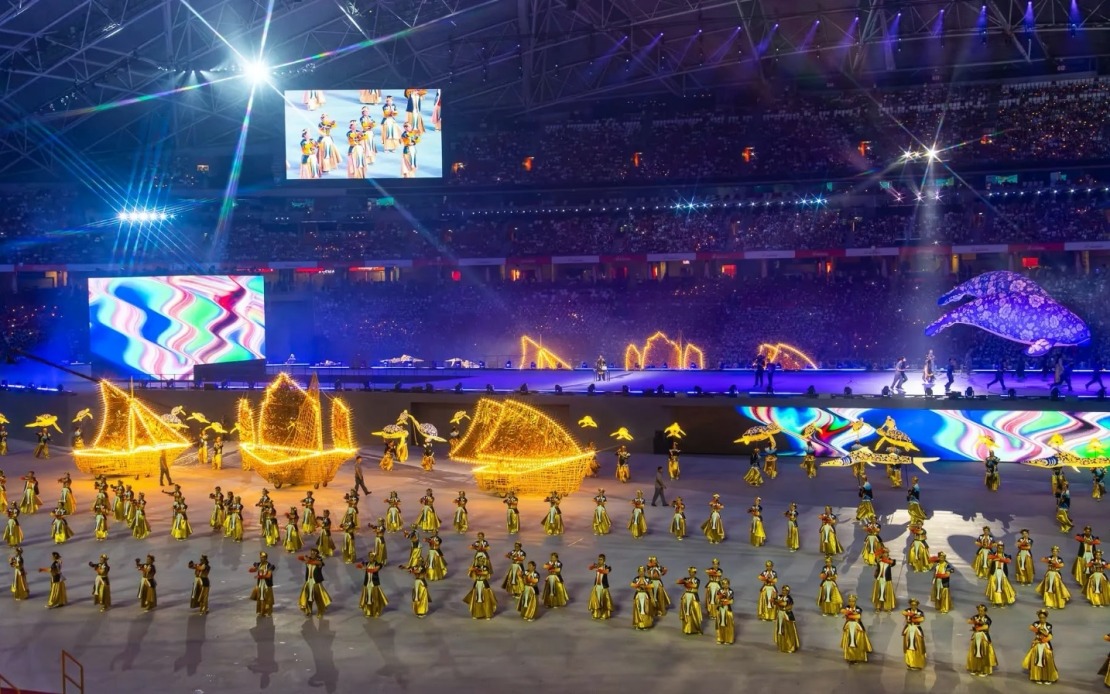
Singapore marked a significant milestone in its civic calendar on Sunday, celebrating its 61st National Day with the return of the National Day Parade to the National Stadium for the first time in a decade. The celebration, held under the banner "Majulah Singapura, Go Beyond!", drew some 42,000 members of the public dressed in the nation's colours of red and white. President Tharman Shanmugaratnam and Prime Minister Lawrence Wong attended the ceremony alongside Cabinet ministers and members of parliament, underscoring the occasion's importance as a showcase of national unity and progress.
The parade and ceremony segment commenced at around 6 pm, organised around the thematic focus of "Go Beyond Self". The procession brought together 32 contingents representing more than 2,000 participants, each selected to illustrate different facets of Singapore's society and institutions. Six Guard of Honour contingents, comprising 72 personnel drawn from the Singapore Army, Republic of Singapore Navy, Republic of Singapore Air Force, Digital and Intelligence Service, Singapore Police Force, and Singapore Civil Defence Force, escorted the SAF Colours Party. Beyond these uniformed contingents, the parade featured contributions from 10 youth organisations and 16 supporting contingents, weaving together a narrative of generational continuity and institutional strength.
One of the most striking innovations this year was the geographical expansion of ceremonial elements beyond the stadium itself. For the first time in Singapore's six-decade history as an independent nation, the Presidential Gun Salute and State Flag Flypast were conducted at Kallang Basin rather than confined to the stadium grounds. This departure from tradition reflected a deliberate effort to extend the celebration's reach and accessibility. Four 25-pounder Howitzer guns, mounted on Mobility 3rd Generation rafts, navigated the basin's waters, allowing thousands of additional spectators positioned throughout the wider Kallang precinct to experience the ceremonial elements in a more intimate manner than traditional viewing arrangements would permit.
The gun salute ceremony itself involved considerable military coordination. The traditional 21-gun salute featured 151 participants from the 23rd Battalion of the Singapore Artillery and 35th Battalion of Singapore Combat Engineers, demonstrating the precision and discipline that Singapore's defence forces bring to national commemorations. This integration of military pageantry with civilian observation spaces reflects how the city-state approaches national celebrations—as moments of institutional pride balanced with public accessibility.
The show segment that followed the ceremonial opening presented a strikingly different character, centred on the broader theme of "Go Beyond". This portion of the celebration showcased some 36 artistes working alongside more than 2,600 performers, creating an entertainment spectacle designed to resonate with contemporary Singaporean audiences. Rather than relying solely on martial displays or governmental pomp, the performance segment drew from what organisers characterised as "authentic stories" of Singaporean life, woven together with innovative technological elements and a composed soundtrack.
A particularly noteworthy element of this year's celebrations was the deliberate inclusion of performers with diverse abilities and backgrounds. Seven dancers from varied communities participated in the show segment, a group that notably included both an autistic dancer and a dancer with Down syndrome. This programming choice carried explicit symbolic weight, with organisers framing it as a demonstration of the principle that every Singaporean, irrespective of background or ability, possesses the capacity to contribute meaningfully to the nation's collective future.
For Malaysian observers, Singapore's National Day celebrations offer instructive parallels and contrasts to how our own nation commemorates independence. Both countries frame their celebrations around themes of unity and progress, yet Singapore's approach tends toward tighter choreography and technological integration. The decision to expand ceremonial elements beyond the stadium proper also reflects broader trends in how city-states approach public gatherings—balancing exclusive ceremonial spaces with inclusive public participation.
The return of the parade to the National Stadium itself marks a transition point in post-pandemic event management across the region. For the better part of a decade, large-scale public celebrations had necessarily adapted to space constraints or modified formats. Singapore's decision to recommit to the stadium venue represents confidence in its ability to stage major events and suggests that regional capitals are moving beyond temporary pandemic-era compromises toward fuller resumptions of traditional civic ceremonies.
The thematic content of this year's parade—particularly the emphasis on "going beyond" conventional boundaries—carries implications beyond simple pageantry. For a mature, high-income economy like Singapore, national day celebrations increasingly centre on aspiration and future-oriented messaging rather than retrospective recounting of historical achievements. The inclusion of performers with diverse abilities sends a signal about inclusive economic participation and social integration that resonates with regional conversations about labour market adaptation and demographic change.
The scale of participation—over 2,600 performers and 42,000 spectators—demonstrates the continued civic investment Singaporeans place in collective national commemoration. In an era when many developed democracies struggle to mobilise populations around shared civic events, the sustained enthusiasm for Singapore's National Day celebrations reflects either genuine patriotic sentiment or, more likely, a combination of institutional organisation, cultural tradition, and the public holiday's role in the social calendar.
Regional governments monitoring trends in how neighbouring states manage national celebrations will note Singapore's integration of technological innovation, inclusive representation, and expanded geographical reach. These elements reflect conscious choices about what contemporary national identity should look like—dynamic, technology-enabled, and explicitly welcoming of diverse participants. As Southeast Asian nations continue negotiating their identities in an increasingly connected world, the aesthetics and messaging of national celebrations offer valuable windows into how leaderships wish to position their societies domestically and internationally.

