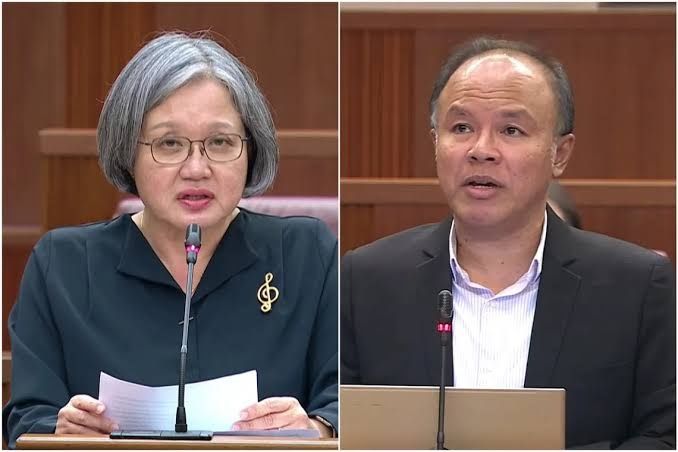
The Singapore Parliament has formally ended its pursuit of disciplinary action against Workers' Party figures Sylvia Lim and Faisal Manap, with the Legislature unable to proceed further due to legal constraints on how long it can wait to punish parliamentary misconduct. Leader of the House Indranee Rajah made the announcement in a ministerial statement, explaining that although the two politicians had been found to have provided false testimony to a parliamentary committee investigating the circumstances surrounding former MP Raeesah Khan's fabricated parliamentary statement, the passage of time has now rendered Parliament incapable of imposing formal penalties under existing law.
The underlying incident traces back to 2021, when Khan, then representing Sengkong GRC, delivered a speech in Parliament containing a fabricated anecdote about police conduct. A subsequent parliamentary inquiry established that Khan had invented the story, and crucially, discovered that several party colleagues had been aware of the falsehood. The Committee of Privileges found that Workers' Party leader Pritam Singh had explicitly encouraged Khan to conceal the deception, while Lim and Manap, both then MPs for Aljunied GRC, attended a relevant meeting where the matter was discussed but later denied to investigators that such conversation had taken place.
The investigation proceeded at different speeds for different individuals involved. Given the severity of findings against Pritam Singh—specifically his instruction to Khan to "take her lie to the grave"—Parliament referred his case to criminal prosecutors rather than handling it internally. The reasoning was to afford him the protections of legal representation and the full due process of the criminal justice system. By contrast, Lim and Manap were identified as playing secondary roles and demonstrating limited but some cooperative attitudes toward the inquiry, leading Parliament to decide it would wait for Pritam's criminal case to conclude before deciding on their fates, as a matter of procedural fairness.
Pritam Singh's legal odyssey stretched across several years. He was ultimately convicted by the District Court in February 2025 of lying to Parliament, a conviction he immediately challenged. The High Court upheld the conviction in December 2025, meaning the criminal proceedings were exhausted. By this juncture, however, the political landscape had shifted dramatically. Singapore held general elections in 2025, returning a new Parliament with a different numbered designation—the 15th Parliament—which convened in September of that year.
This change of Parliament triggered technical but decisive consequences for the ability to sanction Lim and Manap. The Parliament (Privileges, Immunities and Powers) Act contains time-bound provisions that restrict how far back the current legislature can reach in disciplining past misconduct. Specifically, Section 22 of the statute permits Parliament to punish only those violations that occurred either in the current parliamentary session or in the final session of the immediately preceding Parliament. Since Lim and Manap's false statements to the committee occurred during the first session of the 14th Parliament, and the 15th Parliament has now commenced following the dissolution of its predecessor, the legal window has permanently closed.
Indranee acknowledged the frustration this timeline creates. She noted that ordinarily, offences under parliamentary privilege legislation are resolved swiftly, sometimes within the same parliamentary session in which they occur. In exceptional circumstances, matters may carry over to a subsequent session and still be properly dealt with. However, the statutory design includes a deliberate cutoff point, presumably to prevent indefinite pursuit of historical grievances and to create certainty about when conduct will or will not be subject to parliamentary sanction. The Minister stated bluntly that had Parliament acted sooner—or indeed, had the criminal proceedings against Pritam concluded before the dissolution of the 14th Parliament—she would have pursued disciplinary penalties for Lim and Manap.
She emphasised that this outcome stemmed partly from Parliament's own earlier decision to defer action. When the Committee of Privileges issued its initial findings in 2021, Parliament possessed the authority to move immediately against all three leaders but instead chose to grant Lim and Manap "the benefit of the doubt" pending resolution of Pritam's case. This forbearance, intended as procedurally fair, inadvertently created the conditions where the legal deadline would eventually expire.
Alternative remedies remain theoretically available, though limited in scope. Parliament can pass a motion expressing regret or disapproval of the conduct, a symbolic gesture that falls short of formal punishment but signals institutional censure. Notably, this threshold was already crossed in January when Parliament passed a motion declaring Pritam unsuitable to serve as Leader of the Opposition—a rebuke that carries significant political weight even without formal penalties. Indranee suggested this earlier motion adequately communicated Parliament's disapproval regarding the broader pattern of deception and misrepresentation that had occurred.
The legal confirmation in Pritam's High Court judgment that his false testimony was indeed established added another dimension to the resolution. The court's findings effectively validated what the parliamentary committee had concluded years earlier, meaning the factual foundations for disciplining Lim and Manap remained solid even if the procedural pathway had closed. However, Indranee stressed that the rule of law requires strict observance of statutory limitations, even when the underlying conduct remains morally objectionable. The law, she indicated, could not be circumvented simply because the circumstances were frustrating or because Parliament might have preferred a different outcome.
For Malaysian observers, this episode illustrates both the strengths and complexities of parliamentary accountability mechanisms in Singapore's system. The detailed investigation into whether MPs had misled investigators demonstrated institutional commitment to integrity within the legislature. Yet the denouement reveals how technical procedural rules—in this case, temporal restrictions on when sanctions can be applied—can interact with external events like elections to produce outcomes that feel at odds with substantive justice. The case also demonstrates how decisions made early in proceedings, such as Parliament's decision to wait on Pritam's criminal trial, can have cascading consequences that ultimately determine what remedies are available.
When Lim rose to address Parliament following Indranee's statement, she indicated she was not objecting to the closure of the matter. She reiterated points she had made during the January motion debate, noting that references to her conduct in Pritam's appeal judgment were based solely on prosecution evidence presented at his trial, in which she had no opportunity to testify and present her own account. This distinction—between what prosecutors alleged about her knowledge and actions versus what she could directly defend—underscores a tension in the broader episode: individuals implicated in an investigation through others' testimony face constraints in mounting direct legal defences if they are not themselves prosecuted.
The parliamentary resolution represents a formal end to what has been a contentious multi-year saga within Singapore's political system. The Workers' Party faced internal as well as external scrutiny over the incident, and party members in June voted to retain Pritam as leader despite his conviction, signalling internal acceptance of his continued leadership despite the legal findings against him. With Parliament now unable to impose formal consequences on Lim and Manap due to the expiry of statutory timeframes, the matter passes into political and historical record rather than remaining an active parliamentary accountability proceeding. The episode demonstrates how the intersection of procedure, timing, electoral cycles, and statutory design can determine outcomes in institutional integrity cases, offering lessons for legislators in any democratic system contemplating how to structure accountability mechanisms that are both fair and durable across political transitions.

