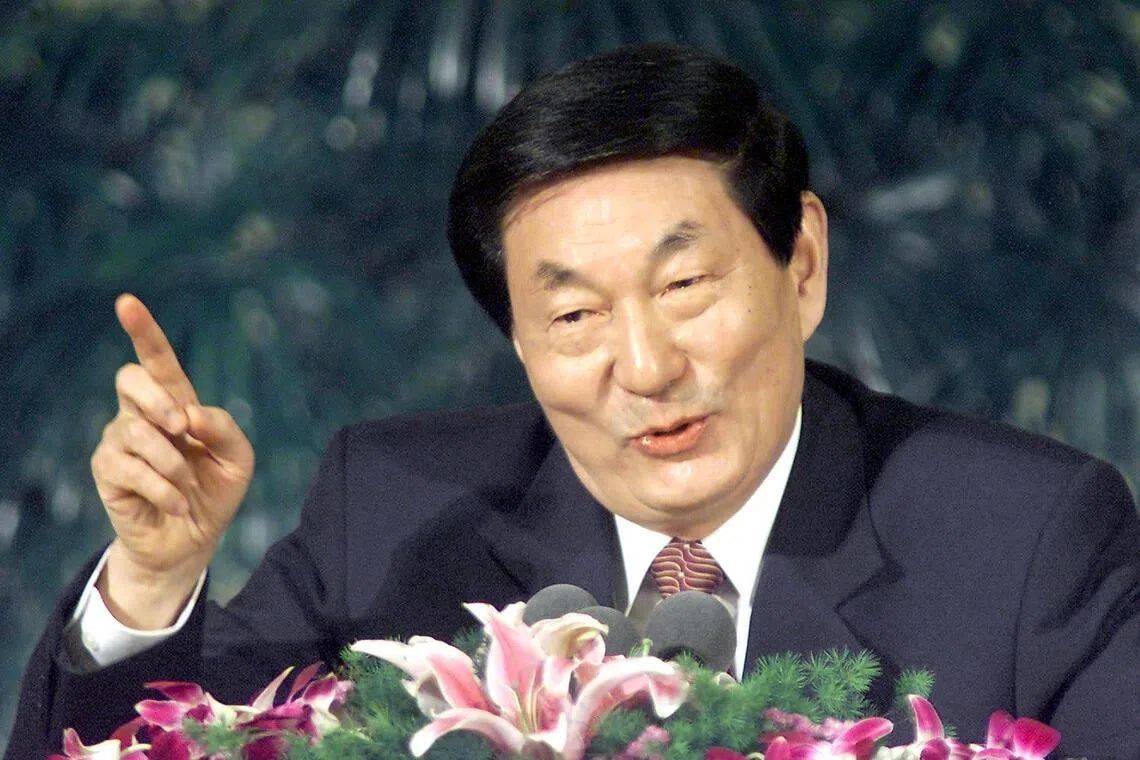
Singapore Prime Minister Lawrence Wong has conveyed his condolences to Chinese Premier Li Qiang following the death of former Chinese premier Zhu Rongji, who passed away in Beijing on Wednesday, just two months before what would have been his 98th birthday. The passing of Zhu marks the end of an era for one of China's most transformative leaders, whose tenure saw the nation undertake sweeping economic modernisation and reshape its role in the global trading system. In his formal letter dated August 13, Wong paid tribute to Zhu's enduring legacy and his particular significance to Singapore's bilateral relationship with Beijing.
Throughout his career in public office spanning several decades, Zhu established himself as an architect of China's economic transformation during a critical period of the nation's development. Wong highlighted in his condolences that Zhu demonstrated exceptional strategic thinking and determination in steering China through its economic reform agenda, a process that fundamentally altered the nation's trajectory and positioned it as a major player in international commerce. The former premier's crowning achievement in the economic arena came in 2001 when he successfully orchestrated China's accession to the World Trade Organization, an outcome that reverberated across global markets and cemented Beijing's integration into the international economic order.
Beyond his domestic achievements, Zhu cultivated deep personal relationships with Singapore's political leadership over many years of engagement. Wong noted that the former Chinese premier had met extensively with Singapore's two founding prime ministers, Lee Kuan Yew and Goh Chok Tong, during multiple official visits and diplomatic encounters. These interactions reflected the high regard in which Singapore's leadership held Zhu and underscored the personal dimension of the bilateral relationship that extended well beyond formal government-to-government protocols. Such direct engagement between senior leaders often proved pivotal in shaping the strategic understanding between the two nations.
A particularly significant moment in Zhu's relationship with Singapore came in 1999 when he became the first Chinese leader to deliver the Singapore Lecture, a prestigious annual address organised by the ISEAS – Yusof Ishak Institute. This platform, which has historically featured prominent global statesmen and intellectual figures, provided Zhu with an opportunity to articulate his vision for China's economic future and its implications for Asia. His address resonated far beyond Singapore's borders, signalling to the region that Beijing's leadership saw economic prosperity and regional cooperation as interconnected objectives rather than competing priorities.
During that landmark lecture, Zhu expounded on his strategic conviction that China's economic expansion would generate positive spillovers benefiting not just the nation itself but Asia writ large and the global economy generally. His reasoning reflected a sophisticated understanding of regional interdependence at a time when such thinking was still evolving among policymakers. More innovatively, Zhu proposed the establishment of a free trade area linking the Association of Southeast Asian Nations with China, a concept that represented bold vision for deepening economic integration across the Asia-Pacific region. This proposal anticipated by several years the formal establishment of closer economic arrangements between ASEAN and China.
The prescience of Zhu's vision has become evident through subsequent developments in the regional architecture. Wong explicitly acknowledged that Zhu's strategic foresight regarding China's role as an economic engine for Asian growth has proven remarkably accurate, with China now functioning as a crucial economic partner not only for Singapore but for virtually every country in Southeast Asia. The trade relationships, investment flows, and supply chain networks that developed in the aftermath of China's WTO accession largely vindicated Zhu's assessment that Beijing's integration into the global system would benefit the wider region. Wong's observation underscores how far-sighted policy thinking can shape outcomes across decades.
Zhu's contribution to Singapore-China relations extended into concrete developmental projects that physically manifested the growing partnership between the two nations. Wong specifically highlighted Zhu's early and consistent support for the China-Singapore Suzhou Industrial Park, a pioneering government-to-government collaborative venture that functioned as a tangible expression of bilateral commitment. This park represented more than simple commercial cooperation; it embodied a shared vision of how two different economic systems could work synergistically for mutual benefit. The project became a flagship example of Singapore's successful engagement with China during a transformative period.
Before ascending to the national stage, Zhu served as mayor of Shanghai, during which period he fostered institutional and personal exchanges with Singapore that proved foundational for later national-level cooperation. Wong noted that Zhu's tenure as Shanghai's chief administrator was marked by encouragement of official delegation visits and mutual learning initiatives between Shanghai and Singapore. These person-to-person and institution-to-institution connections created networks of understanding and trust that would later facilitate smoother cooperation when Zhu occupied positions of greater national authority. Such grassroots relationship-building often proves more durable than high-level diplomatic gestures alone.
The cumulative effect of these various engagement initiatives—from the Suzhou Industrial Park to the Singapore Lecture to the Shanghai-Singapore exchanges—created what Wong characterised as a strong foundational architecture for the close relationship that Singapore and China subsequently developed. Wong emphasised that the current depth of bilateral ties and the extensive scope of exchanges between the two nations represent the fruition of seeds planted during Zhu's leadership era. This assessment reflects a mature understanding that bilateral relationships develop through accumulated interactions across multiple levels and domains rather than through isolated high-profile events.
Wong concluded his tribute by noting that Zhu will be long remembered for his exceptional contributions both to China's development as a nation and to the specific bilateral relationship that Singapore has cultivated with Beijing. The recognition extended to Zhu by Singapore's current prime minister demonstrates the enduring respect accorded to leaders whose strategic vision transcends the immediate period of their tenure. For Malaysian and other Southeast Asian policymakers, Zhu's legacy offers instructive lessons about the importance of economic pragmatism, regional cooperation, and sustained diplomatic engagement in building durable partnerships that benefit all parties.

