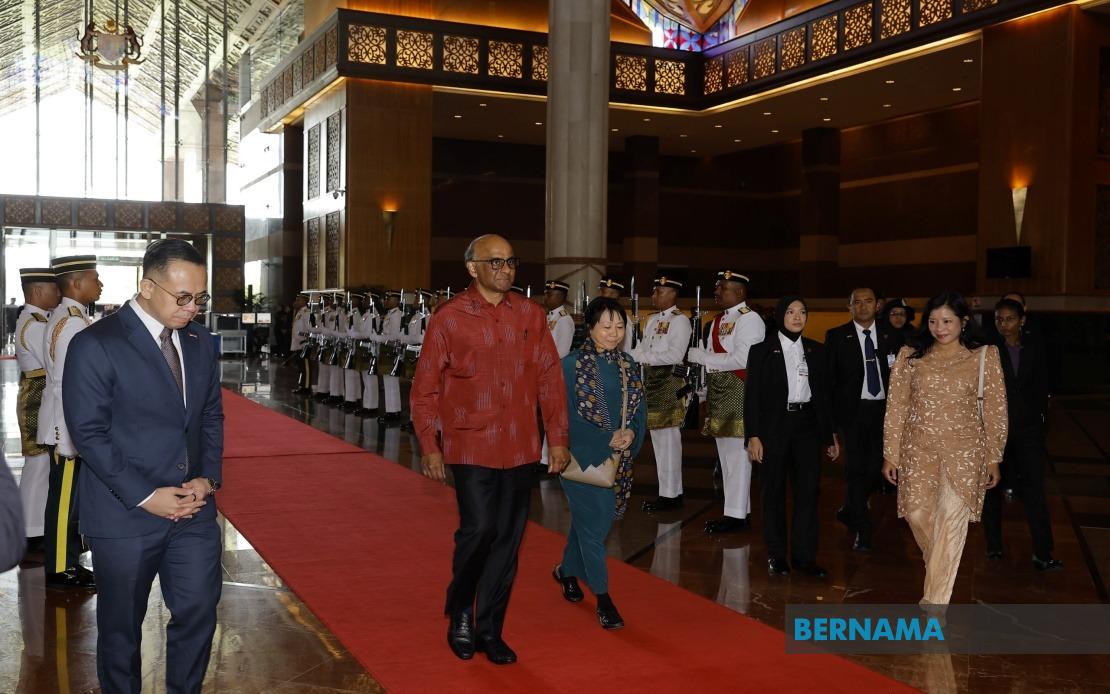
Singapore President Tharman Shanmugaratnam departed Malaysia on Monday afternoon, bringing to a close a three-day state visit that reinforced the diplomatic bonds between the island nation and its closest neighbour. Tharman, accompanied by his wife Jane Ittogi and an official delegation, left Kuala Lumpur International Airport's Terminal 1 at 2.20 pm on a commercial flight returning to Singapore. The departure was marked by formal protocol, with Minister of Entrepreneur and Cooperatives Development Steven Sim attending the farewell at the Bunga Raya Complex, where the President was accorded a static Guard of Honour comprising two officers and 26 personnel from the First Battalion of the Royal Ranger Regiment.
The visit, which commenced on Sunday at the invitation of His Majesty Sultan Ibrahim, King of Malaysia, held particular significance as Tharman's inaugural state visit to the country since his inauguration as Singapore's ninth President on September 14, 2023. The timing and nature of the engagement underscored the priority both nations place on maintaining high-level dialogue and personal connections between their leadership. By hosting the Singapore President for such a formal occasion, Malaysia demonstrated its commitment to nurturing the relationship at the highest diplomatic level, a gesture that carries weight in Southeast Asian geopolitics where bilateral relations often set the tone for regional cooperation frameworks.
The three-day programme reflected a carefully choreographed series of engagements designed to showcase mutual respect and shared interests. On his arrival day, Tharman was greeted with a formal state welcoming ceremony, followed by a private audience with Sultan Ibrahim at Istana Negara, the official residence of Malaysia's constitutional monarch. These opening meetings establish the ceremonial foundation for substantive discussions and signal to both domestic and international audiences the importance accorded to the visitor. The visit also included a courtesy call from Prime Minister Datuk Seri Anwar Ibrahim, which was notably well-attended by senior members of the Malaysian cabinet, including Foreign Minister Datuk Seri Mohamad Hasan, Investment, Trade and Industry Minister Datuk Seri Johari Abdul Ghani, and Steven Sim.
The presence of such high-ranking officials at what might be termed a courtesy meeting indicates the broad-based engagement Malaysia wished to demonstrate. By assembling ministers responsible for foreign affairs, trade, and entrepreneurship, Malaysia signalled that bilateral relations encompass far more than ceremonial exchanges—they extend to tangible areas of economic cooperation, investment facilitation, and business development. For Malaysian readers and businesses, such visibility of ministerial involvement in Singapore state visits carries practical implications, suggesting heightened attention to cross-border opportunities and potential policy initiatives that might emerge from strengthened ties.
Beyond the national level, the visit extended to Malaysia's state leadership, reflecting the federal structure of Malaysian governance. On the second full day of the visit, the Sultan of Selangor, Sultan Sharafuddin Idris Shah, granted an audience to Tharman at Istana Alam Shah. This multi-layered engagement pattern, involving both national and state-level royalty and government officials, demonstrates how Singapore-Malaysia relations operate across multiple governance levels. Such inclusive protocols serve to broaden the foundation of the bilateral relationship and ensure that regional sensibilities and state-level interests receive appropriate acknowledgement.
This state visit functioned explicitly as a reciprocal gesture, following Sultan Ibrahim's own state visit to Singapore on May 6 and 7, 2024. The exchange of high-level visits between heads of state represents one of the most significant diplomatic courtesies in international relations, and the relatively close timing of these reciprocal engagements—within roughly a two-month window—suggests both nations prioritise the relationship and seek to maintain momentum in their interactions. For Malaysia and Singapore, which share a complex history marked by both deep interdependence and occasional tensions over issues ranging from water agreements to maritime boundaries, such personal diplomatic engagement serves as a confidence-building mechanism and a platform for addressing concerns at the highest level.
The historical context of Singapore-Malaysia relations adds weight to these contemporary state visits. The two nations emerged from a shared colonial experience and joint federation, yet diverged into separate sovereign states, creating a relationship that combines profound interdependence with periodic friction. Both countries rely significantly on cross-border trade, tourism, and labour mobility, making stable political relations essential to economic wellbeing. Singapore serves as a major financial and trading hub for Malaysian businesses, while Malaysia provides Singapore with critical resources including water and land for industrial and residential expansion. Against this backdrop, presidential and royal visits serve not merely ceremonial purposes but function as critical mechanisms for managing bilateral relations and preventing misunderstandings.
For Southeast Asia more broadly, the stability and warmth of Singapore-Malaysia relations carries implications extending beyond the bilateral relationship. Both countries play influential roles in regional organisations such as ASEAN and maintain significant strategic partnerships with major powers including the United States, China, and India. The health of their bilateral relationship influences regional stability and the cohesion of Southeast Asian diplomatic efforts on matters ranging from maritime security to trade negotiations. When Singapore's President visits Malaysia and receives the full panoply of state honours, the message reverberates across the region that these two neighbouring nations remain committed to constructive engagement, setting a positive tone for regional diplomacy during a period marked by geopolitical complexity and competing strategic interests.
The formal conclusion of Tharman's visit, marked by proper protocol and ministerial attendance at his departure, ensured that the relationship ended on a note of mutual respect and continued commitment. The three-day programme, though brief, had been densely scheduled with meetings at the highest levels of government and state leadership, indicating substantial business had been conducted behind closed doors. While the official programme focused on ceremonial aspects and courtesy calls, such high-level visits typically provide opportunities for candid discussions about shared challenges, bilateral irritants, and areas for expanded cooperation that rarely appear in public statements or press releases.
Moving forward, the momentum generated by these reciprocal presidential and state visits is likely to translate into continued engagement at multiple levels. Malaysian and Singaporean officials will undoubtedly reference the warm reception and positive atmosphere of these visits when negotiating on outstanding issues or proposing new areas of cooperation. The personal relationships and goodwill established during such occasions create capital that can be drawn upon during more routine diplomatic interactions, potentially facilitating smoother resolution of inevitable disagreements and accelerating agreement on mutually beneficial initiatives. For Malaysian business leaders, investors, and policymakers, the heightened diplomatic engagement signals opportune timing for cross-border ventures and collaborative projects that align with both governments' development priorities.

