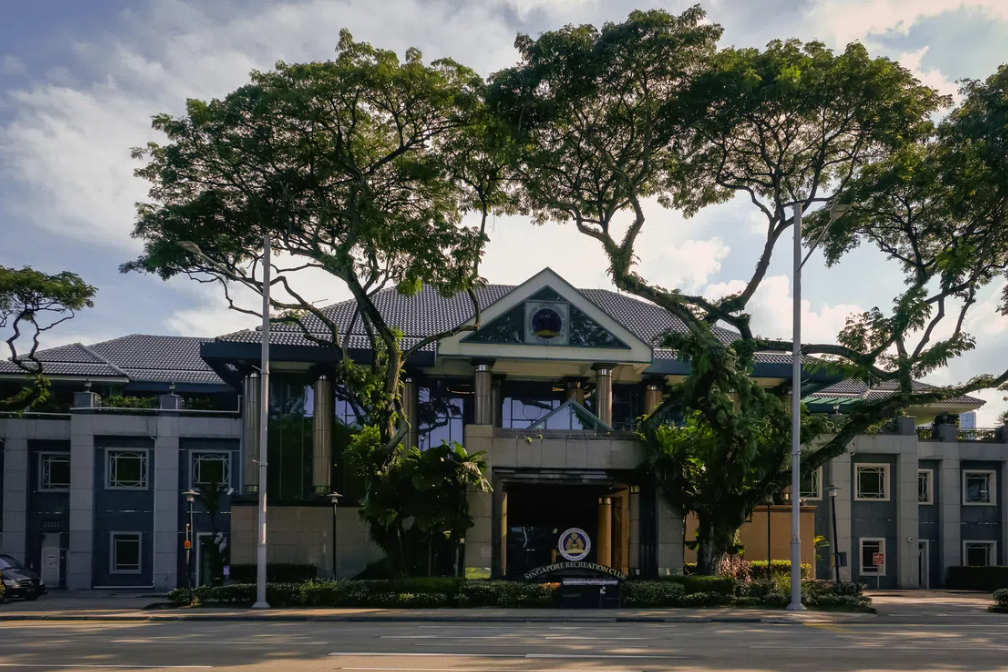
A dispute over transformation plans at the Singapore Recreation Club (SRC) is moving toward a full court trial after a High Court judge determined that significant legal questions warrant examination before a judge. Senior Judge Chan Seng Onn cleared the way for the proceedings when he issued his written grounds of decision on August 26, effectively overturning an earlier court decision to dismiss the case and allowing two club members to proceed with their challenge to the controversial resolution.
The centre of this controversy involves the mechanics of how club members voted on a proposal to relocate the billiards section from the second floor of the clubhouse to basement level, with the intention of creating a co-working space in its place. When the estimated costs ballooned dramatically—from a budgeted S$1.5 million in land betterment charges to an actual S$4.9 million bill—the management committee scrambled to reassess the financial viability of the project. Rather than abandon the transformation entirely, they convened an extraordinary general meeting on October 18, 2025, to allow members to choose from three different paths forward.
The voting structure that emerged from this meeting became the source of intense disagreement. Club members received two distinct voting slips. The first allowed them to vote either to proceed with the original relocation plan and approve payment of the higher charges, or to vote against this option. However, the slip included language instructing members that if they ticked yes to this first option, the second voting slip would not apply to them. The second voting slip presented two mutually exclusive alternatives: members could select either to convert the billiards room into a co-working space, or alternatively to integrate the billiards room within a broader co-working space development.
Sean Kerwin Mathews and Mu Yee Shyong, both members of the club's billiards section, filed suit in November 2025 arguing that the entire voting process violated the club's constitution. They contended that club rules required any resolution to gain approval from a majority of members physically present at the meeting—a threshold they calculated at 280 members out of the 559 who attended. Since only 151 members voted in favour of the second resolution when the results were finally tallied, they argued the resolution failed to meet this constitutional requirement.
The specific outcome announced by management two days after the vote indicated that 514 votes were actually cast on the second resolution. Of these, 151 supported the conversion of the billiards room into a co-working space, while 125 opposed it. The remaining 238 votes were distributed between 183 spoilt ballots and 55 blank votes. The management committee declared victory with a simple majority of 54.7 percent, based on the 151 votes in favour. Mathews and Mu, represented by lawyer Clarence Lun, counter that the 55 blank votes should logically be counted alongside the 125 votes against, creating a total of 180 votes in opposition to the resolution—thus falling short of any majority threshold.
When an assistant registrar initially heard the case on May 13, she sided with the club and its management committee, striking out the entire statement of claim. However, Mathews and Mu appealed to the High Court on June 24, and Judge Chan found sufficient merit in their arguments to overturn this decision. The judge identified two distinct legal issues that required proper trial examination: first, whether the constitutional rule cited by the members actually applied to this particular resolution, and second, whether blank and spoilt votes carried any independent weight as a form of opposition to the proposals.
Judge Chan's reasoning on the second point proved particularly illuminating and potentially decisive. He noted that in ordinary circumstances, blank or spoilt ballots might be disregarded because they reflect neither support nor opposition to a proposal. However, he identified what he termed a "peculiar case" where the voting structure itself appeared to constrain members' ability to express opposition. The management committee had designed two resolutions that created a voting trap: members could not vote no to both options without rendering their ballot spoilt, thereby effectively curtailing their right to reject both proposed paths forward.
This observation led the judge to conclude that the way the voting slips were structured—with conditional instructions and mutually exclusive choices—may have infringed upon club members' fundamental voting entitlements. The management committee had arguably engineered a voting scenario where wholesale rejection of the presented options became procedurally difficult. In such circumstances, the judge reasoned, it became entirely defensible to count blank votes as expressions of opposition rather than dismissing them as meaningless marks on paper.
The club's legal representatives, led by Walter Alexander, had argued during initial proceedings that invalidating the resolution would serve no useful purpose and would leave the organization locked in deadlock. Judge Chan firmly rejected this reasoning, observing that the club could simply hold a fresh vote conducted under clearer rules if the court determined the original resolution invalid. He emphasized that claimants seeking a fairly conducted ballot ought not to be dismissed as pursuing litigation without purpose or value. The question facing the club was not whether a decision would be made, but rather whether it would be made through procedures that respected member rights.
The SRC itself is a significant institution within Singapore's social and recreational landscape, boasting approximately 7,000 members. In March 2024, these members had already approved a comprehensive S$16.6 million transformation plan in a previous vote. That initial approval encompassed the relocation of the billiards section, with provisions included to cover anticipated land betterment charges—the tax levied by authorities when property undergoes changes that increase its underlying value. The subsequent discovery that these charges would run to S$4.9 million rather than the estimated S$1.5 million prompted the October crisis.
For Malaysian observers and institutions managing similar major member initiatives, this dispute holds instructive lessons about the importance of transparent voting procedures and the dangers of structuring ballots in ways that inadvertently suppress opposition or manipulate outcomes. While the co-working space conversion itself reflects broader regional trends toward flexible work environments, the governance question at stake is far more fundamental. Courts in Singapore, Hong Kong, Malaysia, and elsewhere increasingly scrutinize whether member votes in clubs and associations were conducted according to procedures that genuinely respect participant choice, rather than mechanically tallying results from ballots that may have been compromised by procedural design.
The trial will likely explore whether the club's constitutional provisions actually governed this particular decision, what remedies are available if voting defects are found, and whether the management committee acted in good faith when it structured the voting options as presented. The outcome may have ramifications extending beyond the SRC to other clubs and associations throughout Southeast Asia that operate under similar constitutional frameworks. The case underscores that even well-intentioned organizational leaders cannot dismiss procedural challenges as trivial, and that courts remain willing to examine voting mechanics when fundamental member rights appear at stake.

