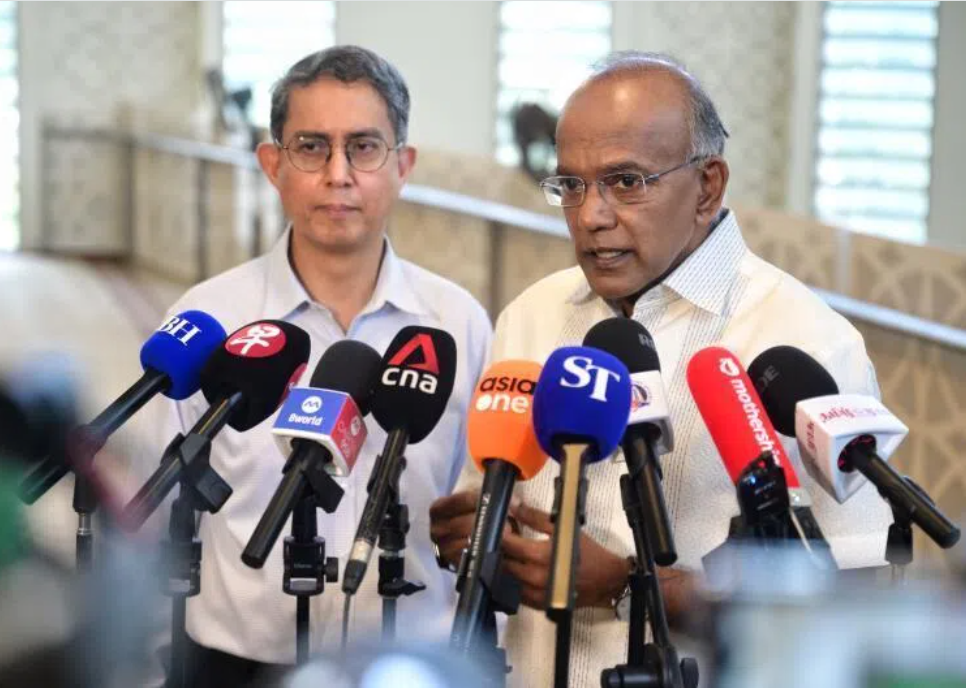
Singapore's Minister for Home Affairs K Shanmugam has defended the handling of former Minister-in-charge of Muslim Affairs Faishal Ibrahim's resignation, characterising the online exchanges that prompted his departure as crossing professional boundaries while emphasising that the ex-minister was afforded appropriate due process throughout the matter.
Shanmugam's statement came in response to Faishal's resignation on July 20, following the escalation of a series of private messages he had exchanged with an unnamed woman to the Prime Minister's office. The Home Affairs Minister acknowledged that while Faishal had not intended any impropriety, the factual record pointed to conduct that fell short of the standards expected of holders of high public office in Singapore. Shanmugam stressed that regardless of the former minister's motivations, the government's response was grounded in a careful examination of the evidence rather than assumptions about intent.
The sequence of events reveals how a matter initially characterised as a private disagreement between two adults became a governance issue requiring ministerial intervention. According to Shanmugam's account, Faishal engaged in prolonged online interactions with the woman, and when he eventually attempted to terminate contact, she responded with anger. She subsequently contacted Prime Minister Lawrence Wong, forwarding messages and pictures from their exchanges and alleging harassment. Faishal countered that he himself had experienced harassment from her, prompting the authorities to refer the matter to the police for investigation. This escalation fundamentally transformed the nature of the situation from a personal dispute into something with public implications.
Shanmugam articulated a principled framework for evaluating such matters, one anchored in standards established by Singapore's founding leader Lee Kuan Yew and reinforced by former Prime Minister Lee Hsien Loong. According to this doctrine, conduct that remains entirely private and is remedied through counselling can stay confidential, but matters that enter the public sphere through formal complaints demand scrutiny and proportionate action if impropriety is established. Shanmugam argued that once the woman lodged a complaint against a public office holder with the Prime Minister's office, the situation ceased to be purely private and required the government to assess whether Faishal's interactions were appropriate.
The core issue centred on Faishal's messaging patterns and what they conveyed to the recipient. Shanmugam explained that Faishal had been reluctant to abruptly sever contact because he worried about the woman's reaction, leading him to maintain engagement through his responses. However, these responses, while perhaps intended to soften the termination, objectively read as continued participation and encouragement to the woman. She interpreted them as signals to persist, and this misalignment between Faishal's internal understanding and the external impact of his words encapsulates the core of the impropriety charge. The distinction is crucial: the former minister may not have consciously intended to extend the relationship, but his manner of disengagement created an appearance that invited continued contact.
Crucially, Shanmugam stressed that Faishal received a fair hearing in the process. The former minister was permitted to explain his perspective, acknowledge his missteps, and reach his own conclusions about the viability of his position. Shanmugam noted that Faishal himself recognised that he should never have allowed the exchanges to develop as they did and that he should have established clearer boundaries from the outset. This self-awareness and acceptance of responsibility appear to have influenced the government's handling of the matter, with Faishal voluntarily resigning rather than being dismissed. Prime Minister Wong accepted the resignation, lending credence to Shanmugam's claim that Faishal was not subjected to a predetermined outcome.
Faishal's political trajectory underscores the loss incurred by his departure. Entering parliament as part of the People's Action Party's Marine Parade team in 2006, he built a consistent record across three decades of service before returning to Marine Parade for the 2025 general election, where his team won without contest. His ascent through the ranks—from parliamentary secretary for transport in 2012 to senior parliamentary secretary handling education and social development portfolios, then to minister of state in 2020, and most recently to senior minister of state and acting minister following Prime Minister Wong's May 2025 cabinet reshuffle—reflected consistent advancement and expanding responsibilities. Before his political career, he had been a National University of Singapore real estate professor, suggesting an academic background that complemented his legislative and executive roles.
Shanmugam's commentary on Faishal's character and contributions serves as an unusual coda to a resignation statement, offering an implicit reminder of what Singapore loses with his departure from government. The Home Affairs Minister praised Faishal as someone genuinely committed to improving others' lives, describing him as 'a true gem' whose heart was firmly aligned with public service. Shanmugam remarked that Faishal had worked conscientiously and made substantial contributions, particularly within his Nee Soon GRC constituency, and suggested that few individuals in or outside government matched Faishal's commitment and capabilities. This characterisation complicates the narrative, painting a picture of a capable minister whose serious lapses in judgment overshadowed what was otherwise a record of dedicated service.
The case also highlights tensions inherent in modern governance and digital communication. The blurred lines between professional and personal spheres, exacerbated by instant messaging platforms and online interaction, create novel challenges for public officials navigating relationships. Faishal's struggle to cleanly disengage from the woman—driven partly by empathy and a desire to minimise hurt—ultimately complicated his position rather than resolving it. The message dynamics illustrate how intentions and impact can diverge significantly, and how those in public office operate under heightened scrutiny where private missteps quickly become public concerns.
For Malaysian observers, the Singapore case offers instructive parallels and contrasts. Both Malaysia and Singapore maintain high standards for ministerial conduct, yet this incident reveals differences in how lapses are handled and communicated. Shanmugam's detailed public explanation of the decision-making process—while protecting the woman's identity—provides transparency about governance standards and the factors that trigger ministerial intervention. Such public articulation of principles helps set expectations for public officials while demonstrating that governments apply rules consistently regardless of an individual's prior contributions or seniority. The outcome also reflects a system where voluntary resignation, accepted without prolonged scandal, appears to be the preferred resolution when an officeholder's position becomes untenable, avoiding both the appearance of persecution and the chaos of formal dismissal proceedings.
The broader implications extend to how Singapore manages the reputational risks that arise when public figures engage in conduct perceived as inconsistent with their office. By acting decisively while permitting Faishal a graceful exit, the government has signalled that standards are real constraints on behaviour rather than merely advisory guidelines. Yet the sympathetic characterisation of Faishal's decades of service and evident genuine commitment to public welfare suggests that Singapore seeks to distinguish between grave misconduct and serious but isolated lapses in judgment. This calibrated response—firm on standards but acknowledging human complexity—may represent an attempt to deter future transgressions while maintaining institutional stability and public confidence in the integrity of the system as a whole.

