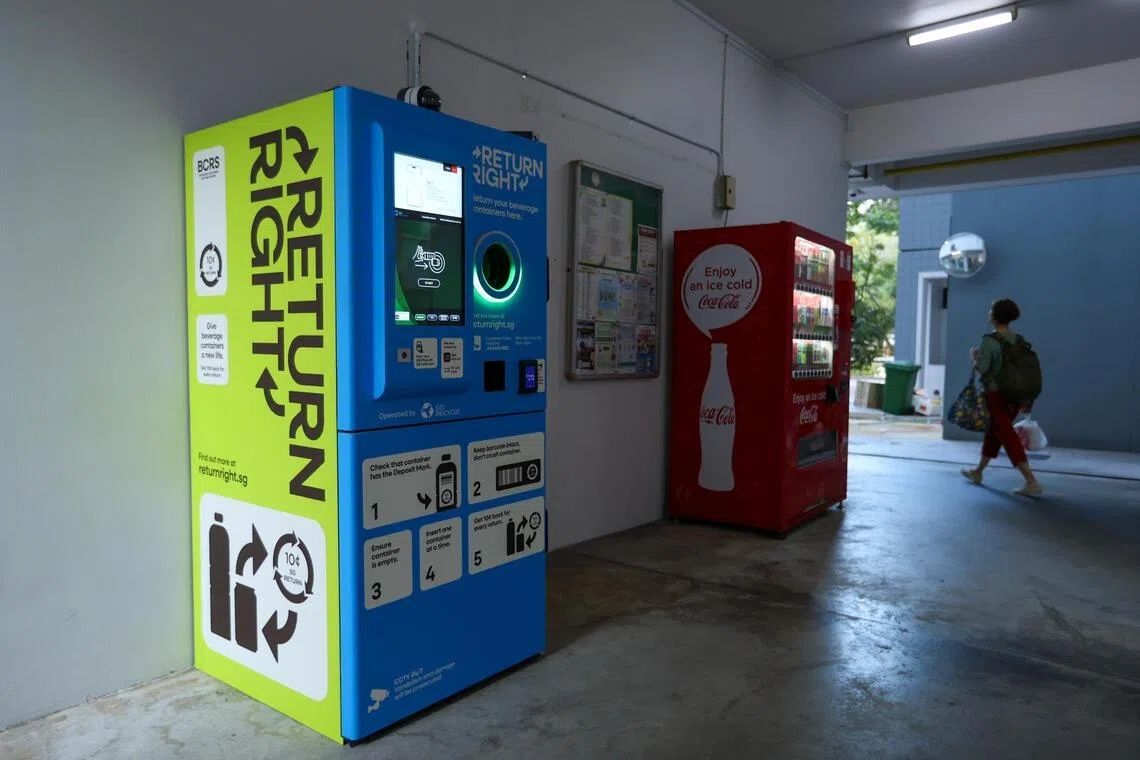
Singapore's National Environment Agency has moved to quell growing public scepticism surrounding the island's flagship beverage container recycling initiative, dismissing online accusations of financial impropriety as fundamentally flawed in their understanding of how the scheme operates. The agency's statement came after weeks of online discussion questioning why deposits from millions of returned containers appeared to account for far fewer refund transactions, raising concerns about potential misappropriation or corruption within the Beverage Container Return Scheme.
The confusion appears to have arisen from parliamentary remarks made by Senior Minister of State for Sustainability and the Environment Janil Puthucheary on August 5, when he reported that the scheme had processed more than one million successful refunds covering 5.5 million used bottles and cans since its April launch. Some online commenters interpreted this statement to mean that only a fraction of the returned containers had been refunded to consumers, leading to speculation about what happened to the remaining deposits. The apparent mathematical disconnect sparked a wave of accusations suggesting that funds may have been improperly retained or mishandled.
The NEA's response on August 15 sought to dissolve this controversy by explaining a straightforward aspect of how consumers interact with the reverse vending machines. Rather than each refund transaction corresponding to a single container return, the machines are designed to process multiple containers in a single transaction. This means that when a consumer deposits several used beverage containers at once, the system counts as one transaction but processes multiple refunds. On average, the NEA stated, consumers returned approximately 5.5 containers per transaction, which explains the discrepancy that had sparked online concern. The agency characterised accusations of misappropriation or corruption as fundamentally misplaced given this basic operational reality.
The mathematics of the scheme become clearer when examining the actual refund figures. With each container carrying a 10-cent deposit and 5.5 million containers returned across roughly one million transactions, the total amount refunded comes to approximately S$550,000 (US$429,822) since the scheme's April 1 launch. This figure aligns with what would be expected given the volume of containers processed, suggesting that the scheme is functioning as intended from a financial standpoint. The NEA's explanation underscores how misunderstandings about operational mechanics can generate unfounded concerns about financial integrity.
The Beverage Container Return Scheme itself represents Singapore's attempt to incentivise recycling and reduce beverage container waste through economic incentives rather than mandates alone. Consumers pay an additional 10 cents when purchasing canned or bottled drinks, with the understanding that they can recover this deposit by returning the empty containers to designated reverse vending machines. The scheme has attracted considerable participation, with the early statistics suggesting public engagement with the concept despite some technical difficulties during the initial rollout phase.
However, the scheme has not operated entirely without friction. During its opening months, numerous users reported frustration with the reverse vending machines, experiencing delayed refunds due to technical errors and being forced to contact BCRS customer service separately to retrieve their deposits. Some consumers also encountered repeated rejections when attempting to return containers, a problem that undermined confidence in the system's reliability and fairness. These practical difficulties, while distinct from the financial integrity concerns raised online, have contributed to broader public wariness about the scheme's administration.
Janil's earlier parliamentary statement attempted to address these concerns, asserting that the vast majority of transactions and container returns at the machines had proceeded successfully. He acknowledged that a small number of issues had occurred but characterised the operator's response as prompt and effective, with the scheme operator BCRS and the machine operators working collaboratively to resolve problems as they emerged. This framing positioned technical glitches as inevitable in any large-scale public system rather than indicative of systemic failures or malfeasance.
The recycling scheme carries particular significance within Singapore's broader environmental policy framework, where waste management and resource efficiency represent key strategic priorities for an island nation with limited natural resources and constrained landfill capacity. The deposit-based system follows models adopted in several developed economies, where financial incentives have proven effective at driving participation in recycling programmes. For Southeast Asian readers, Singapore's experience offers insights into how such schemes might operate in other contexts, particularly regarding the balance between incentivising public participation and managing the inevitable operational challenges that accompany large-scale consumer-facing systems.
The NEA's governance structure, which requires BCRS to submit annual financial reports and account for all revenues and expenditures, theoretically provides oversight mechanisms to prevent the kind of large-scale financial impropriety that online commenters had suggested. However, the fact that such concerns could gain traction online suggests that the agency and scheme operators may benefit from more proactive communication about how the system works, potentially preventing future misunderstandings. Transparent reporting on transaction volumes, refund amounts, and operational metrics could help maintain public confidence in the scheme's integrity and effectiveness.
Looking ahead, the early volatility surrounding the beverage container recycling scheme illustrates broader challenges associated with implementing new environmental policies that require sustained public participation. While the initial confusion appears resolvable through clearer communication, the underlying technical issues that led to transaction failures and delayed refunds remain matters requiring ongoing attention. As the scheme matures beyond its first few months, addressing these operational concerns will likely prove as important as managing public perception in determining the programme's long-term success and public acceptance throughout Singapore and potentially beyond the region.

