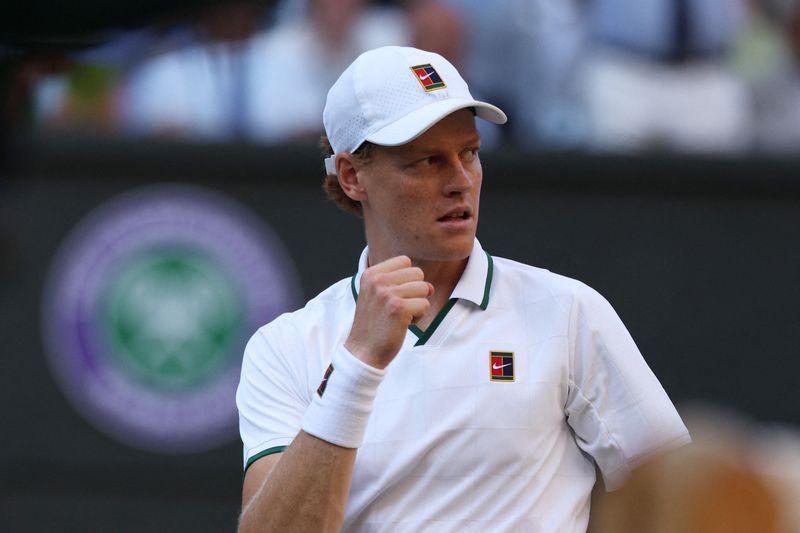
Jannik Sinner etched his name further into tennis history on Sunday by successfully defending his Wimbledon title, overcoming Alexander Zverev in a demanding final that tested both men's physical and mental reserves. The Italian claimed a 6-7(7) 7-6(2) 6-3 6-4 victory on Centre Court, a result that delivered his fifth Grand Slam trophy and underscored his emergence as one of the sport's most dominant contemporary forces. The triumph represents a significant milestone in Sinner's career trajectory, positioning him among an exclusive group of just ten men in the professional era to successfully retain the Wimbledon crown.
The opening set encapsulated the intensity that would define the entire encounter, with both finalists engaged in an extended tactical duel that stretched to twelve games before resolution. Under warm and blustery conditions, neither player ceded ground easily, resulting in a first-set tiebreak that hinged on crucial moments and shot-making. Zverev ultimately prevailed in this early skirmish, demonstrating the clean striking that has characterized his recent form and delivering a powerful forehand winner that sent him to his feet in emphatic celebration. The German's aggressive approach suggested he might have found the formula to break Sinner's recent dominance in their head-to-head encounters.
The second set followed a similar trajectory of tension and high-quality tennis, though Sinner's demeanor underwent a noticeable transformation as the proceedings continued. Where Zverev displayed early confidence and animated celebrations, the Italian gradually elevated his performance and became increasingly animated himself, shifting the emotional momentum in his favour. Sinner's superior execution proved decisive in the second-set tiebreak, where he gained the decisive advantage and levelled the match at one set apiece after what had already become a gruelling examination of endurance and skill.
Drama interjected itself into the proceedings during the third set when Zverev pursued an opportunity to break Sinner's serve midway through the set. In attempting to counter a Sinner drop shot, Zverev's footing betrayed him, and he collapsed to the court surface after being comprehensively wrong-footed. The injury proved significant enough to draw gasps from the Centre Court spectators as Zverev rolled backwards while clutching his right knee, his expressions indicating genuine distress. Despite the physical setback, the German rallied and continued competing, though the injury appeared to affect his mobility and confidence in the crucial moments that followed.
With Zverev visibly compromised, Sinner capitalized ruthlessly on the next service game to secure a crucial break and move to a 5-3 advantage. His frustration evident through a forceful racket slam, Zverev found himself unable to mount a recovery as Sinner closed out the third set to move two sets ahead after nearly three hours of absorbing battle. The complexion of the final had fundamentally shifted, with the injured Zverev now facing an increasingly insurmountable challenge against an opponent who had found his rhythm and intensity.
The fourth set proceeded with Sinner consolidating his advantage, breaking again to establish a 4-3 lead as Zverev's already diminished performance deteriorated further under the accumulated physical and psychological burden. Though the set contained entertaining exchanges and moments of quality tennis, Sinner's control never wavered as he held his service games with increasing authority. The 24-year-old Italian maintained the discipline and focus required to convert his structural advantage into tournament victory, ultimately collapsing to the grass in uninhibited celebration upon securing match point.
The victory carries profound implications for the competitive landscape of professional tennis. Sinner's triumph extends his extraordinary winning streak against Zverev to ten consecutive victories, demonstrating a level of psychological and tactical mastery over the German that borders on absolute dominance. This superiority in their personal rivalry reflects Sinner's broader ascendancy among the sport's elite, establishing him as a genuine challenger to Carlos Alcaraz's accumulating major championship tally of seven titles.
Sinner's successful title defence at Wimbledon fundamentally reshapes narratives about generational succession in tennis. At just 22 years old when claiming his first Wimbledon crown last year, his ability to return immediately and successfully retain the title speaks to an extraordinary maturity and consistency that typically takes years for players to develop. The fifth Grand Slam crown represents a milestone that places him among an increasingly exclusive cohort of contemporary champions, vindicating the considerable expectations that have surrounded him throughout his career development.
The Italian's emotional reaction upon victory, where he referenced the privilege of competing at Wimbledon and acknowledged the special atmosphere created by the Centre Court crowd, reflected genuine gratitude rather than mere platitude. Sinner's acknowledgment that repeat returns to championship moments cannot be guaranteed suggested the perspective of a player who comprehends both the difficulty of winning major tournaments and the ephemeral nature of tennis success at the highest levels.
Zverev's fourth Grand Slam final defeat carries a different emotional resonance, particularly given the injury that compromised his ability to compete fully during the latter stages of the match. The German's magnanimous post-match remarks, delivered with self-deprecating humour as he jokingly remarked that he no longer appreciated Sinner following his latest defeat, masked genuine disappointment at another major final eluding him. His observation that Sinner's recent performance demonstrates why the Italian ranks among the world's finest players acknowledged the gap that has emerged between the two competitors at this particular moment in their respective careers.
For Malaysian and Southeast Asian tennis enthusiasts, Sinner's continued excellence provides context for understanding the contemporary professional game's competitive environment. The Italian's rise reflects a global shift in tennis development, where players from historically non-dominant regions are establishing themselves as dominant forces at the sport's pinnacle. This development pattern carries implications for how emerging tennis markets in the region approach player development and tournament infrastructure, particularly as aspirational young players seek models for achieving elite-level success.
The implications of Sinner's Wimbledon defence extend beyond individual achievement to encompass broader questions about tennis longevity and championship sustainability. Successfully defending a major championship immediately afterward remains genuinely difficult, requiring players to overcome both the psychological challenge of defending expectations and the physical demands of competing at the highest level consecutively across multiple seasons. Sinner's accomplishment suggests that tennis fans may witness an extended period of dominance from the Italian, potentially reshaping the competitive hierarchy and establishing him as the principal obstacle for aspirant challengers pursuing major championship success throughout the coming years.

