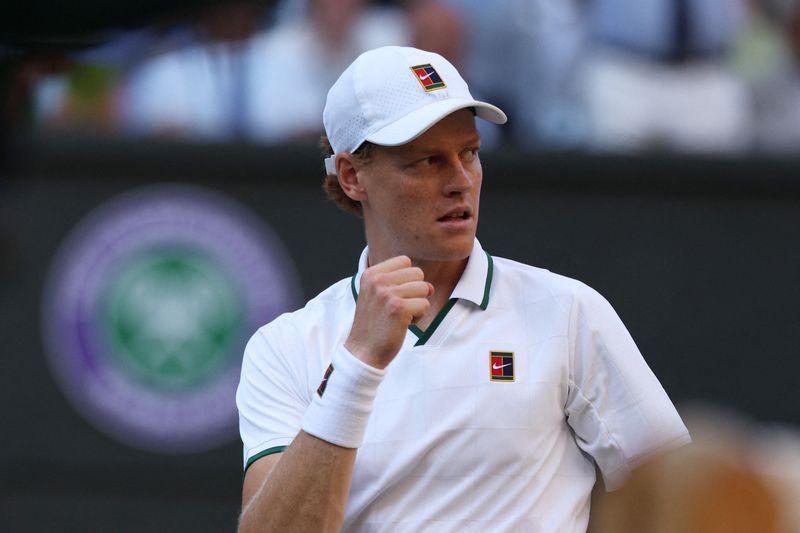
Jannik Sinner has successfully defended his Wimbledon singles championship, fending off a determined Alexander Zverev on Sunday to secure his fifth Grand Slam title and join an exclusive fraternity of men who have retained the crown in the professional tennis era. The Italian top seed prevailed 6-7(7) 7-6(2) 6-3 6-4 in a high-intensity final at the All England Club, demonstrating the resilience and tactical acumen that has made him the sport's dominant force this season. After taking the title last year by defeating Carlos Alcaraz, Sinner's repeat victory places him among only ten players ever to accomplish the feat of back-to-back Wimbledon triumphs.
The match itself unfolded as an enthralling contest between two players operating at peak efficiency on grass courts. Zverev, riding the crest of his maiden Grand Slam victory at Roland Garros weeks earlier, entered as a genuine threat to upset the proceedings. The German, bidding to become the first of his nationality to claim the Wimbledon men's singles title since Michael Stich in 1991, matched Sinner's intensity throughout an opening set that stretched beyond sixty-five minutes. The first frame showcased textbook heavy-metal tennis, with both competitors striking the ball with exceptional precision and power from the baseline, yet break opportunities proved vanishingly rare. Only once in the initial twelve games did either player face break point, a chance that Sinner squandered when he uncharacteristically sent a forehand wide on Zverev's serve.
Zverev's performance on Centre Court demonstrated remarkable composure, particularly with his forehand—a stroke that has historically been a vulnerability during high-pressure moments throughout his career. The 29-year-old proved especially resilient on his own delivery, dropping merely eight points on serve during the opening set and maintaining such consistency that Sinner struggled to create meaningful opportunities. This solidity forced the outcome toward a tiebreak, where Zverev initially seized the initiative by reaching set point. However, Sinner's court sense proved decisive at crucial junctures, with a passing shot at the net denying Zverev immediate victory. When Zverev saved one set point with a powerful ace before converting his next opportunity with a crisp forehand winner, he ended a dispiriting run in which he had lost fourteen successive sets to his Italian rival.
The psychological momentum generated by claiming the first set appeared to energize Zverev as the second set commenced, with his serving prowess once again rendering him virtually unbreakable on his own serve. Sinner's frustration became visible during this phase, unable to manufacture the pressure normally required to dent such formidable defensive walls. Yet the Italian's composure under adversity proved instructive, as he raised his intensity when the match entered the second tiebreak. Here, Sinner shifted tactical gears, elevating his attacking options and employing greater aggression to level the match and send the contest into the decisive third set.
That third set proved the turning point, though it came through an unexpected moment of misfortune for Zverev rather than pure tactical brilliance from Sinner. After nearly two hours and forty-two minutes of competition, with the set poised at 3-3, Zverev earned his first break point opportunity of the entire match. As Sinner responded with a delicate drop shot, Zverev retreated rapidly toward the baseline but slipped awkwardly while attempting to change direction, crashing to the turf. Although Zverev gamely indicated he could continue, the physical impact of the tumble visibly affected his mobility and rhythm for the remainder of the match.
Sinner, displaying both tactical awareness and sportsmanship, briefly checked on his opponent before returning to baseline proceedings. He subsequently held serve and executed the breakthrough that had eluded him until that point, with Zverev moving noticeably more cautiously and his movements appearing constrained. The German's frustration mounted visibly as he flung his racket across the grass, a rare display of emotion that signaled his slipping grip on the match. While Zverev managed to stabilize temporarily during the fourth set, Sinner's dominance had become unmistakable, and he secured another break at 4-3 before serving out the championship.
The climax proved appropriately theatrical for a Wimbledon final, with Sinner's final service game featuring two extraordinary rallies that showcased the caliber of tennis being contested at match point. After three hours and forty-six minutes of tennis that will be remembered as one of the more entertaining finals in recent Wimbledon history, Sinner sealed victory and claimed the trophy. The Italian has now recorded ten consecutive victories against Zverev, a streak that highlights the competitive gulf between them despite this particular encounter's competitive nature.
For the 24-year-old Sinner, the achievement carries particular significance given his recent struggles at Roland Garros, where he suffered a second-round exit, and his narrow escape at Wimbledon's earlier rounds against Miomir Kecmanovic. His ascent through the draw revealed a player rediscovering his absolute best form, particularly evident in neither dropping a service game during his semi-final and championship matches. Speaking immediately after his victory, Sinner articulated his appreciation for Wimbledon's unique status within professional tennis and his awareness that defending major championships remains a rare accomplishment.
His comments reflected genuine emotion at returning to the historic Centre Court as champion, acknowledging that repeated success at such venues cannot be assumed. Sinner praised both the quality of opposition and his own performance level, revealing the respect he maintains for competitors of Zverev's caliber despite his dominance in their head-to-head record. The Italian's philosophical approach to championship defense underscores a maturity that has elevated him beyond his rivals this season.
While Zverev departs London without the trophy, his two-month trajectory merits considerable celebration and respect. Capturing his first Grand Slam title at Roland Garros represented a watershed moment for the German, who had previously contested four Grand Slam finals without success. His maiden major victory in Paris provided considerable confidence entering Wimbledon, where he proved far more competitive on grass courts than most observers anticipated. At twenty-nine years old, Zverev has now experienced both the profound satisfaction of winning his first major championship and the sting of falling just short in a second consecutive Grand Slam final.
Zverev's reflection after the match acknowledged this transformation in self-belief, with the German expressing genuine optimism about his newfound conviction that Wimbledon represented an achievable objective. His performance in the final, despite the unfortunate tumble that altered momentum, demonstrates that German men can remain competitive at the highest levels of professional tennis. The loss, while undoubtedly disappointing, provides a foundation upon which Zverev can build future campaigns.
For Malaysian and Southeast Asian tennis enthusiasts, Sinner's continued dominance and Grand Slam accumulation merit close attention. The Italian represents a generational shift in the sport's power structure, having achieved success across multiple surfaces and demonstrating the consistency required to win and defend major championships. As Asia's rising players, including those from Malaysia, continue developing their games, Sinner's approach to tennis—combining technical excellence, mental resilience, and strategic sophistication—offers valuable lessons about championship-level performance.

