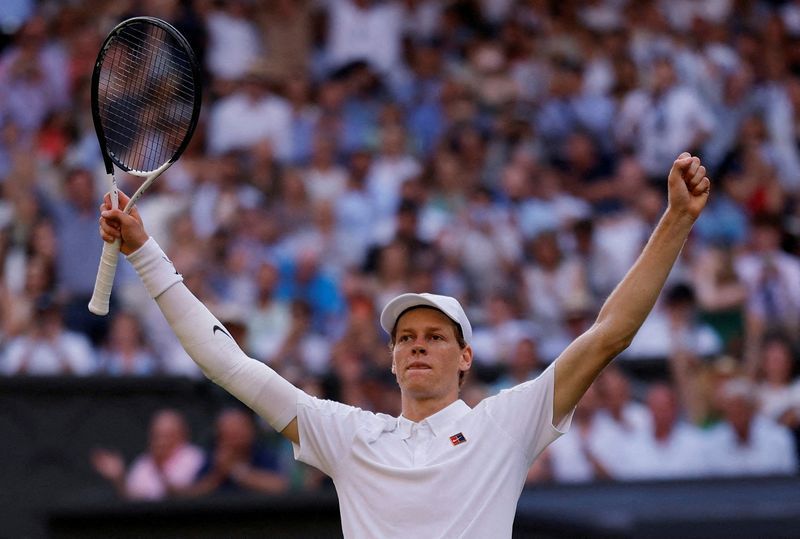
The tennis landscape has shifted dramatically heading into Wimbledon, with defending champion Jannik Sinner no longer appearing the impenetrable force many expected him to be. The Italian's formidable run across clay surfaces came to an abrupt and troubling halt at Roland Garros last month, where physical ailments derailed his campaign in the second round and snapped a remarkable 30-match winning streak that had stretched back to February. That vulnerability opens a door at the All England Club that few anticipated could swing wide, inviting a host of rivals to harbour realistic ambitions of claiming tennis's most prestigious grass-court trophy.
The stakes for Sinner extend beyond merely retaining his title. At just 24 years old, he holds the world number one ranking and possesses the raw talent to dominate the sport for the next decade, yet questions linger about his durability when tournaments reach their most demanding phases. The Italian skipped traditional warm-up events before the Grand Slam begins on Monday, a strategic choice that raises eyebrows even as it suggests careful management of his condition. Whether this represents prudent recovery or a concerning pattern of fragility at crucial junctures remains uncertain, lending an intriguing subplot to his pursuit of consecutive titles.
Mats Wilander, the seven-times Grand Slam champion, refuses to count Sinner out despite acknowledging the Italian's physical struggles. Wilander attributes the Paris collapse to accumulated fatigue rather than fundamental weakness, arguing that a compressed schedule across the preceding two months left Sinner depleted despite his extraordinary win rate. The legendary Swede suggests that rest has restored the world number one to fighting condition, yet tempers expectations with a crucial caveat: grass presents its own unpredictable challenges that even the most formidable clay-court performers cannot always master. This measured assessment captures the essence of Wimbledon's unique demands, where movement patterns differ dramatically from other surfaces and serve placement becomes paramount.
No figure looms larger over Sinner's defence than Novak Djokovic, whose movement and returning ability transform grass into his hunting ground. The 39-year-old Serbian champion approaches the tournament with dual motivations that inject genuine urgency into his campaign. Djokovic seeks an eighth Wimbledon title to match Roger Federer's record of excellence at SW19, a milestone that would cement his legacy as the greatest grass-court player of the modern era. More pressingly, he pursues an elusive 25th Grand Slam trophy in standalone fashion, a target that grows more distant with each passing year as time inexorably limits his window for achievement.
Djokovic's own stumble at Roland Garros might ordinarily suggest vulnerability, yet Andy Roddick, the American three-times Wimbledon finalist, argues forcefully against dismissing the Serb's chances. Speaking on his podcast, Roddick suggested that Djokovic likely perceives Wimbledon through a different lens than Paris, viewing the grass courts as terrain where his particular skills shine most brightly. Roddick's analysis captures a psychological dimension often overlooked: champions frequently recalibrate their outlook between tournaments, and Djokovic's four-year absence from the Wimbledon title represents both a gap to rectify and a canvas upon which to paint redemption. The Serb's return to the grass after last winning there in 2020 cannot be underestimated as a motivating force.
Alexander Zverev presents perhaps the most intriguing challenger, arriving at Wimbledon on the crest of his greatest achievement. The German secured his maiden Grand Slam title at Roland Garros, a breakthrough that arrives at age 27 and fundamentally alters the complexion of his career. Zverev brings a formidable serve ideally suited to grass-court tennis, a weapon that Boris Becker, the six-times major champion and fellow German, identifies as effectively placing him on a direct path to the semi-finals. Becker's declaration that Zverev ranks as his favourite for the title reflects not hyperbole but rather recognition that momentum, confidence, and tactical fit occasionally align to create unexpectedly powerful combinations.
Carlos Alcaraz's injury absence creates a void that cannot be entirely filled by emerging talent alone. The Spanish champion won Wimbledon in consecutive years during 2023 and 2024, establishing himself as the grass-court master of his generation and removing from contention perhaps the only player besides Sinner capable of orchestrating dominant campaigns on this surface. This absence redistributes opportunity throughout the draw, preventing any single dominant force from monopolising the conversation and instead creating genuine uncertainty about which faction might prevail. For Malaysian and Southeast Asian followers accustomed to tracking the sport's leading narratives, this represents an unusual transition toward competitive equilibrium rather than individual supremacy.
The supporting cast of contenders adds further intrigue to the championship equation. American players Ben Shelton, Taylor Fritz, and Frances Tiafoe each possess the explosive weapons and tactical flexibility necessary to trouble established favourites in specific matchups. Their aggressive serving and risk-taking approach suits grass-court tennis better than clay, potentially unlocking performances that exceed their overall rankings. Italian Flavio Cobolli, who reached the French Open final as a challenger, represents the next wave of emerging talent that may not immediately contend for the title but possesses the quality to influence outcomes in the upper draw.
The tournament unfolds with several layers of narrative complexity that extend beyond Sinner's title defence. Djokovic's quest for historical legacy, Zverev's maiden Grand Slam validation, and the possibility that an unexpected champion might emerge from the middle ranks all coexist within a single fortnight. For regional audiences, the balance of power within professional tennis remains unusually fluid, offering genuine unpredictability that recent seasons have sometimes lacked. Wimbledon's grass, with its characteristic unpredictability and reward for specific skill-sets, may prove the great leveller that forces the narrative to rewrite itself across the coming weeks.

