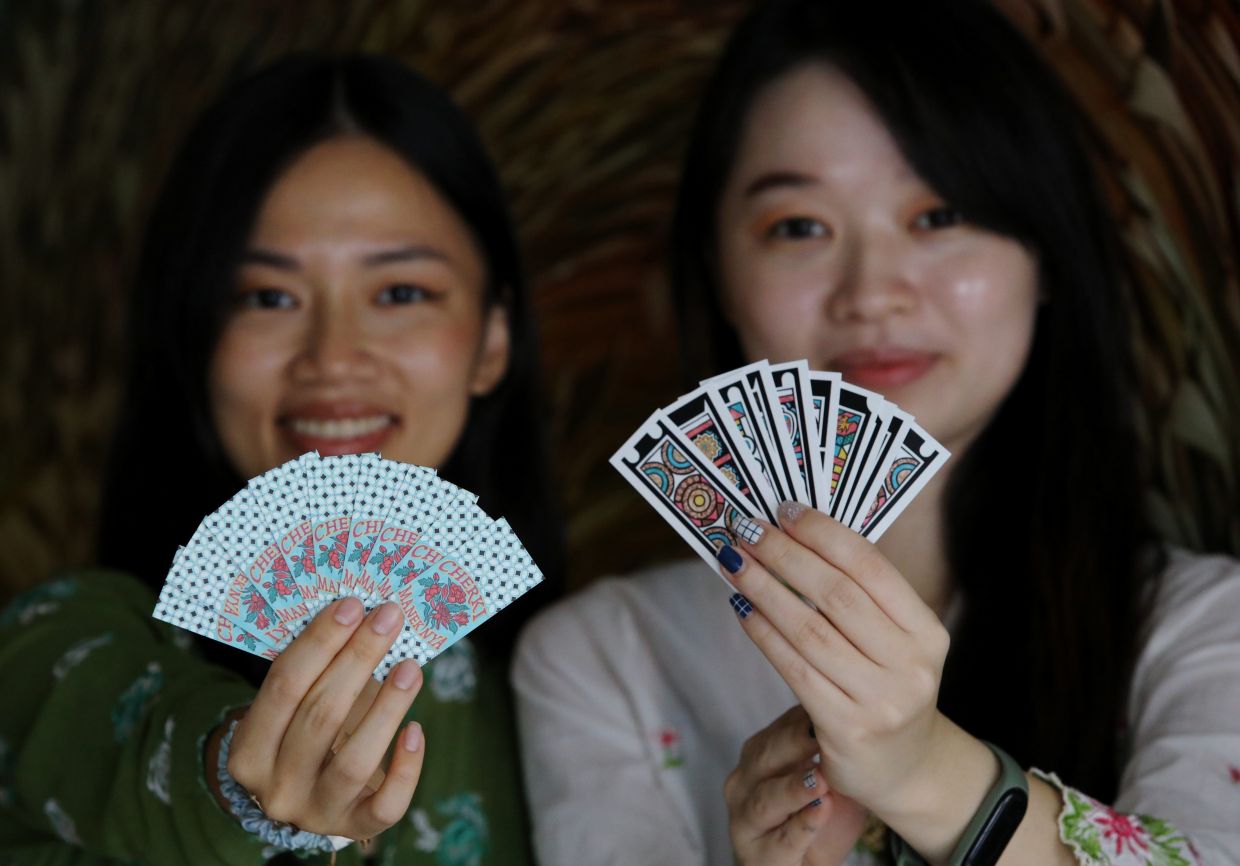
The Peranakan cultural landscape in Malaysia is typically defined by its visual splendour and gastronomic richness – the intricate beadwork of traditional slippers, the elegance of the baju kebaya, and beloved dishes such as ayam buah keluak that represent generations of culinary knowledge. Yet a quieter but equally significant dimension of this heritage is quietly fading from memory: the card game Cherki, a pastime that once graced family gatherings throughout Baba Nyonya households. Sisters Lee Swee Lin, 32, and Lee Swee May, 31, are determined to rescue this forgotten tradition from obscurity by transforming it into something that speaks to contemporary players while honouring its ancestral roots.
The original Cherki cards embodied stark simplicity – monochrome designs that served their practical purpose without flourish. The Melaka-born siblings, who already operate a Kuala Lumpur-based enterprise focused on Peranakan beaded accessories and decorative items, recognised an opportunity to reintroduce the game through a distinctly modern lens. Their redesigned deck introduces abundant colour and contemporary visual language, yet preserves the foundational motifs and symbolic elements that make Cherki distinctly Peranakan. This calculated balance between innovation and tradition reflects a philosophy that heritage need not be preserved in amber to remain authentic.
The sisters' motivation stems deeply personal and rooted in family experience. Their paternal grandmother, Deo Yeok Kim, served as the primary inspiration for this venture. Growing up in her Melaka household exposed the siblings to Peranakan culture in its most organic form – transmitted through food preparation, oral storytelling, linguistic practice, and the daily rituals through which traditions maintain themselves across generations. Following her recent passing, Swee Lin recognised that the knowledge and practices their grandmother embodied were themselves forms of cultural inheritance that might otherwise evaporate without deliberate intervention. This realisation propelled the sisters to action, viewing their beading business – itself learned from their mother and grandmother – as already infused with ancestral meaning and influence.
The challenge facing the Peranakan community extends beyond a single family's concern. Swee Lin identifies a troubling pattern affecting her generation and those younger: as the opportunities to learn directly from elders diminish, younger Peranakans drift further from their cultural moorings. The acceleration of lifestyle change, the pervasiveness of digital entertainment, and the attractions of global pop culture create formidable competition for the attention and commitment of young people. Without deliberate efforts to preserve and revitalise cultural practices like Cherki, distinctive heritage elements face the prospect of complete erasure. By reintroducing the game in an accessible and visually appealing format, the sisters aim to serve as a bridge – connecting younger Peranakans to traditions that might otherwise remain confined to academic study or family folklore.
This generational disconnect reflects broader patterns within the Peranakan community. A 2022 academic study examining cultural material differences between original and newer Baba Nyonya descendants in Malacca documented how younger community members increasingly encounter global influences, from international entertainment franchises to social media-driven lifestyle preferences. The research underscored the critical importance of sustained cultural education and transmission. Lee Yuen Thien, deputy president of Persatuan Peranakan Baba Nyonya Malaysia (PPBNM), echoes these concerns, noting that professional commitments and contemporary priorities frequently overshadow traditional cultural practices. With the association counting approximately 3,000 active members and estimates suggesting 10,000 to 15,000 Peranakans nationwide, the scale of potential cultural loss becomes apparent. Geographic dispersion from ancestral strongholds in Melaka and Penang, combined with population mobility and intercommunal marriages, has fundamentally altered the transmission patterns through which Peranakan identity traditionally passed between generations.
Cherki itself carries considerable historical weight. The traditional game employs two decks comprising sixty cards arranged into thirty distinct patterns, each repeated twice. Three suits – coins, strings, and myriads – structure the deck, with card values running from one through nine, supplemented by three special cards: white flower, red flower, and old thousand. Historically played across Singapore, Malaysia, Indonesia, and Thailand under various linguistic iterations including Ceki, Chi Kee, and Koa, the game bears testimony to the interconnectedness of regional commerce and cultural exchange. The Malay designation daun ceki, derived from daun meaning 'leaf', demonstrates how the game became naturalised within Southeast Asian linguistic landscapes. Historical records trace card games themselves to China's Tang Dynasty, where ninth-century chronicles reference a 'leaf game', with evidence suggesting these games traversed ancient trade routes eventually reaching Europe by the fourteenth century.
The sisters' development process began in earnest during 2024, involving collaboration with a small design collective. Utilising digital platforms including Procreate and Adobe Illustrator, they systematically introduced colour schemes, decorative patterns, and cultural motifs while maintaining structural fidelity to the original game. Crucially, they produced clearer instructional materials to lower the barrier to entry for novice players unfamiliar with Cherki's mechanics. The modernised deck retains the game's fundamental architecture while introducing a significant modification: the thirty patterns now repeat four times rather than twice, and the three special cards transform from white flower, red flower, and old thousand into butterfly, dragon, and phoenix – symbols deeply resonant within Peranakan visual culture.
Each value card in the redesigned deck functions as a small cultural artefact, featuring distinctly Peranakan imagery that carries specific significance. The kantan, a fragrant flower integral to Nyonya culinary traditions, adorns certain cards. The chupu, porcelain vessels traditionally employed for food presentation, appears throughout. The kerongsang, the ornamental brooch that secures the kebaya, features prominently as does the gelang, the bracelets characteristic of Nyonya women's adornment. These design choices transform the cards from mere game pieces into educational vectors of cultural knowledge, enabling players to absorb Peranakan material culture even during casual recreational play.
Swee May articulates the strategic thinking behind this modernisation approach with particular clarity. The sisters deliberately sought to create something that contemporary players would willingly retrieve from a shelf and introduce into a social gathering, rather than an artefact consigned to historical documentation. The infusion of colour and contemporary illustration serves this accessibility goal, yet the preservation of traditional Peranakan patterns and symbols ensures that players engage with the same essential heritage their grandparents encountered. The methodology prioritises immediate appeal and ease of learning without sacrificing cultural authenticity – younger players can approach Cherki without requiring specialist knowledge, gradually encountering Peranakan cultural elements through the game's structure.
The broader implications of this revival extend beyond the immediate Peranakan community. As Malaysia confronts questions about cultural preservation in an era of rapid modernisation and globalisation, the sisters' approach offers a pragmatic model: heritage survives not through museumification or academic study alone, but through creative recontextualisation that makes traditions relevant to contemporary life. By allowing cultural forms to evolve while maintaining their essential character, communities can sustain intergenerational transmission without imposing ossified versions of tradition that alienate younger members. Museum officials and cultural advocates increasingly recognise this principle, with practitioners like those at the Baba & Nyonya Heritage Museum Melaka advocating for awareness-building strategies that spark genuine interest rather than obligatory participation.
The success of the revitalised Cherki remains to be documented, yet the initiative itself signals an important shift within Malaysia's Peranakan community. Rather than passively witnessing the erosion of cultural knowledge, a new generation of community members – themselves products of contemporary life yet emotionally invested in ancestral heritage – are crafting solutions that meet younger generations on their own cultural and aesthetic terms. By combining business acumen with genuine cultural stewardship, Lee Swee Lin and Lee Swee May have transformed a personal family story into a potential template for heritage preservation across Southeast Asia, suggesting that tradition and modernity need not represent opposing forces but rather complementary elements within evolving cultural identity.

