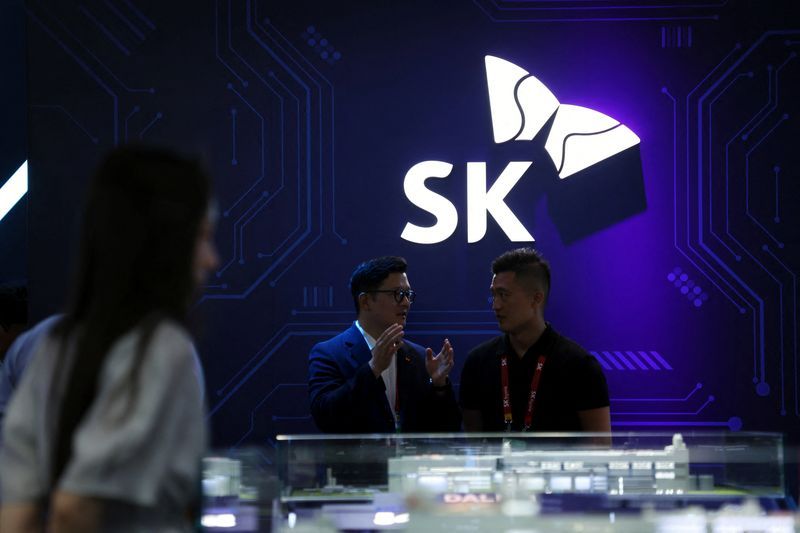
South Korea's memory chip giant SK Hynix announced Wednesday that it will seek to raise as much as 45.45 trillion won, equivalent to $29.43 billion, through a listing of American Depositary Receipts on the Nasdaq exchange. The move represents a significant capital deployment strategy for the chipmaker, which is capitalizing on surging global demand for processors that power artificial intelligence applications. The company plans to list 17.79 million new shares backing the ADR offering, with trading expected to commence on July 10. Underwriters managing the deal include BofA Securities, Citigroup Global Markets, Goldman Sachs and JP Morgan Securities, lending substantial institutional weight to what could become a landmark offering.
The fundraising target may adjust following the bookbuilding process, where institutional investors indicate demand at various price points, but the current range positions SK Hynix among the world's most ambitious capital raises. Under the ADR structure, ten receipts will represent one underlying common share, a conversion ratio typical of Korean companies accessing American capital markets. The company emphasized that the final quantum of capital raised remains subject to market conditions and investor appetite during the roadshow phase. This flexibility is standard practice for large international offerings, allowing underwriters and the issuer to calibrate pricing against real-time demand signals from institutional investors.
The capital raised will fund three major strategic initiatives designed to entrench SK Hynix's position in the high-performance semiconductor supply chain. A significant portion will support construction of an advanced chip fabrication facility in Yongin, addressing capacity constraints as artificial intelligence adoption accelerates globally. Simultaneously, the company plans to establish an advanced packaging facility in Cheongju, which will handle sophisticated assembly processes required for cutting-edge semiconductors. Equipment purchases, notably expensive Extreme Ultraviolet Scanner technology essential for manufacturing leading-edge chips, will consume additional capital. These investments directly address production bottlenecks that have constrained SK Hynix's ability to meet explosive demand from artificial intelligence platform developers and system integrators.
SK Hynix has emerged as a primary beneficiary of the artificial intelligence boom that began capturing investor attention following the release of advanced large language models. The company supplies high-bandwidth memory chips that are integral components in AI inference and training systems. Its customer roster includes Nvidia, the American artificial intelligence hardware leader, and Alphabet's Google, positioning SK Hynix in the supply chain's most profitable segment. These chips, distinct from conventional memory products, command premium pricing due to their specialized performance characteristics and limited production capacity. The company's strategic importance to the global AI ecosystem has fundamentally altered investor perception of its growth trajectory and profitability prospects.
The timing of SK Hynix's Nasdaq listing assumption carries symbolic significance for South Korea's technology sector. On Monday, June 23, SK Hynix briefly surpassed Samsung Electronics as South Korea's most valuable publicly listed company, a historic milestone reflecting the dramatic revaluation of memory chipmakers amid the artificial intelligence transition. This development underscores how concentrated technology sector value has become in semiconductor manufacturing, particularly companies positioned to supply artificial intelligence infrastructure. Samsung Electronics, while vastly larger by revenue and employee count, saw its valuation compressed partly due to exposure to mature memory chip segments facing pricing pressure, whereas SK Hynix's customer concentration in artificial intelligence applications attracted growth premium valuations.
The proposed ADR offering would eclipse the previous record for American Depositary Receipt fundraisings if completed at the upper end of the indicated price range. Alibaba's 2014 New York debut raised $21.8 billion, holding the previous record for over a decade. SK Hynix's potential $29.43 billion achievement would represent a substantial increase, reflecting both the capital intensity of modern semiconductor manufacturing and the market's appetite for exposure to artificial intelligence supply chain participants. The record-breaking nature of the offering underscores how investor enthusiasm for the artificial intelligence sector has reshaped capital markets, with technology companies accessing international capital at scales and valuations previously reserved for oil majors and financial institutions.
For Malaysian investors and the broader Southeast Asian technology sector, SK Hynix's capital raise carries multiple implications. The fundraising demonstrates the substantial financial resources required to remain competitive in semiconductor manufacturing, establishing barriers that benefit established players while complicating entry for ambitious newcomers. Malaysia's own semiconductor ecosystem, which encompasses assembly, testing, and back-end processing operations, depends partly on stable supplies from companies like SK Hynix. The company's capacity expansion supports regional semiconductor networks by ensuring sufficient component availability. Additionally, the fundraising highlights how capital markets increasingly price exposure to artificial intelligence infrastructure plays, potentially influencing investment allocation across Southeast Asian technology companies and chip-related manufacturing operations.
The Nasdaq listing also reflects broader trends regarding capital market access for major Asian technology companies. Historically, large South Korean firms accessed domestic capital through Korea Exchange listings, but direct access to American capital markets provides SK Hynix with liquidity, valuation benefits, and investor diversification advantages. The ADR structure enables American and international investors to own shares without establishing Korean brokerage accounts or navigating local regulatory complexities. This approach has become increasingly common for major Asian technology companies seeking to maximize their valuation multiples by accessing the world's deepest equity markets. SK Hynix's decision signals confidence in sustained artificial intelligence demand and reflects management's assessment that international investor bases will reward the company's strategic positioning with premium valuations relative to what domestic markets might offer.
The chipmaker's expansion strategy addresses real supply constraints that have frustrated artificial intelligence system manufacturers and cloud infrastructure providers. Nvidia and other hardware developers have publicly identified high-bandwidth memory availability as a bottleneck limiting their ability to scale production of artificial intelligence accelerators. By expanding capacity in Yongin and Cheongju, SK Hynix directly tackles this constraint, positioning itself to capture market share from competitors and command improved pricing power. The capital raise essentially allows SK Hynix to monetize the artificial intelligence boom by converting anticipated production growth into immediate capital, then deploying that capital to build the manufacturing facilities that will generate such growth. This virtuous cycle reflects the semiconductor industry's structure, where dominant players with access to substantial capital can reinforce their competitive positions through capacity investments.
Investor dynamics driving the ADR offering extend beyond simple artificial intelligence enthusiasm to encompass recognition of SK Hynix's improved balance sheet trajectory and cash generation profile. Memory chip pricing, which had deteriorated through 2022 and 2023, has recovered substantially as artificial intelligence demand absorbed available supplies. This pricing improvement translated directly into profitability recovery for SK Hynix, enhancing the company's capacity to service debt and fund growth investments internally. However, management apparently concluded that accessing capital markets at current valuations exceeded the cost of internal funding, suggesting confidence that artificial intelligence demand will persist sufficiently to justify substantial capacity investments. The willingness to issue new shares, thereby diluting existing shareholders, indicates management's conviction regarding long-term value creation prospects from artificial intelligence infrastructure investments.
The broader context of South Korean technology sector dynamism provides essential background for understanding SK Hynix's ambitions. South Korea has maintained world-leading positions in memory chip manufacturing for decades, with SK Hynix and Samsung controlling substantial global market shares. The country's technical expertise, manufacturing discipline, and capital mobilization capabilities enable these companies to compete effectively against international rivals. However, the artificial intelligence revolution has intensified competition for investment capital and engineering talent, requiring ever-larger capital deployments to maintain technological leadership. SK Hynix's proposed $29.43 billion raise reflects this intensifying competition and the need to sustain manufacturing capacity growth matching artificial intelligence sector expansion. Without such investments, competitors might capture market share, forcing SK Hynix into a declining position despite its current dominance.