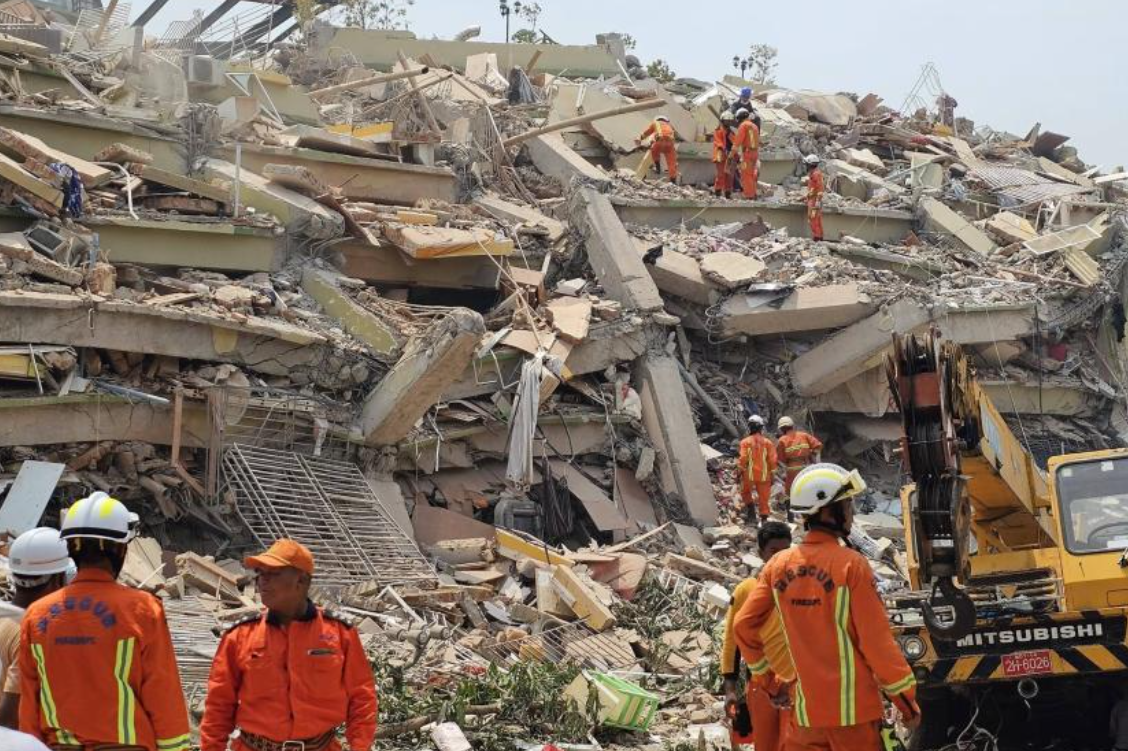
The owner of Sky Villa Condominium has been sentenced to five years imprisonment with hard labour by Myanmar's Aungmyaythazan Township Court for his role in the catastrophic building collapse that claimed more than 200 lives during the Mandalay earthquake. U Naing Htun Lin received the sentence on June 23 under Section 304-A of the Penal Code, which addresses acts causing death by negligence. The verdict marks a significant legal outcome in one of the disaster's most devastating structural failures, as the 11-storey residential building became emblematic of the earthquake's human toll when it crumbled in Aungmyaythazan Township.
The judicial process began when U Naing Htun Lin was formally charged on February 10 at the same township court. Initially, the defendant was released on bail to stand trial outside of custody, reflecting standard Myanmar legal procedures for cases of this gravity. However, the situation shifted dramatically on March 17 when judicial authorities revoked his bail and ordered him remanded in custody to await the conclusion of trial proceedings. This reversal signalled the court's assessment of either flight risk or the severity of the charges as evidence accumulated throughout the investigation phase.
The investigation itself was conducted by the No. (1) Area Police Station located within Aungmyaythazan Township, with the case formally registered under negligence provisions of the Penal Code. U Zaw Moe Aung, a staff officer from the Special Investigation Department, assumed the role of plaintiff in bringing the case before the court on behalf of the state. This official designation underscores the public interest dimension of prosecuting building safety failures that resulted in mass casualties—distinguishing this from ordinary private disputes and elevating it to a matter of state concern.
The verdict has not ended legal proceedings, however. An information officer from Aungmyaythazan Township Court confirmed that the Aungmyaythazan District Court subsequently requested the complete case file for review under Criminal Revision Case No. 39Ka/2026. Both the prosecution and defence have filed appeals and revision petitions challenging the original judgment, suggesting fundamental disagreements remain about culpability assessment, sentencing proportionality, or the interpretation of negligence standards applicable to construction industry figures.
The Sky Villa building itself was positioned between 21st and 22nd Streets on 60th Street in Aungmyaythazan Township, placing it in a densely populated urban district where residential density compounds disaster impact. Among all structures that failed during the earthquake, the Sky Villa collapse emerged as one of the single deadliest incidents, with recovery teams eventually extracting more than 200 bodies from the rubble. This casualty toll reflected not only the building's height and residential density but also raised pointed questions about construction standards, material quality, and structural design adequacy in a nation where building codes have been inconsistently enforced.
The role of construction practices became central to understanding how the collapse occurred with such devastating consequences. U Naing Htun Lin's company, NTL Construction Company, had been responsible for building the condominium. The negligence charge effectively positioned construction quality and safety oversight as the legal foundation for criminal liability. In Myanmar's developing economy, where rapid urbanisation has sometimes outpaced regulatory frameworks, construction industry accountability has become an increasingly contested domain between commercial interests and public safety mandates.
Following the collapse, Daw Thet Thet Khine, U Naing Htun Lin's wife and managing director of NTL Construction Company, participated in a series of public reconciliation efforts. The family organised three separate ceremonies at a monastery pavilion on 19th Street in Mandalay, venues chosen for their spiritual and community significance. During these events, representatives apologised formally to families bereaved by the disaster and presented compensation payments of 10 million kyats per deceased person to survivors and dependents. While such gestures may represent acknowledgment of responsibility and attempt to provide material relief to affected families, they occurred within the context of criminal prosecution and did not directly address underlying structural failures that enabled the collapse.
The compensation disbursed—10 million kyats per victim across 200+ deaths—represented a substantial financial commitment by the family, though the adequacy of such sums remains debated given the permanent loss and trauma experienced by bereaved families. In Myanmar's economic context, where average incomes remain modest, such payments can provide meaningful support yet often fall short of replacing lost household earners or addressing long-term psychological consequences. The parallel operation of civil compensation and criminal prosecution reflects Myanmar's dual approach to accountability in disaster contexts.
For Malaysian and Southeast Asian readers, the Sky Villa case illuminates critical vulnerabilities in building safety regulation across the region. Many developing nations in Southeast Asia, including Myanmar, continue grappling with ensuring that rapid urbanisation occurs within robust enforcement frameworks. Myanmar's experience demonstrates how construction industry actors may prioritise cost minimisation over structural integrity, with catastrophic consequences when natural disasters test building resilience. The criminal prosecution of building owners represents one accountability mechanism, though questions persist about whether sentencing individual owners adequately addresses systemic failures in permitting, inspection, and material standards enforcement.
The broader implications extend to how courts in post-conflict or transitional economies balance commercial development interests against public safety imperatives. Myanmar's legal system, having undergone significant transformation in recent years, faces ongoing scrutiny regarding consistency in applying professional accountability standards. The revision proceedings now underway suggest the judiciary itself remains uncertain about optimal sentencing levels for building-related negligence, particularly when balanced against competing concerns about investor confidence and development encouragement.
The earthquake itself exposed infrastructure vulnerabilities across Mandalay, and the Sky Villa collapse became a focal point for debates about construction oversight and building code enforcement. Beyond Myanmar's borders, neighbouring countries including Thailand, Laos, and Cambodia have monitored Myanmar's legal response to the disaster, as similar seismic and urban development challenges affect their own cities. The conviction represents an important precedent, suggesting that construction industry professionals face genuine criminal consequences for failures resulting in mass casualties—a principle that resonates across the region as urbanisation accelerates and natural disaster risks compound.
Moving forward, the resolution of pending appeals and revision proceedings will clarify Myanmar's jurisprudence on construction negligence and appropriate sentencing frameworks. Should higher courts affirm or modify the original sentence, their reasoning will likely influence how future building collapse cases are adjudicated throughout Myanmar. For international observers and investors alike, the outcome carries significance for understanding how Myanmar balances public accountability with business environment considerations. The case ultimately reflects broader tensions across Southeast Asia between enabling rapid economic development and ensuring that urban expansion occurs within adequate safety and quality guardrails.

