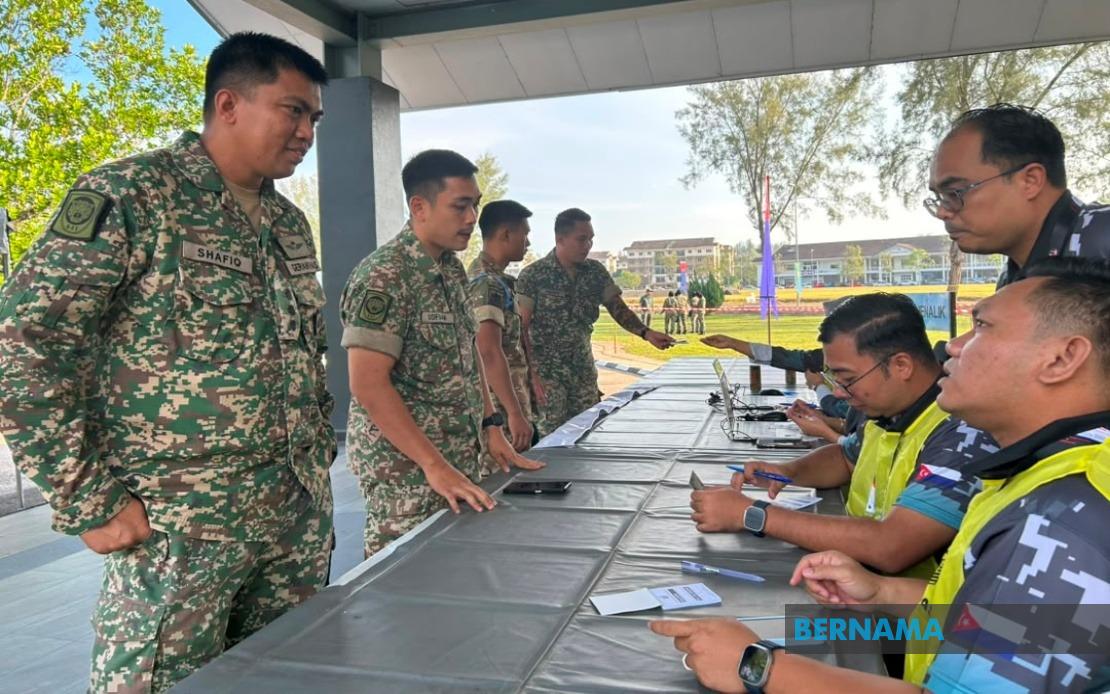
Early voting in Johor's 16th state election commenced without incident on July 7, with clear skies facilitating the arrival of security personnel at polling centres that opened their doors at 8 am. The favourable morning weather proved instrumental in ensuring smooth operations across all 64 designated early voting locations, allowing both voters and Election Commission staff to navigate the centres with minimal disruption. Security personnel were among the first to exercise their franchise, beginning their arrival from 7.30 am, well before official opening times, demonstrating the organisation's emphasis on punctuality and readiness.
The early voting exercise accommodated a substantial 24,751 voters, representing a significant portion of the eligible electorate who could not cast ballots during the main polling day scheduled for Saturday. This figure comprised 12,041 personnel from the Malaysian Armed Forces and their spouses, alongside 12,710 members of the Royal Malaysia Police and General Operations Force with their family members. The inclusion of these security sector voters reflects an institutional commitment to enabling those on duty to participate in the electoral process despite their operational commitments to maintaining public order.
Distribution of early voting stations reflected Johor's geographic spread and population distribution, with centres strategically positioned across the state's various constituencies. Notable polling locations included the 5th Battalion GOF Camp in Simpang Renggam, the Johor Contingent Police Headquarters, and Mahkota Kluang Camp, each of which the Election Commission verified operated efficiently throughout the morning. Bernama's field checks at these locations confirmed that the voting process proceeded without administrative bottlenecks, suggesting the Election Commission had adequately prepared infrastructure and staffing levels to handle the expected voter volume.
Prior to the commencement of voting, Election Commission personnel executed comprehensive final inspections at all centres to eliminate potential procedural disruptions. This preparatory phase underscored the institutional readiness required for managing a statewide electoral exercise. The Commission's meticulous approach to verification processes, while sometimes tedious, ultimately contributes to the credibility and integrity of electoral outcomes that are essential for democratic legitimacy in Malaysian politics.
Weather considerations loomed as a potential complication for the broader electoral cycle. The Malaysian Meteorological Department issued warnings that afternoon thunderstorms would sweep across Johor, raising questions about whether Saturday's main polling day might face weather-related challenges. Early voting scheduling in the morning hours thus provided a strategic buffer, ensuring that at least a portion of registered voters could cast ballots before adverse weather conditions potentially materialised. This temporal arrangement demonstrates how electoral administration must contend with environmental variables when planning voting processes.
The main election itself involves considerably higher stakes than the early voting phase, with 2,727,926 registered voters eligible to participate across 1,140 polling centres throughout the state. This election would determine the composition of Johor's state assembly following contests across 56 constituencies. The sheer scale of this electorate underscores Johor's significance as a major political battleground within the Malaysian federation, where outcomes could reshape the state's political trajectory and influence broader national dynamics.
A total of 172 candidates had filed nominations to contest the 56 state assembly seats, indicating competitive multi-sided races in most constituencies. This candidate-to-seat ratio suggests that voters would encounter meaningful choices in their constituencies rather than uncontested positions, fostering genuine democratic competition. The diversity of candidates reflects varied political interests and community factions seeking representation, essential characteristics of healthy democratic participation.
The scheduling of early voting operations to close in stages between noon and 6 pm, differentiated by location and registered voter populations, demonstrated sophisticated planning by electoral authorities. Rather than imposing uniform closing times across the state, the Election Commission recognised that centres with differing voter populations required flexible schedules to accommodate all eligible voters while managing staff resources efficiently. This approach reflects administrative maturity in handling large-scale logistics.
For Malaysian electoral observers, the smooth execution of early voting in Johor provided encouraging signals about the Election Commission's operational capacity and preparedness. Given Malaysia's recent expansion of early voting mechanisms to include more categories of voters and workers, the successful administration of this phase suggested the institution was scaling up its capabilities appropriately. The evident absence of significant administrative problems during early voting offered positive indicators for Saturday's main polling exercise across the state.
The Johor state election represents one of several significant electoral contests scheduled across Malaysian states in this political cycle, making its administration particularly noteworthy. Success in managing large, complex polling operations enhances public confidence in electoral institutions, a prerequisite for accepting electoral outcomes as legitimate regardless of individual voting preferences. The clear weather and smooth operations observed on July 7 contributed to building such institutional credibility.
As voters prepared for the main polling exercise, security sector participation in early voting had been completed efficiently, removing potential complications around scheduling accommodations for armed forces and police personnel. This advance completion meant Saturday's polling could proceed without requiring special arrangements for these large voter blocs, potentially streamlining operations and reducing logistical complexity on the busier main voting day.

